U.S. Boycotts G20 Talks in South Africa After Sharp Words From President Ramaphosa
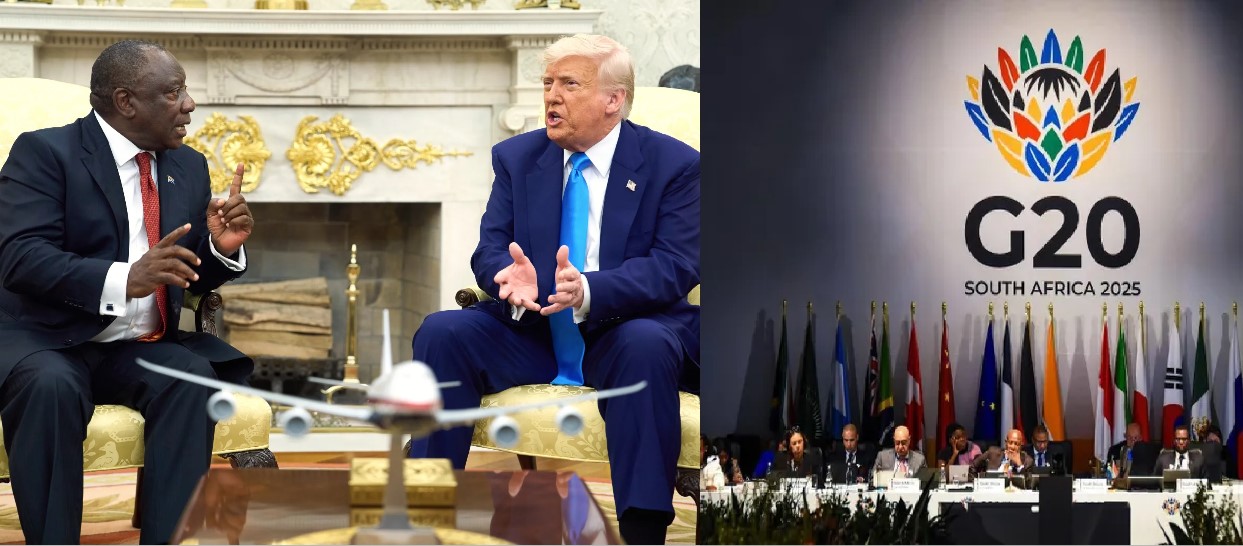
The Johannesburg summit of the Group of Twenty (G20), scheduled for November 22–23 and hosted by South Africa, is set to proceed with a conspicuous absence: the United States will not participate in the official talks, according to a statement by the White House press secretary.
Press Secretary Karoline Leavitt stated explicitly that “The United States is not participating in official talks at the G20 in South Africa.” She also rebuked criticism from South African President Cyril Ramaphosa, saying: “I saw the South African president running his mouth a little bit against the United States … and that language is not appreciated by the president or his team.”
By contrast, Ramaphosa has argued that the United States — as the world’s largest economy — should be present. He claimed to have received late-notice communication suggesting a possible “change of mind” from Washington. “We have received notice from the United States … about participating in one shape, form or other in the summit,” he told reporters.
Why the United States is sitting out
The Trump administration’s decision appears rooted in a confluence of diplomatic and ideological grievances with South Africa. President Donald Trump announced his government would not attend the Johannesburg summit, citing alleged human-rights abuses in South Africa — specifically claims that white Afrikaner farmers are being “killed and slaughtered” and their land illegally confiscated.
A White House official said Washington is sending only a chargé d’affaires to attend the formal handover ceremony of G20 presidency from South Africa to the U.S., but will “not take part in any talks.” According to Ramaphosa, the U.S. embassy in Pretoria had earlier communicated that “South Africa’s G20 priorities run counter to the U.S. policy views and we cannot support consensus on any documents negotiated under your presidency.”
The U.S. appears to object to the Johannesburg summit’s emphasis on climate change, debt relief, and Global South resource-sharing — agenda items Washington regards as misaligned with its policy priorities.
The U.S.’ importance to the G20 and implications of non-participation
The United States holds a uniquely central role in the Group of Twenty. As one of the founding members and the world’s largest economy, Washington’s absence from leader-level discussions significantly weakens the forum’s claim to universality and effectiveness.
By not participating in the official talks, the U.S. reduces the legitimacy of any joint communique or shared decision emerging from Johannesburg. South African officials have expressed concern that the absence of the U.S. could undermine consensus and even result in a summit without a final, meaningful declaration. In his remarks, Ramaphosa suggested he would be “handing over to an empty chair” when the presidency transfers to the U.S. next year.
Strategically, the U.S. non-participation comes at a time when many developing countries look to G20 forums to address climate impact, debt relief and sustainable development — areas in which the U.S. plays a major role. Its absence may shift momentum toward alternative blocs or reinforce perceptions of U.S. retreat from global economic leadership.
What President Ramaphosa said
At a joint press conference with European Commission President Ursula von der Leyen and European Council President António Costa, President Ramaphosa asserted that South Africa had received a message from the U.S. signalling a change of position.
“The United States is a member of the G20 … so they have the right to be here,” he said. He characterised the communication as coming “at the 11th hour” and suggested his government was assessing the “practicalities” of U.S. participation.
Ramaphosa also emphasised South Africa’s insistence on a joint declaration despite U.S. objections. He described the broader agenda of the summit — under South Africa’s presidency — as including “solidarity, equality and sustainability.”
Has the U.S. ever stayed away from a G20 summit before?
In the history of G20 leaders’ summits, it is extremely rare for the United States to opt out of participating. There is no known prior instance where the U.S. refused to send any representative to participate in the main leaders’ talks of a G20 summit.
While some U.S. officials have skipped ministerial or working-group sessions — for example Secretary of State Marco Rubio declined to attend a foreign ministers’ meeting earlier in 2025 citing “anti-Americanism” — the present case involves absence from the summit’s core deliberative forum, making it unprecedented.
Is any other country adopting similar language or boycott?
Yes — several nations are also sending delegations rather than heads of state, or skipping altogether. Chinese President Xi Jinping and Russian President Vladimir Putin are not attending and will send lower-level representation.
Argentine President Javier Milei has also signalled alignment with the U.S. approach in this instance. While their motivations differ, the cumulative effect is a Johannesburg summit where multiple major economies are absent at the top-leader level.
What this means going forward
The United States’ decision to eschew official talks in Johannesburg opens several questions:
-
How meaningful will the summit’s outcomes be with one of its most influential members abstaining?
-
Will South Africa’s role as G20 president be compromised by the U.S. absence?
-
Will this push countries to question the effectiveness of the G20 format?
-
What will this mean for U.S.–South Africa relations, which now face a new diplomatic strain?
For South Africa, the message is symbolic: the host seeks to assert the voice of the Global South, but the U.S. non-participation raises doubts about whether the platform is truly inclusive.
As the summit convenes, all eyes will be on whether the U.S. will change course at the last moment and engage beyond the ceremonial hand-over.
The exchange between Washington and Pretoria — including the White House’s admonishment of Ramaphosa’s remarks — signals a more tense diplomatic dynamic than is typical for G20 host-country interactions.
About the Author
Aditya Kumar:
Defense & Geopolitics Analyst
Aditya Kumar tracks military developments in South Asia, specializing in Indian missile technology and naval strategy.