U.S Army Plan to Fund $386.4 Million in XM30 in 2026 for New Infantry Fighting Vehicle
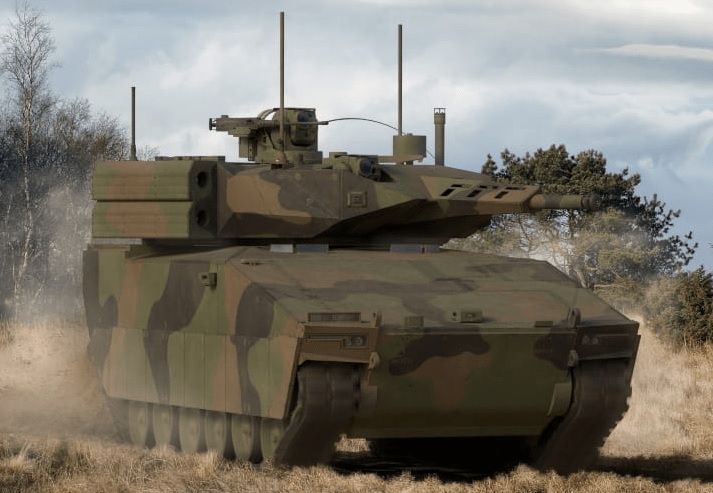
WASHINGTON, D.C: The U.S. Army is poised to accelerate development of its next-generation mechanized combat vehicle after the Department of Defense unveiled its Fiscal Year (FY) 2026 budget request, allocating approximately $386.4 million to the XM30 Combat Vehicle program. The investment sustains momentum for the long-planned Bradley Infantry Fighting Vehicle replacement and moves the program deeper into detailed engineering and prototype efforts without yet committing to full-scale production.
From Concept to Prototype
The XM30 Combat Vehicle, previously known as the Optionally Manned Fighting Vehicle (OMFV), represents the Army’s most ambitious effort in decades to modernize its armored forces and replace the aging M2 Bradley Fighting Vehicle, which has been in service since 1981.
Under the FY 2026 budget blueprint, funding will support the transition from the Preliminary Design Review (PDR) to the Critical Design Review (CDR) phase. This shift marks a milestone in moving from abstract design toward the construction of physical prototypes and integrated systems testing. Army leaders have framed this stage as essential for validating vehicle architecture, survivability suites, and digital systems that will define the XM30’s battlefield effectiveness.
Both industry competitors — General Dynamics Land Systems, with its Griffin III-based platform, and American Rheinmetall Vehicles, offering a variant based on the Rheinmetall KF41 Lynx — are under firm-fixed-price contracts supporting system development and demonstration. The Army’s continued investment in dual pathways preserves competitive tension and technical comparison ahead of a future selection decision.
A Strategic Pivot for Army Modernization
The XM30 program is part of the broader Next Generation Combat Vehicle (NGCV) portfolio, one of several key modernization priorities that also includes the new M1E3 Abrams main battle tank. Unlike previous replacement efforts that faltered under technical and budgetary challenges, the XM30 initiative leverages an open systems architecture and digital engineering tools to enable rapid upgrades as technologies evolve.
According to Congressional Research Service documentation, the XM30 is being acquired through a five-phase approach, starting with market research and advancing through concept and detailed design, prototype build and test, and ultimately limited production. The platform is designed as an optionally manned vehicle, meaning it can operate with an onboard crew or with remote control, depending on mission requirements — a significant leap in tactical flexibility.
Technical Aspirations and Future Capabilities
The XM30 is expected to deliver decisive lethality on the modern battlefield with advanced sensors, robust troop protection, and enhanced situational awareness. Hybrid-electric propulsion is a core program requirement, offering improved fuel efficiency, reduced thermal signature, and support for silent watch operations. Digital backbone architecture and modular systems are intended to future-proof the vehicle against emerging threats, including integration with unmanned systems and AI-enabled targeting solutions.
While the Army has not finalized exact production numbers or dates, planning documents indicate that prototype fabrication and system trials could accelerate in 2027, with a Milestone C decision — the formal authorization to enter low-rate initial production — targeted for early FY 2028.
Balancing Legacy and Innovation
Despite the XM30’s progress, the Bradley family of vehicles will remain in service for years to come. Modernized Bradley variants, such as the M2A4E1 equipped with improved powerplants and active protection systems, will continue to support Army formations while XM30 prototypes are tested and matured.
The FY 2026 investment in the XM30 program underscores the Pentagon’s commitment to transforming ground combat capabilities in the face of evolving global threats. By advancing detailed design and prototyping efforts, the Army aims to field a vehicle that not only replaces the Bradley but reshapes infantry maneuver warfare for the decades ahead.
✍️ This article is written by the team of The Defense News.