U.S Approves $3 Billion Sale of Advanced Air-Defence Network to Denmark
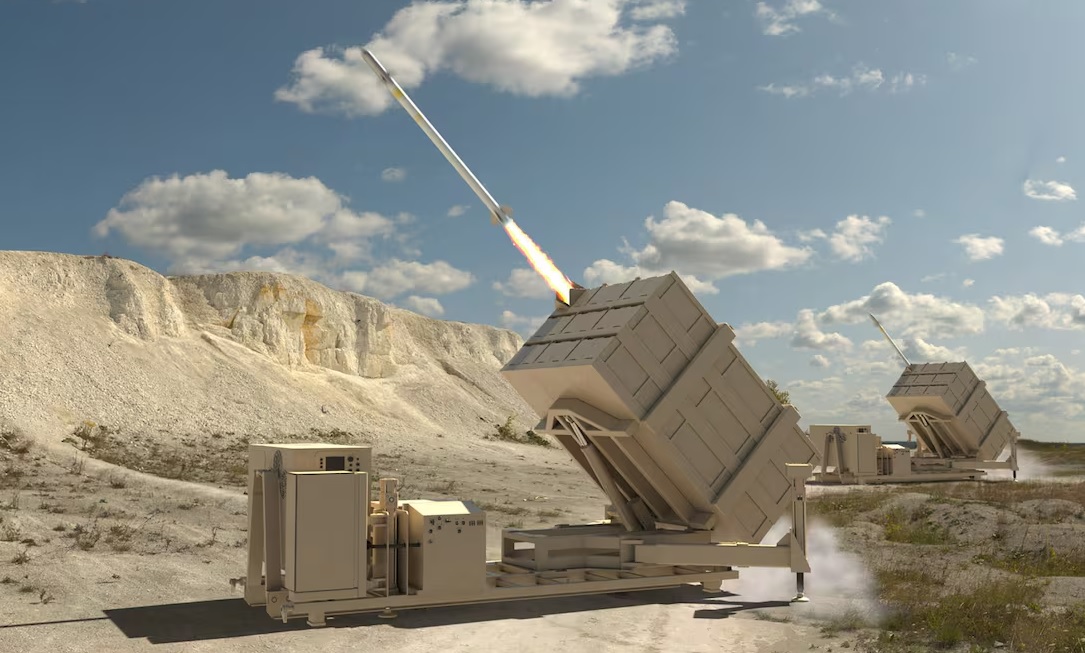
On 5 December 2025, The U.S. Department of State has approved a proposed Foreign Military Sale (FMS) worth approximately US$3.0 billion to the government of Denmark. The package includes the cutting-edge Integrated Battle Command System (IBCS) combined with the Indirect Fire Protection Capability (IFPC), along with radars, launchers, ammunition magazines, and related support equipment.
The deal — officially notified to Congress by the Defense Security Cooperation Agency (DSCA) — covers a comprehensive set of components: 24 All-Up Round Magazines (AUR-M), 8 IFPC Increment 2 launchers, 2 Sentinel A4 radars, 2 IBCS Engagement Operations Centers, 2 IBCS Integrated Collaborative Environments, 6 IBCS Integrated Fire Control Network relays, plus associated communications, training systems, and logistical support.
What Are IBCS and IFPC And Why It Matters
IBCS is a state-of-the-art command-and-control (C2) fire-control system developed by the U.S. Army. Its core advantage lies in the “plug-and-fight” architecture — it can link diverse radar and sensor systems to different missile/launcher systems, giving commanders flexibility: “any sensor, any shooter.”
By integrating sensors and effectors across domains (radar, missiles, launchers), IBCS enables a unified air- and missile-defence network, improving situational awareness, resource management, and responsiveness.
IFPC — the Indirect Fire Protection Capability — is designed to complement traditional air defence systems by protecting critical fixed or semi-fixed sites against threats such as cruise missiles, unmanned aerial systems (UAS), and rocket, artillery or mortar (RAM) attacks.
The combination of IBCS + IFPC gives Denmark a layered, flexible ground-based air defence architecture with the capacity to detect, track, and engage multiple simultaneous threats — from low-flying drones to ballistic or cruise missiles.
Beyond Launchers and Radars
In addition to the headline items, the authorised sale covers a broad suite of ancillary systems and support elements:
-
Communications gear, including GPS receivers, encrypted communications devices, radios, IFF devices, and network encryptors.
-
Tools, test and support equipment, generators, publications, technical documentation, and spare/repair parts.
-
Training systems, including a reconfigurable air-defence trainer; initial and long-term training for Danish personnel; and provision of U.S. Government and contractor technical, logistics, and engineering support.
-
System integration and checkout, field office support, and sustained program support over multiple years. According to the DSCA, 9–14 U.S Government staff and 12–17 contractor personnel are expected to travel to Denmark over a period of up to seven years to support delivery, integration, training, and maintenance.
This means Denmark is not only acquiring hardware, but also the infrastructure, support, and training necessary to operate and sustain a modern ground-based air and missile defence network.
For Denmark, NATO, and Regional Defense
According to the DSCA, the sale supports U.S. foreign-policy and security goals by enhancing the defence posture of a NATO ally, strengthening political stability and collective security in Europe.
For Denmark, the acquisition signals a significant upgrade in its air and missile defence capabilities — giving it modern, layered protection against a wide array of aerial threats, from drones to missiles. The flexibility offered by IBCS makes it easier to integrate future sensors or weapons, ensuring the system remains adaptable as threats evolve.
From a NATO perspective, the addition of an advanced, interoperable ground-based defence node in Denmark enhances the alliance’s collective air- and missile-defense architecture, reinforcing deterrence and increasing readiness against fast-moving or hybrid threats.
Officials noted that the sale “will not alter the basic military balance in the region,” suggesting that while it upgrades Denmark’s capabilities, it is calibrated to avoid fueling regional arms races.
Contractors and Implementation
The prime contractors for the sale have been identified as RTX Corporation (Arlington, VA), Lockheed Martin (Syracuse, NY), Leidos Inc. (Reston, VA), and Northrop Grumman (Falls Church, VA).
DSCA noted there are currently no offset agreements publicly disclosed; any offset arrangements would be negotiated separately between Denmark and the contractors.
As for deployment, integration, and activation: hundreds of components — radars, launchers, command centers, communications gear — must be delivered, integrated, and tested. The U.S. Government and contractor personnel are expected to remain in Denmark for up to seven years for training, system integration, and maintenance support.
IBCS + IFPC in Modern Air and Missile Defence
The IBCS — first conceptualized in 2004 — represents a major shift from traditional standalone air-defence systems to a network-centric architecture. By 2023, the IBCS was approved for full-rate production after completing initial operational testing and evaluation.
With IBCS, a single radar (or sensor) can feed data to any compatible weapons system — improving flexibility, reducing reaction times, and enabling more efficient resource use (“any sensor, any shooter”).
When integrated with IFPC — designed to counter threats like missiles, rockets, mortar fire, and drones — IBCS delivers a layered defence capability bridging gaps between short-range systems (SHORAD), medium/high-altitude missile defence (Patriot, THAAD), and counter-RAM / counter-UAS protection.
From Approval to Field Deployment
With the State Department’s determination, the sale now awaits formal agreement, purchase order, financing, and scheduling. Once finalized, delivery, installation, training, and system integration will follow — a process expected to take several years given the complexity and scale of the package.
During that period, U.S. and Danish engineering, logistics, and support teams will collaborate to deploy hardware, configure networks, and train Danish personnel. After commissioning, Denmark will become one of the few European nations operating a modern, IBCS-enabled air and missile defence network — a capability likely to influence its future defense posture, NATO’s readiness, and broader European security dynamics.
About the Author
Aditya Kumar:
Defense & Geopolitics Analyst
Aditya Kumar tracks military developments in South Asia, specializing in Indian missile technology and naval strategy.