U.S. Air Force Roadmap Shows Slow F-35 Growth and Fighter Fleet Decline Until 2030
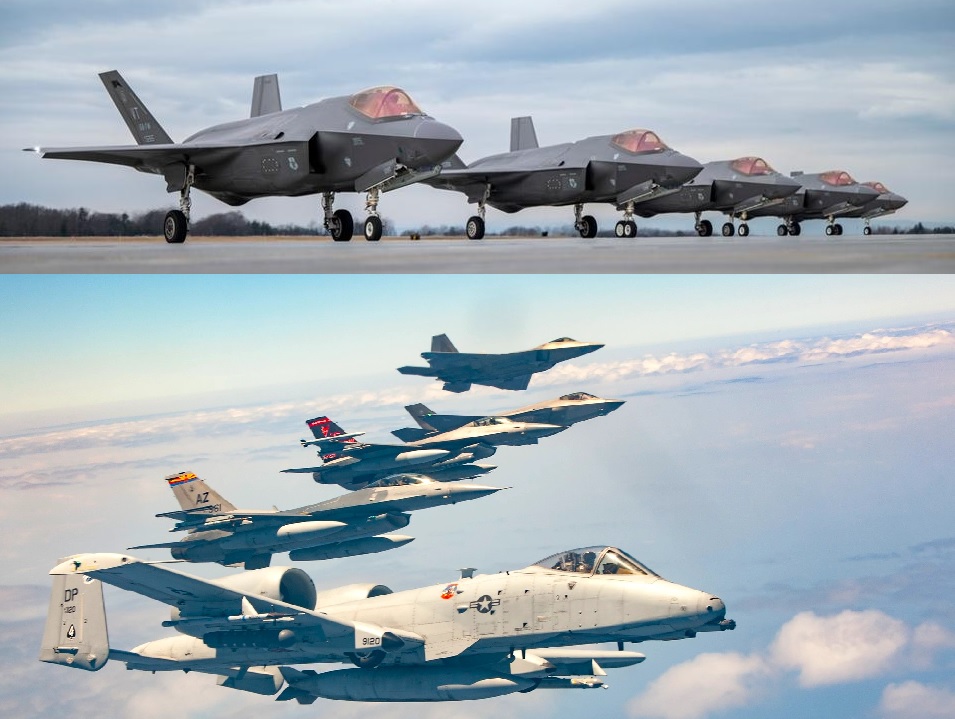
The U.S. Air Force (USAF) is preparing for a slow but deliberate evolution of its fighter inventory over the next decade, according to a new fighter roadmap submitted to Congress. The document, finalized in August and released in October, outlines a strategic transition period marked by modest F-35 fleet growth, planned retirements of aging aircraft, and a temporary dip in overall fighter numbers before a recovery begins near the end of the decade.
The roadmap, which serves as the most comprehensive outlook on U.S. fighter modernization in years, indicates that the Air Force’s total fighter force will continue to shrink through 2028, reaching its lowest point before gradually expanding again by 2030 as new aircraft deliveries accelerate.
Modest Growth for the F-35A Lightning II
The report shows that the Air Force expects only incremental expansion of its F-35A fleet through the decade, contrary to earlier ambitions of rapid buildup. The projected fleet count stands at 344 aircraft in FY2026, increasing to 383 in FY2027, 401 in FY2028, 433 in FY2029, and 472 in FY2030.
However, the Air Force clarified that these numbers do not represent fixed procurement goals, but rather the desired “possessed inventory” available for operations. The service emphasized that procurement plans will continue to depend on funding levels, industrial capacity, and the ongoing modernization cycle.
Notably, the roadmap confirms that the Air Force does not intend to purchase more than 48 F-35As per year through 2030 — the same number it acquired in FY2024. This figure is far below the earlier aspiration of 70–72 jets annually, proposed in the early 2010s when the F-35 program was expected to reach full production.
Technology Refresh Bottlenecks and Modernization Delays
A key factor limiting procurement is the delay in the Technology Refresh 3 (TR-3) and Block 4 upgrade programs, which are crucial for integrating the F-35’s next-generation capabilities, including improved sensors, computing power, and electronic warfare systems.
The roadmap highlights that F-35s still using the older TR-2 hardware “will fall behind in mission capability and overall fleet utility.” This gap could render early-production aircraft less viable for future combat operations, forcing eventual replacement or extensive retrofits.
According to the Air Force, earlier decisions to slow F-35 purchases in the mid-2010s were deliberate — aimed at avoiding costly retrofits of older airframes once the Block 4 standard became available. However, persistent software and integration challenges have delayed the TR-3 rollout by more than a year, further constraining fleet expansion.
As a result, the Air Force’s FY2026 budget request includes only 24 new F-35As, a steep reduction from past years. Unlike previous budget cycles, Congress did not increase this figure, despite adding funding for other programs such as the F-15EX Eagle II and the classified F-47 fighter initiative.
Fighter Inventory: Decline Before Recovery
The Air Force’s total fighter inventory currently stands at around 1,271 aircraft. The roadmap forecasts a dip to 1,215 in FY2028, driven by planned retirements of legacy aircraft, before rebounding to approximately 1,304 by FY2030.
The service aims to grow to 1,558 fighters by 2035, a target deemed achievable only if production lines can reach maximum output — specifically, 100 F-35s per year and 36 F-15EX jets annually.
In the near term, the Air Force faces an aging fleet and logistical strain as parts availability declines for platforms such as the F-15E Strike Eagle and early-lot F-35s. The report warns that “recapitalization of aging platforms due to early lot obsolescence and diminishing parts availability” will be a key driver of future acquisitions.
The Fate of Legacy Fighters
The roadmap outlines an aggressive plan to retire older aircraft while ramping up deliveries of new-generation fighters.
-
A-10 Thunderbolt II: The last A-10s will be retired by the end of 2027, marking the end of nearly five decades of close-air-support operations.
-
F-15C/D: The aging air-superiority fighters will fall from 42 in 2026 to just 21 in 2029, with a handful of upgraded “Platinum Eagles” retained for homeland defense into the early 2030s.
-
F-15E Strike Eagle: The multi-role Strike Eagle fleet will shrink sharply, from 133 aircraft in 2026 to 78 by 2028, as older airframes reach the end of their service life.
-
F-15EX Eagle II: The replacement program continues to grow steadily, with 27 aircraft in 2026 and an expected 111 by 2030, filling roles vacated by the F-15C/D fleet.
-
F-22 Raptor: The Air Force plans to retire 32 of its oldest Raptors, retaining 134 aircraft through the 2030s, focused on homeland defense and limited air dominance missions.
-
F-16 Fighting Falcon: The F-16 fleet remains stable at around 488 aircraft, serving as the backbone of the Air Force’s fighter force until next-generation platforms arrive.
-
F-47 Program: Details of the classified F-47 fighter remain withheld, with numbers “still being determined.” Defense analysts believe the F-47 could refer to a sixth-generation platform being developed under the Next Generation Air Dominance (NGAD) initiative.
A New Metric: Combat-Coded Total Aircraft Inventory
The report introduces a new accounting standard — the Combat Coded Total Aircraft Inventory (CCTAI) — which measures the entire fighter fleet, including aircraft in testing, training, and maintenance. This replaces the older Primary Mission Aircraft Inventory (PMAI), offering a broader picture of fleet health and readiness.
By using this more inclusive metric, the Air Force hopes to align its modernization plans with real-world operational availability, accounting for maintenance downtime, depot-level modifications, and modernization cycles.
Collaborative Combat Aircraft: The Coming Addition
Interestingly, the roadmap clarifies that Collaborative Combat Aircraft (CCAs) — the Air Force’s planned autonomous wingmen drones — are not included in fighter counts. The service stated that CCAs will be “additive to the inventory,” meaning they will supplement, rather than replace, crewed fighters once introduced later this decade.
CCAs are expected to expand overall combat capacity, offering low-cost, high-risk mission capabilities alongside platforms like the F-35A, F-15EX, and the future NGAD fighter.
A Decade of Transition
The new fighter roadmap paints a picture of strategic patience rather than rapid expansion. The Air Force appears to be balancing short-term readiness with long-term modernization, prioritizing the arrival of fully capable Block 4 F-35As and advanced F-15EX fighters over sheer numbers.
By 2030, the Air Force envisions a more digitally integrated, mixed-generation fighter force, combining stealth platforms with upgraded legacy aircraft and AI-enabled unmanned systems. Yet, the path to that future will involve temporary downsizing, modernization bottlenecks, and production constraints.
In the words of one senior defense official,
“This is a necessary transition period. We’re trading quantity today for quality tomorrow — ensuring that when the next fight comes, the U.S. Air Force will fly not just more jets, but smarter, more survivable, and more connected ones.”
About the Author
Aditya Kumar:
Defense & Geopolitics Analyst
Aditya Kumar tracks military developments in South Asia, specializing in Indian missile technology and naval strategy.