U.S Air Force Receives First T-7A Red Hawk, Marking a Major Transformation in Pilot Training
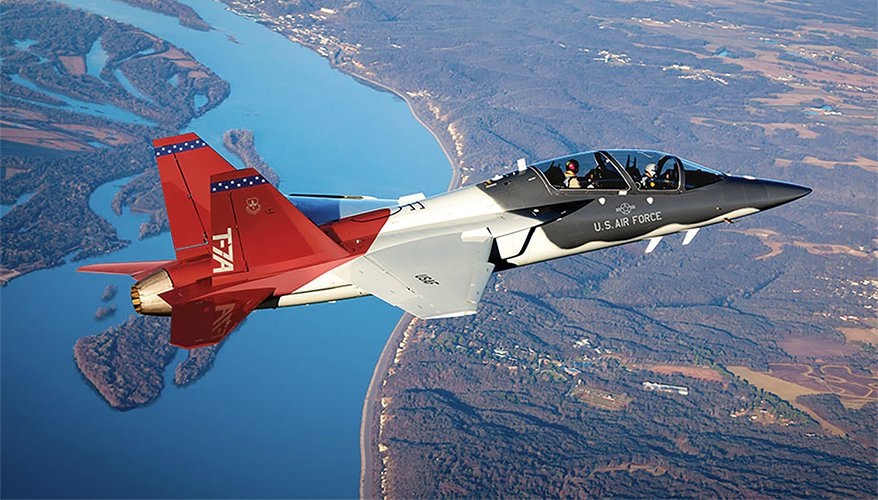
The U.S. Air Force has officially entered a new era of pilot training with the arrival of its first T-7A Red Hawk on 5 December, delivered to the 12th Flying Training Wing under Air Education and Training Command (AETC). The milestone marks the beginning of a sweeping modernization effort aimed at preparing pilots for the cognitive and technological demands of fifth- and sixth-generation combat aircraft.
A Symbolic and Technological Leap
Brig Gen Matthew Leard, Director of AETC Plans, Programs, Requirements and International Affairs, called the arrival “the first physical representation of progress within the program.” The T-7A replaces the ageing T-38 Talon, which has trained generations of American fighter and bomber pilots since the early 1960s.
Costly to maintain and increasingly out of step with modern aircraft, the T-38 has been extended “multiple times,” Leard noted. “There’s an escalating cost of keeping it flyable, and it’s no longer aligned with current or future platforms.”
The T-7A, developed by Boeing in partnership with Saab, is named to honor the Tuskegee Airmen. It will be assigned to the storied 99th Flying Training Squadron, the “Red Tails,” which will introduce the aircraft into the Air Force training pipeline over the next several years.
Lt Col Michael Trott, commander of the 99th, said the squadron intends to continue the Tuskegee legacy of innovation. “The 99th will re-write what pilot production looks like and shape the future of pilot training for the next generation of warfighters in America,” he said.
Building Pilots for a Data-Rich Battlespace
According to AETC leaders, the T-7A is not just a replacement trainer—it is a complete shift in training philosophy.
Maj Gen Gregory Kreuder, commander of the 19th Air Force, said that from the first day of training, new pilots will be immersed in sensor-rich, information-heavy environments similar to operational fifth-generation fighters like the F-35.
“Students won’t just be learning to fly; they’ll be learning to manage information, interpret data from advanced sensors, and make critical decisions in a complex environment,” he said. “This aircraft enables us to close the gap between basic pilot training and the realities of fifth-generation plus warfare.”
Leard compared the transformation to the leap from early mobile phones to today’s software-driven platforms. The T-7A’s open-architecture system allows rapid upgrades, while its fly-by-wire configuration lets instructors tailor handling characteristics to student needs.
Kreuder added that traditional flying skills alone are no longer enough. “Our legacy T-38 built incredible ‘stick-and-rudder’ aviators, but it is ill-suited for the aircraft we employ today. Students must become tactical problem-solvers and be comfortable as critical nodes in a data-rich environment.”
New Training Features: Virtual Integration and Ground Systems
The T-7A integrates tightly with a Ground-Based Training System (GBTS) and features Live Virtual Constructive (LVC) training, allowing pilots in simulators and aircraft to operate in the same scenario. This reduces the number of required flying hours while maintaining—and in many cases improving—training quality.
Leard said the LVC model offers long-term flexibility. “It’s like hardware that grows more powerful through software upgrades.”
Along with the aircraft, the training system includes modern simulators, AI-enabled instruction tools, and real-time data analytics for individualized learning paths.
Investing in Digital Infrastructure and Instructors
AETC is investing heavily in instructor preparation, maintenance modernization, and digital ecosystems that support data-driven training. Kreuder said, “We’re empowering our Airmen to innovate and shape how we train our warfighters so they will continue to dominate in any future fight.”
Programme Scale and Future Expansion
The T-7 program includes 351 aircraft, 46 simulators, and an advanced training system that will eventually replace not just the T-38 but also the T-6 Texan II.
Testing will continue at Edwards Air Force Base, where the T-7 has already undergone high angle-of-attack trials, climatic chamber testing, and escape-system certification. Meanwhile, the 99th Squadron will begin Type 1 maintenance and pilot training as the aircraft matures. “Training will start in parallel with aircraft envelope expansion,” Leard confirmed.
Delivery Timeline and Long-Term Fleet Transition
The Air Force’s fielding plan for the T-7A includes:
-
Initial Operational Capability (IOC): August 2027, with 14 aircraft assigned to the 99th FTS.
-
Full-rate procurement of 40–60 aircraft per year by 2033.
-
Final deliveries by 2035–2036.
-
The T-38 will remain operational until transition completion.
Future T-7A deliveries are scheduled for:
-
Columbus AFB – Fiscal 2027
-
Laughlin AFB – Fiscal 2032
-
Vance AFB – Fiscal 2034
-
Sheppard AFB – Fiscal 2035
Why the T-7A Matters
The T-7A arrives at a time when the U.S. Air Force is preparing for the Next Generation Air Dominance (NGAD) era, rapid global deployments, and operations against technologically sophisticated adversaries. Modern combat aircraft rely heavily on sensor fusion, AI-assisted decision-making, and multi-domain networked warfare—skills that older training aircraft cannot adequately teach.
The Red Hawk’s digital backbone, cockpit design, embedded training systems, and advanced flight characteristics are intended to shape pilots capable of transitioning seamlessly into platforms such as the F-35, F-22, B-21, and future NGAD systems.
With the first T-7A now delivered, AETC leaders say the transformation of U.S. Air Force pilot training has officially begun.
If you want, I can also prepare a shorter version, headline variations, or a bold-marking version for key details.
About the Author
Aditya Kumar:
Defense & Geopolitics Analyst
Aditya Kumar tracks military developments in South Asia, specializing in Indian missile technology and naval strategy.