U.S. Air Force Inducts First T-7A Red Hawk, Marking Digital Shift in Pilot Training
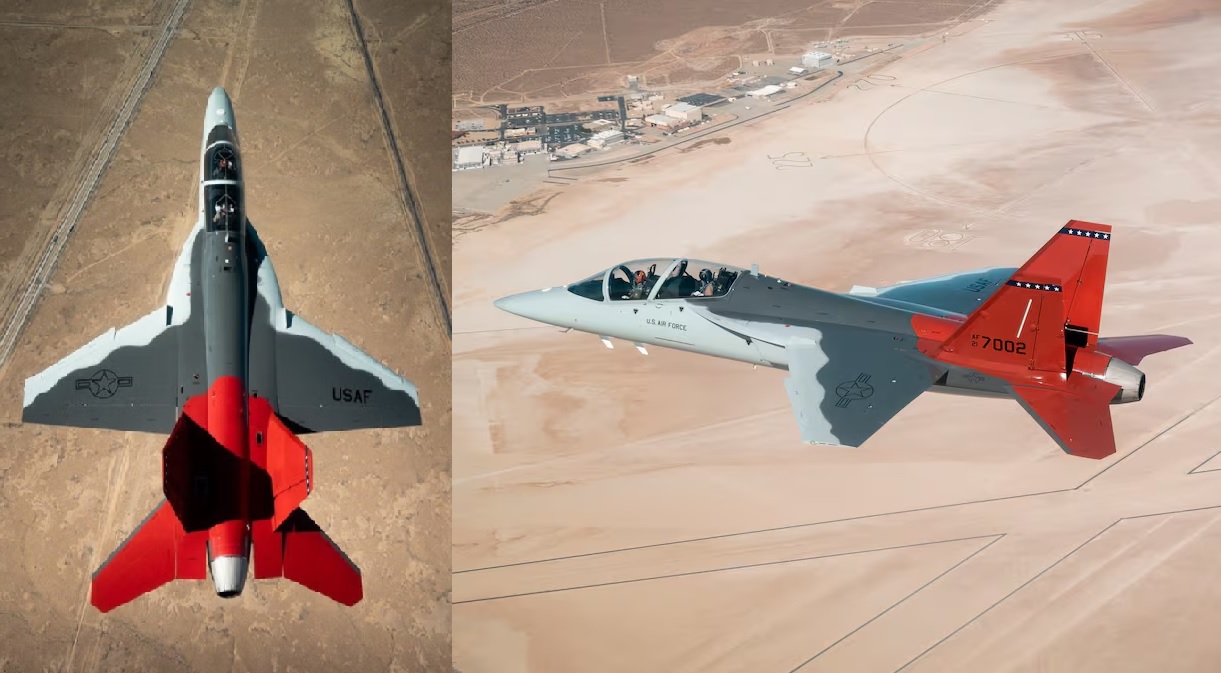
Joint Base San Antonio–Randolph, Texas : The U.S. Air Force has formally inducted its first T-7A Red Hawk advanced trainer into operational service, opening a new chapter in American military aviation training and signaling a decisive move away from Cold War-era platforms toward a fully digital, data-centric training ecosystem.
The aircraft was welcomed during an official arrival ceremony hosted by Air Education and Training Command (AETC) at Joint Base San Antonio–Randolph, confirming the delivery of the first operational Red Hawk from Boeing. Senior Air Force leaders and industry representatives attended the event, underscoring the strategic importance of the programme as the service prepares pilots for increasingly complex and data-intensive air combat.
A Generational Leap in Training
Senior commanders described the induction as far more than a routine fleet update. AETC Commander Lt. Gen. Clark J. Quinn called the T-7A “a generational leap,” stressing that the aircraft will shape Air Force training for decades. Designed using advanced digital engineering methods, the Red Hawk integrates modern avionics, high-fidelity simulation connectivity, and an open-systems architecture that allows rapid software upgrades as new operational requirements emerge.
Unlike legacy trainers, the T-7A was conceived from the outset as part of a broader training ecosystem rather than a standalone aircraft. Its digital backbone enables seamless integration with ground-based simulators and mission systems, allowing student pilots to train in highly realistic environments that mirror the information-dense cockpits of frontline fighters and bombers.
Replacing a 60-Year-Old Workhorse
The Red Hawk is set to replace the T-38 Talon, which has served as the Air Force’s primary jet trainer for more than six decades. While the T-38 laid the foundation for generations of pilots, Air Force officials have acknowledged that it can no longer replicate the sensor fusion, workload management, and networked warfare demands faced by crews flying fifth-generation aircraft—and future sixth-generation platforms now under development.
Acting Vice Chief of Staff Lt. Gen. Scott Pleus highlighted that the T-7A’s performance and digital design are essential for preparing pilots to manage the cognitive demands of modern combat aviation. He emphasized that mastering data flow and decision-making is now as critical as stick-and-rudder skills.
First Squadron, Foundational Role
The 99th Flying Training Squadron, part of the 12th Flying Training Wing, became the first Air Force unit to receive the new trainer. As the lead operational unit, the squadron will play a central role in refining syllabi, validating training concepts, and shaping how the Red Hawk is employed across the wider Air Force training enterprise.
Col. Peter Lee, commander of the 12th Flying Training Wing, said the programme represents the creation of an enterprise-wide foundation rather than the introduction of a single aircraft. According to Lee, lessons learned at Randolph will directly influence how other wings train future pilots as the T-7A fleet expands.
Lt. Col. Michael Trott, commander of the 99th Flying Training Squadron, said the unit’s task is to redefine pilot production for the next generation. He described the Red Hawk as a platform that will fundamentally change how young aviators are trained to think, decide, and operate in contested airspace.
Digital-First Vision for Future Aircrews
The induction of the first operational T-7A comes as the Air Force accelerates efforts to modernise its training pipeline to keep pace with evolving threats. With its modular architecture and software-driven design, the Red Hawk is expected to adapt alongside emerging technologies, ensuring relevance well into the era of next-generation air dominance.
AETC leaders stressed that the arrival of the aircraft is not an endpoint but the beginning of a transition phase. As additional T-7As are delivered and training systems mature, the Air Force aims to produce pilots who are not only proficient flyers but also effective managers of complex combat systems from their very first operational assignment.
With the Red Hawk now officially in service, the U.S. Air Force has taken a decisive step toward reshaping how it prepares aircrews for the realities of 21st-century—and future—air warfare.
About the Author
Aditya Kumar:
Defense & Geopolitics Analyst
Aditya Kumar tracks military developments in South Asia, specializing in Indian missile technology and naval strategy.