UK's JET Facility Sets New Energy Production Record in Nuclear Fusion ,Close to Limitless Clean Energy
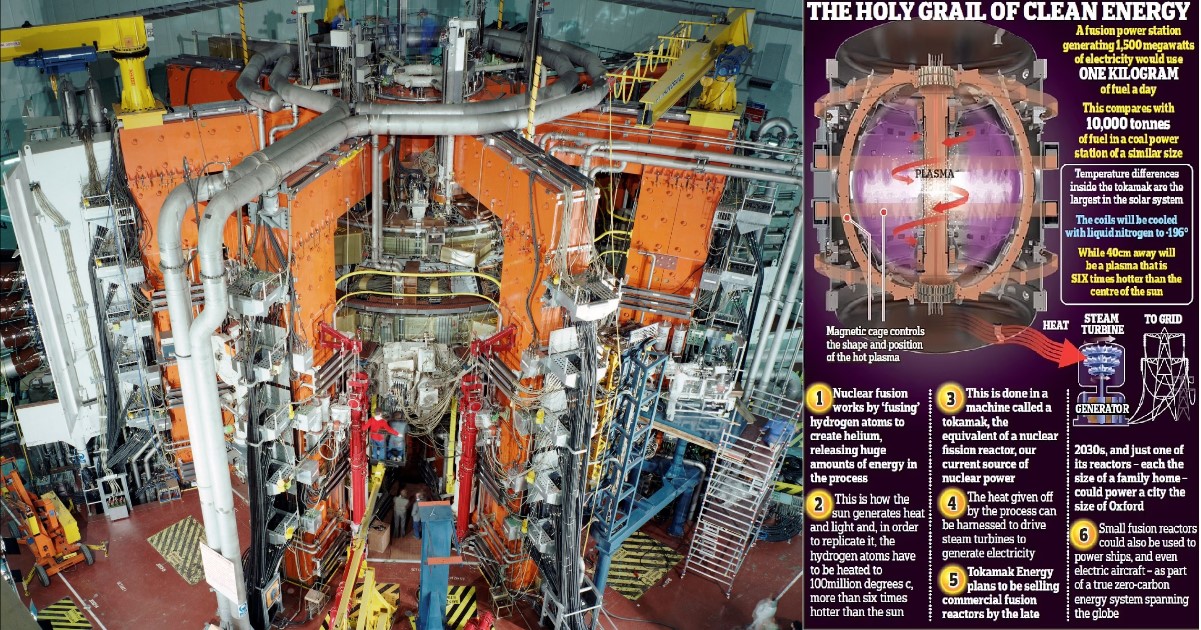
Technology News ,UK :- In a significant stride towards cleaner energy sources, a UK-based nuclear fusion collaboration achieved a groundbreaking feat, producing a record amount of energy at the Joint European Torus (JET) facility. The milestone marked a moment of optimism in humanity's pursuit of sustainable energy solutions. JET generated over 69 megajoules of heat, showcasing the potential of nuclear fusion, a process wherein atomic nuclei fuse, releasing immense energy in the process.
Nuclear fusion stands in contrast to its counterpart, nuclear fission, which involves splitting atoms to generate energy, accompanied by substantial waste. The fusion reaction mirrors the process that powers stars like the Sun, and scientists have long aspired to make this reaction energy-efficient on Earth. The ultimate goal is to achieve a state where fusion reactions generate more energy than they consume, offering the promise of virtually limitless clean energy. However, the commercial viability of fusion remains a challenge, with substantial investments made by organizations such as the UK Atomic Energy Authority (UKAEA) and the US Department of Energy (DOE).
While the dream of commercially viable nuclear fusion always seems a few decades away, recent achievements, like those at JET, serve as crucial steps towards realizing a clean energy future. JET, operational since 1983, recently concluded its scientific operations at the end of December, making way for its decommissioning.
The UK facility, costing £20-30 million per year to operate, is viewed as a precursor to the International Thermonuclear Experimental Reactor (ITER) in France, a massive $22.5 billion project. Andrew Bowie, the UK Minister for Nuclear and Networks, acknowledged JET's contribution, stating, "JET's final fusion experiment is a fitting swansong after all the groundbreaking work that has gone into the project since 1983."
The recent energy record set by JET is particularly noteworthy, achieving this feat using a mere 0.2 milligrams of fuel, equivalent to the weight of a single grain of pollen. The resulting energy output of 69 megajoules is substantial, enough to heat water for approximately 600 cups of tea. This accomplishment surpasses JET's previous record of 59 megajoules set over two years ago and significantly exceeds its initial peak fusion power record of 22 megajoules from 1997.
If sustained at 69 megajoules, JET could potentially provide power to around 12,000 households continuously. The facility's four-decade-long journey has been dedicated to demonstrating the potential of nuclear fusion as a viable power source. The recent success at JET also outshines the energy output record of the US Department of Energy’s National Ignition Facility from the previous year, achieved through a different fusion process.
JET utilized tokamaks and stellarators, employing magnetic fields to confine plasma and catalyze fusion over an extended period. The facility's final act serves as a triumphant conclusion to its 40 years of operations, setting multiple records along the way. Andrew Bowie emphasized, "We are closer to fusion energy than ever before thanks to the international team of scientists and engineers in Oxfordshire."
The prospect of a world powered by fusion energy brings with it the promise of a cleaner and more sustainable future, where concerns over carbon emissions and energy dependence may be alleviated. The success of JET stands as a testament to the progress made in fusion research, offering hope for a time when fusion energy becomes a practical and reliable source, transcending the current mirage-like perception of its commercial viability. In such a world, the achievements of projects like JET could play a pivotal role in reshaping our energy landscape, making the dream of a cleaner, greener future a reality.
✍️ This article is written by the team of The Defense News.