UK Navy Proteus Autonomous Helicopter Moves Into Engine Testing
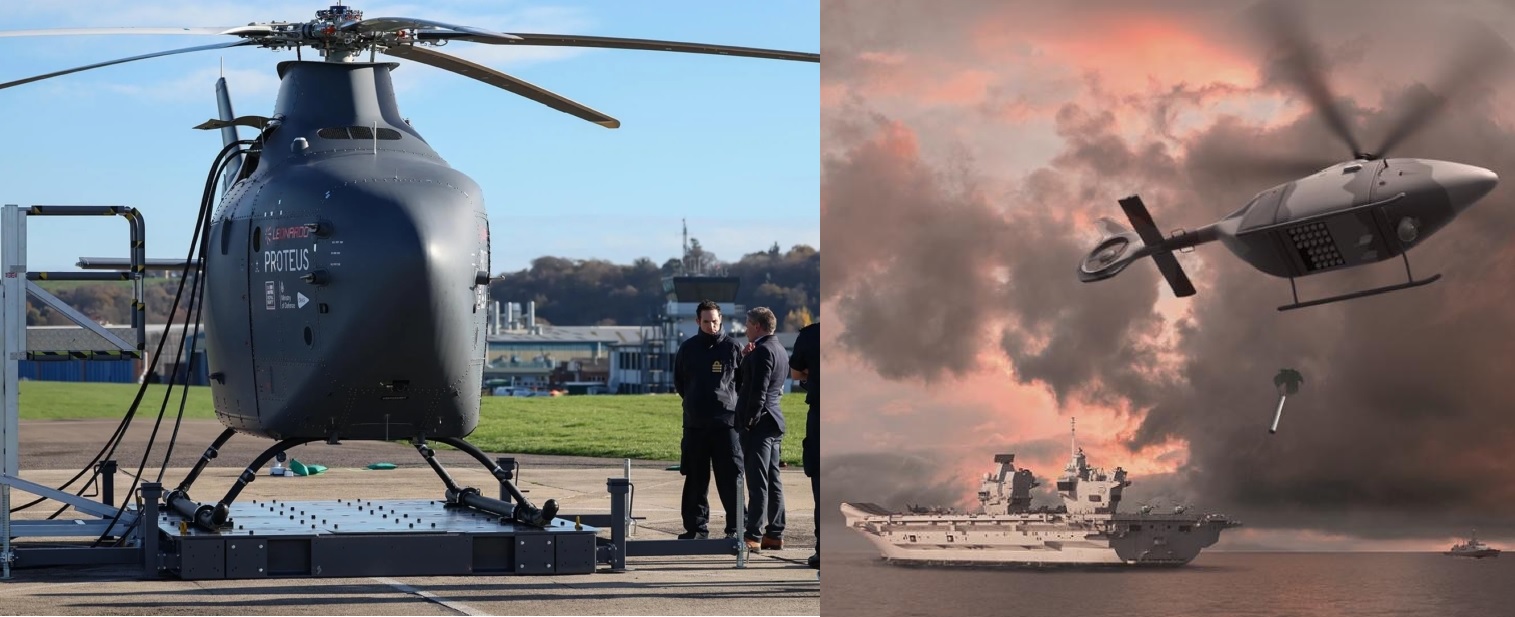
The UK’s next major step in autonomous aviation advanced this week as the Proteus Technology Demonstrator, a full-scale autonomous helicopter developed by Leonardo, completed its first ground-running tests at Yeovil. The aircraft, similar in size to a conventional helicopter, has been designed so that it is tasked by an operator rather than flown by a pilot, marking a new direction for future Royal Navy aviation programmes.
Proteus has been developed in less than two-and-a-half years under a £60 million Ministry of Defence programme, and is regarded as one of the first full-size autonomous VTOL aircraft of its type. The ground-running event involved testing the helicopter’s engines, systems, and rotor blades to verify basic functionality before flight trials begin.
Senior Royal Navy and Ministry of Defence staff visited Leonardo’s facility to observe the demonstration and to review the aircraft’s autonomy software, onboard processing systems, and integrated sensors.
Captain David Gillett, Head of Maritime Aviation and Carrier Strike in the Royal Navy’s Develop Directorate, said the programme reflects current defence requirements. “It’s been a huge pleasure to work with Leonardo and across Defence, as one team, to deliver Proteus. It combines cutting-edge technology, the experience of recent conflicts and has enormous potential to shape the Royal Navy’s future hybrid air wing.”
Nigel Colman, Managing Director Helicopters UK at Leonardo, said the system is designed to operate reliably in maritime conditions. “Proteus is equipped with cutting-edge onboard software capabilities, carrying a suite of sensors and systems that allow it to sense its environment, make decisions and act accordingly,” he noted, adding that these features are intended to allow the aircraft to function in high sea states and strong winds.
Building the Royal Navy’s Future “Hybrid Air Wing”
Proteus is intended not just as a flying prototype but as a foundational technology demonstrator for what the Royal Navy describes as a future hybrid air wing — a mix of crewed helicopters, drones, and autonomous VTOL platforms operating cooperatively.
The aircraft’s one-tonne payload bay opens the door to a wide mission set, far beyond its initial anti-submarine warfare (ASW) evaluation. Potential operations include maritime surveillance, search and rescue, strike support, logistics resupply, intelligence gathering, and control of unmanned systems. The ability to fly long-endurance missions without fatiguing crews offers a major enhancement to fleet-wide operational tempo.
Global navies increasingly see autonomous rotorcraft as the future backbone of maritime aviation. The United States, France, Japan, and Australia are all investing in similar systems, but Proteus stands out as one of the first full-scale, heavy-lift autonomous helicopters to undergo integrated naval testing.
Autonomous Warfare: Proteus and the Anti-Submarine Battle
The initial testing campaign focuses on the platform’s ability to contribute to anti-submarine warfare — a domain where endurance, data fusion, and precision sensing are critical. Proteus is being prepared to patrol designated maritime areas autonomously, integrating intelligence from allied ships, aircraft, satellites, and underwater sensors.
To detect hostile submarines, the helicopter will deploy sonobuoys and analyse acoustic signatures using onboard AI. Once a target of interest is identified, Proteus will automatically relay its findings to mission commanders, supporting human operators in both threat assessment and tactical planning.
This new approach reflects lessons from recent global conflicts, where distributed sensing, autonomous patrols, and human–machine teaming have shown transformational potential.
How Proteus Fits Into Leonardo’s Broader Technological Push
Proteus is part of Leonardo’s long-term strategy to maintain UK leadership in rotorcraft innovation. The company is simultaneously developing:
-
AI-enabled flight control systems
-
Modular autonomous mission suites
-
Integrated maritime combat data networks
-
Hybrid-electric propulsion concepts for future VTOL platforms
These technologies will inform the Royal Navy’s future replacements for the Merlin and Wildcat fleets, and potentially the UK’s contribution to NATO’s next-generation unmanned aviation doctrine.
The Yeovil site has also been preparing a new simulation environment where naval operators can test human–machine teaming scenarios using Proteus’ flight software. This digital ecosystem aims to reduce physical testing costs while accelerating operational readiness.
Maintaining Human Oversight in a New Autonomous Era
Although Proteus is not flown by a human pilot, every mission is overseen by a trained system operator who works within strict safety protocols and rules of engagement. Engineers stress that human control and oversight will remain central, even as autonomous functions increase.
The goal, officials say, is not to replace pilots but to extend the Navy’s reach, enabling aircrew to focus on complex decision-making while autonomous aircraft handle long, repetitive, or high-risk missions.
A New Era for Britain’s Maritime Air Power
The successful ground test marks the beginning of a multi-year flight evaluation campaign. Upcoming phases will introduce autonomous taxing, hover tests, controlled take-offs, and — eventually — full autonomous missions at sea.
For the Royal Navy, Proteus is more than a technology demonstrator. It is a symbol of the service’s determination to adapt to an era where AI-powered aircraft, long-range sensing networks, and human–machine collaboration are reshaping naval warfare.
With Proteus now alive on the test line, the UK has positioned itself at the forefront of autonomous helicopter development — a domain set to define maritime operations for decades to come.
About the Author
Aditya Kumar:
Defense & Geopolitics Analyst
Aditya Kumar tracks military developments in South Asia, specializing in Indian missile technology and naval strategy.