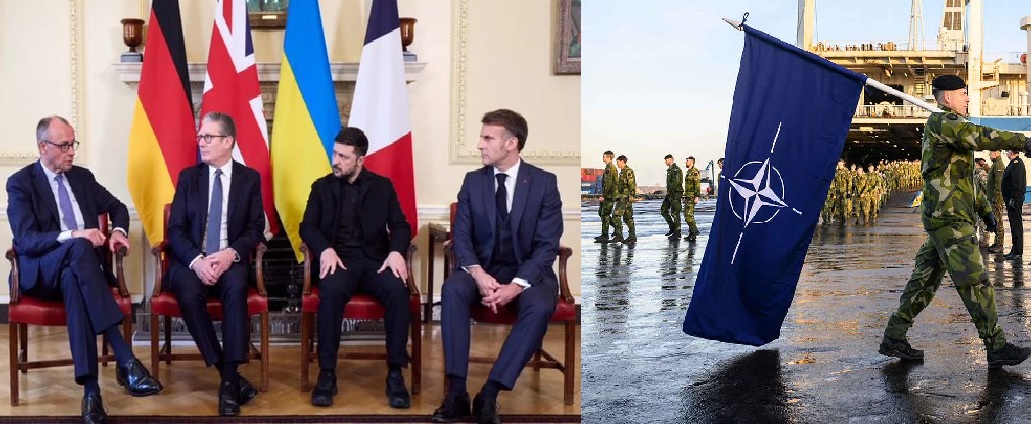
UK, Germany, Netherlands and Sweden Plan to Join France in Rejecting U.S. Peace Council Invitation
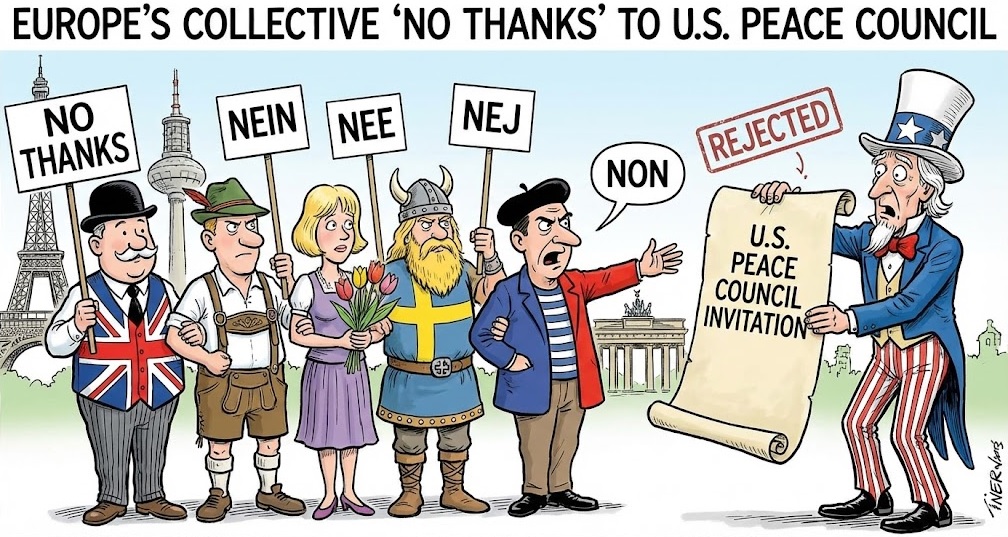
DAVOS / PARIS / LONDON : A growing bloc of major European powers is preparing to reject a controversial U.S.-backed proposal to establish a new international Peace Council ( Board of Peace ), deepening transatlantic divisions over the future management of global conflict resolution and the post-war governance of Gaza.
According to Bloomberg, the United Kingdom, Germany, the Netherlands and Sweden are set to follow France in declining an invitation to join the body, which is being promoted by U.S. President Donald Trump and is expected to be formally unveiled on the sidelines of the World Economic Forum in Davos.
A Push for Rapid Endorsement in Davos
People familiar with the discussions told Bloomberg that Washington is seeking signatures on the Peace Council’s founding charter and governing committee as early as Thursday in Davos. Around 60 countries have reportedly been invited to participate, including Russia, a detail that has raised concerns among several Western capitals.
The proposed council would operate outside existing United Nations mechanisms and, according to preliminary outlines circulated among diplomats, could take on a mandate extending beyond Gaza to broader international security and mediation roles.
France Leads the Opposition
France was the first country to formally reject the initiative. President Emmanuel Macron has expressed deep reservations, arguing that the Peace Council risks undermining established multilateral institutions, particularly the United Nations.
A person close to Macron told Bloomberg that Paris believes the council’s activities would not be limited to Gaza, but could evolve into a parallel diplomatic structure that would weaken the UN’s authority and allow Washington to exert disproportionate influence over French foreign policy decisions.
Northern European Resistance Builds
Diplomats from the UK, Germany, the Netherlands and Sweden have privately echoed France’s concerns, citing fears of mandate creep, unclear legal authority and the inclusion of countries viewed as adversarial or controversial within a Western-led security framework.
Officials from these governments have also questioned the speed with which the charter is being pushed, warning that the Davos timeline leaves little room for parliamentary scrutiny or alliance coordination.
Israeli Objections Over Gaza Role
The proposal has also drawn opposition from Israel. Prime Minister Benjamin Netanyahu said the Gaza-related committee envisioned under the Peace Council was “not agreed with Israel and contradicts its policy.”
Israeli officials are particularly uneasy about the inclusion of representatives from Qatar and Turkey, both of which have played prominent diplomatic roles in Gaza-related negotiations but are viewed in Jerusalem as politically misaligned with Israeli security priorities.
Italy Signals Willingness to Engage
Not all European leaders are turning away. Italian Prime Minister Giorgia Meloni has positioned herself as a potential bridge between Washington and skeptical European capitals.
Meloni has indicated that Italy is “ready to do its part,” framing Rome’s stance as an effort to preserve dialogue and shape the initiative from within rather than reject it outright.
A Test for Global Governance
The unfolding debate highlights widening disagreements over how future conflicts—particularly Gaza—should be managed, and whether new ad hoc institutions should supplement or bypass existing international frameworks.
As leaders gather in Davos, the fate of the Peace Council is shaping up to be a key diplomatic test for Trump’s renewed push to reshape global governance—and for Europe’s willingness to follow Washington down an uncharted institutional path.
About the Author
Aditya Kumar:
Defense & Geopolitics Analyst
Aditya Kumar tracks military developments in South Asia, specializing in Indian missile technology and naval strategy.