UK Developing 500 Km Range ‘Nightfall’ Ballistic Missile To Give Ukraine Deep-Strike Capability
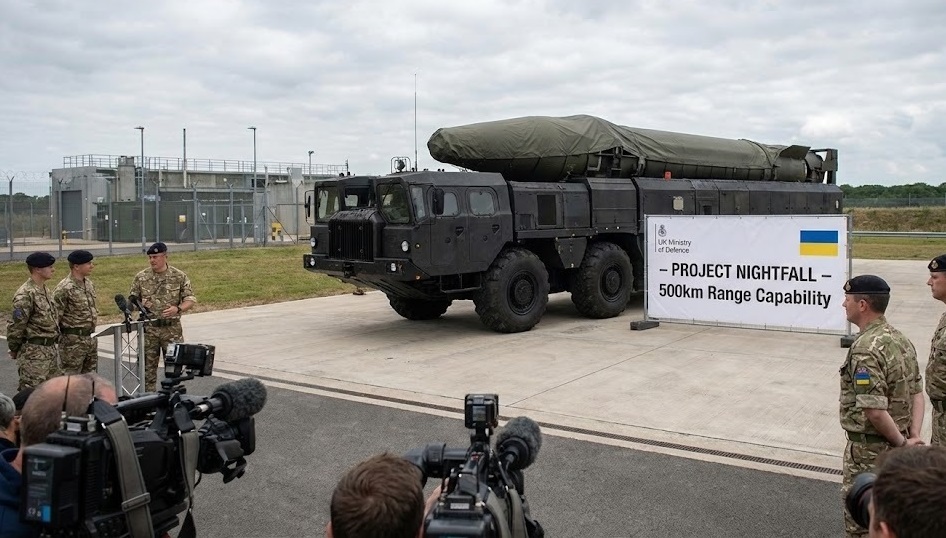
London / Kyiv : Britain has launched the early stages of a new long-range ballistic missile programme that could significantly alter the battlefield balance in Ukraine, as London seeks to strengthen Kyiv’s ability to strike deep behind Russian lines while reinforcing its own future military capabilities.
The system, known by the working name Nightfall, is being developed under a fast-tracked Ministry of Defence initiative aimed at producing a mobile, ground-launched ballistic missile capable of carrying a 200-kilogram warhead to a distance of up to 500 kilometres. If fielded, such a weapon would give Ukraine the ability to target command centres, logistics hubs and ammunition depots well inside Russian-held territory, beyond the reach of most existing artillery and rocket systems.
A Rapid-Strike Missile Built For Modern Warfare
According to programme details, Nightfall is designed around speed, mobility and survivability. The missile will be launched from a vehicle-mounted platform and engineered to support rapid, successive firings, allowing crews to release multiple missiles in a short window before quickly relocating. This “shoot-and-scoot” concept reflects battlefield lessons from Ukraine, where drones, counter-battery radar and precision strikes have dramatically reduced the survivability of static launch systems.
The missile’s ballistic trajectory is intended to deliver a time-to-target of under ten minutes, sharply limiting the warning available to defending forces. Its guidance system is being developed to operate in environments where satellite navigation may be degraded or denied, a critical requirement in a conflict characterised by intense electronic warfare.
Initial Funding And Industrial Push
The UK Ministry of Defence has committed £9 million for the programme’s initial phase, which will focus on detailed design, construction and testing of three prototype missiles. Officials describe this stage as a proof-of-concept effort, intended to validate performance before any decision on larger-scale production.
The project is also notable for its emphasis on cost and manufacturability. Defence planners are seeking a missile that can be produced in meaningful numbers rather than as a niche capability, reflecting concerns that high-intensity warfare rapidly exhausts stocks of precision weapons.
Strategic Intent And Political Messaging
Britain’s Defence Secretary, John Healey, has framed the effort as part of a broader strategy to enhance deterrence and defensive resilience by strengthening Ukraine’s ability to hit back. In public remarks, Healey has argued that modern defence increasingly depends on denying adversaries sanctuary far from the front line.
The initiative also sends a clear strategic signal. By pursuing a domestically developed ballistic missile, Britain is underlining its willingness to support Ukraine with more advanced capabilities at a time when debates over escalation and long-range strikes remain politically sensitive across Europe and the United States.
Implications For Ukraine And The Wider Conflict
For Ukraine, a system like Nightfall would represent a substantial expansion of long-range strike options. A 500-kilometre reach would place a wide array of military infrastructure within range, potentially complicating Russian logistics and forcing Moscow to disperse or harden assets previously considered relatively secure.
From the perspective of Russia, the development underscores a trend toward deeper Western involvement in shaping Ukraine’s strike capabilities, even as Moscow continues to rely heavily on missiles and drones to pressure Ukrainian cities and energy infrastructure.
What Comes Next
At this stage, Nightfall remains a developmental programme rather than a deployed weapon. No timeline has been announced for operational use, and officials have not formally confirmed whether the missile will be transferred directly to Ukraine or initially retained as a British capability that could later be shared.
What is clear is that the project reflects a shift in British defence thinking, shaped by the realities of the Ukraine war: future conflicts are expected to demand long-range precision, rapid mobility and affordable mass, rather than small numbers of exquisite systems. Whether Nightfall ultimately becomes a decisive tool for Ukraine or a cornerstone of Britain’s own arsenal, its emergence marks a significant moment in Europe’s evolving approach to modern warfare.
About the Author
Aditya Kumar:
Defense & Geopolitics Analyst
Aditya Kumar tracks military developments in South Asia, specializing in Indian missile technology and naval strategy.