UK Confirms Live-Fire Trials Of Project Brakestop As Rapid-Scale Cruise Missile Programme Takes Shape
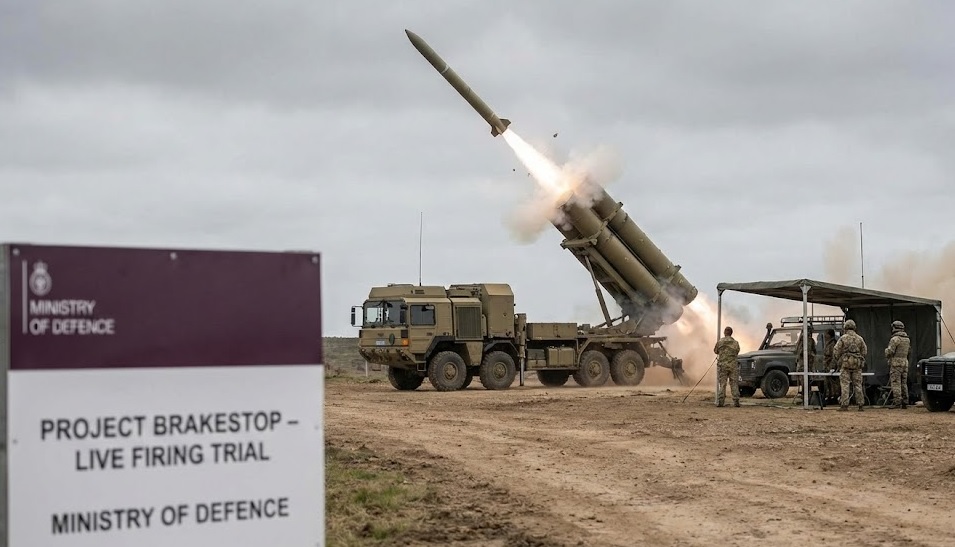
The Ministry of Defence (MoD) has confirmed that Project Brakestop, a new British long-range cruise-missile / “one-way effector” effort built around rapid production and scalable manufacturing, has moved into live firing trials, signalling a wider shift in how Britain intends to buy strike weapons in an era of accelerating demand and wartime consumption rates.
Senior officials told MPs that the programme is being run to an unusually tight, industry-driven rhythm — a deliberate departure from traditional procurement cycles — with the MoD prioritising speed, repeatability, and production capacity over “exquisite” bespoke solutions.
A Missile Programme Designed Around Mass And Tempo
Project Brakestop was first signalled publicly in a Prior Information Notice published on the UK government’s Find a Tender service on 25 September 2024, framing the requirement as a cost-effective, ground-launched One Way Effector (OWE) Heavy for high-threat environments. The notice set out an explicit manufacturing ambition: scalable production at a minimum of 20 units per month, with the ability to increase output further if operations demand.
In evidence and reporting around the latest trials, officials have described Brakestop as a programme built on a tight loop — “buy, try and scale” — intended to take systems from prototype to firing range quickly, then expand what works.
What The MoD Asked Industry To Build
The 2024 MoD notice provides unusually clear performance targets for what the UK wants Brakestop to do. The requirement describes a system able to deliver a 200kg–300kg class payload over a target range of 600km, at around 600km/h, launched safely from a mobile ground platform and able to operate day or night in harsh conditions.
The same document stresses survivability and navigation resilience: the weapon should be of low multispectral signature, operate in a complex electromagnetic environment, and navigate in a GNSS-denied and degraded scenario while resisting electronic warfare, including spoofing. For end-game accuracy, the MoD referenced a CEP (0.5) of 30m for a low-level cruise profile with terminal guidance “as required”.
Cost, Sovereignty And Upgrade Path
Cost is central to the concept. The MoD set a target unit price of no more than £400,000 (ex-VAT) per delivery platform, explicitly excluding the launcher and certain government-furnished items. The notice also underlined that designs should be free from external government trade and usage restrictions — a clear sovereignty and exportability signal — and capable of spiral development for upgrades over time.
From Industry Day To Firing Range: The Programme’s Fast Track
The MoD’s early planning laid out a compressed pathway. An official industry day was scheduled for Tuesday, 8 October 2024 in London, with attendance capped at two personnel per company and registration responses due by 15:00 (GMT+1) on 2 October 2024.
For selection, the MoD described a “3-2-1” down-select model — narrowing submitted proposals to a small set of firms, then to two to five companies, with up to £5 million in funding (subject to contract) to rapidly mature and demonstrate systems. The original schedule aimed at a demonstration firing in Q2 2025, with potential serial production from Q3 2025, still anchored around the 20-per-month minimum output expectation.
By late 2025, officials indicated the effort had drawn interest from 27 companies, spanning established prime contractors and newer entrants, highlighting the MoD’s stated intent to widen supplier participation beyond a small circle of incumbents.
Live Firing Trials Begin And What We Know About The First Shot
The MoD confirmation that Brakestop has entered live firing trials follows disclosure that a first test firing occurred in mid-December 2025, discussed publicly in the context of a wider procurement reform push. Reporting from the parliamentary session indicates the first firing took place on 15 December 2025, revealed the following day during evidence to MPs. The specific company behind that initial test firing was not publicly identified in that account.
Brakestop As A Case Study In Britain’s Procurement Reset
While Project Brakestop is a weapons programme, it is also being treated inside government as a template for a broader cultural shift: moving procurement from slower, requirement-heavy cycles toward faster experimentation, shorter decision loops, and production readiness.
In parallel evidence to Parliament, senior defence figures have argued the UK must adapt to the “dangerous times” environment and absorb lessons from Ukraine — not only about battlefield technology, but about the industrial ability to surge output. The direction of travel, as presented to MPs, is toward simplified processes, more rapid prototyping, and a procurement mindset designed for wartime resilience.
For the MoD, Brakestop’s underlying logic is that long-range strike capacity can no longer be judged only by peak performance; it must also be judged by how quickly it can be produced, replaced, and scaled — at a price point that allows meaningful stockpiles and sustained operations.
✍️ This article is written by the team of The Defense News.