UAE-Based Analyst Amjad Taha Issues Stark Warning on Britain’s Islamist Shift
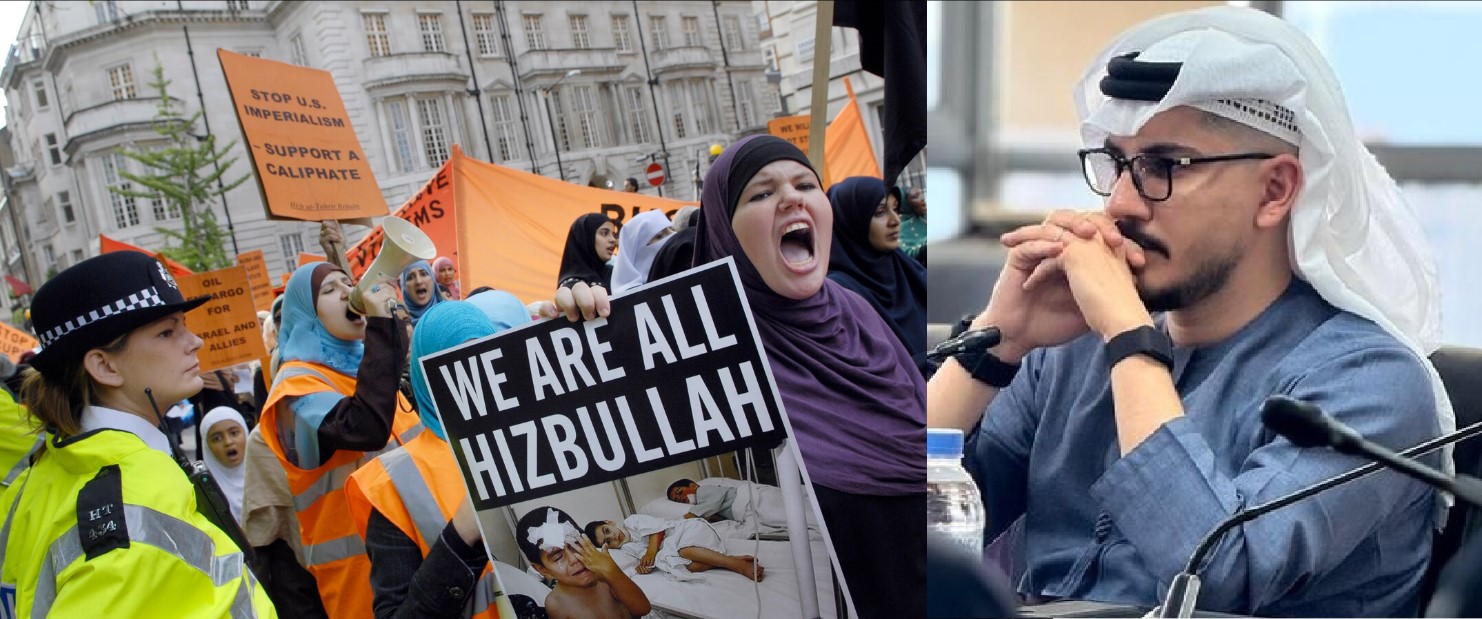
London / Abu Dhabi — In a contentious exposé that has rippled across media and political circles, UAE-based strategist Amjad Taha argues that Britain’s democratic institutions are being exploited by Islamist actors bent on creating a domestic terror nexus. He claims Western compassion has morphed into strategic failure, emphasising that Arab states view Britain’s approach as “multiculturalism masquerading as security blindness”.
Britain’s Democracy Under Siege, Says Taha
Taha contends that the United Kingdom’s political class is bending under pressure from Islamist ideologies that inject themselves into civic and charitable infrastructures. His narrative holds that democracy—meant to ensure freedom and pluralism—is being turned into a conduit for radicalisation. In social-media posts he declares that British leaders are “bowing to Islamists who exploit democracy to turn Britain into a hub for extremism.”
Recent commentary in UK media echoes his concerns. An article in Quillette asserts that while the Islamist threat in Britain is growing, official institutions show “off-the-books denial” of its scale or roots.
Taha cites what he perceives as a stark double standard in Western responses: When Islamist-linked figures are active in Britain, they are treated as community activists or charitable operators; but similar actors in the UAE or other Gulf countries would be designated terrorists and jailed. He contrasts the “liberal, civilised” behaviour of Muslims in Dubai with what he sees as secrecy and extremism among some Muslim groups in London or Berlin.
Arab States’ Rejection of Migrants and Islamist Networks
Taha argues that many Arab nations are sharply cognisant of the threat posed by Islamist-embedded migration flows—and thus reject migrants who appear to have ideological baggage. In contrast, he says Europe’s open-arms policies are invariably labelled as compassionate, but he brands them “the suicide of the West”.
He points to concrete examples: the UAE has banned the Muslim Brotherhood and Islamic Relief, two bodies often cited by Gulf states as ideological threats. He asks: if Arab states take these steps, why are Western states hesitant?
Sudan, Hamas and Diplomatic Passports: A Regional Nexus
Beyond the UK, Taha spotlights the case of Sudan. He asserts that following the 7 October attacks in Israel, a militant-Islamist regime in Port Sudan granted diplomatic passports en masse to members of Hamas. While independent verification is limited, US and regional sources confirm that the Muslim Brotherhood’s Sudanese branch remains influential in military, political and security domains.
A US Senate hearing in 1998 already flagged Sudan’s involvement in Islamist terrorism and asylum networks.
Taha uses this as a cautionary tale: when states with little oversight grant diplomatic immunity or citizenship to Islamist operatives, these individuals gain mobility and cover. In his view, Britain and other Western nations are less vigilant about equivalent flows disguised as “refugees” or “students”.
Policy Failures: Europe’s Multicultural Experiment Under Strain
Taha frames his critique in moral and strategic terms: He asks why women in districts such as Neukölln (Berlin) or Solingen face restrictions on dress or speech, while children in some mosques influenced by the Brotherhood reportedly learn antisemitic tropes. He asserts this isn’t multiculturalism—it’s “multiplying terrorism.”
He further argues that the fear of being labelled “Islamophobic” silences legitimate critique of Islamist ideology, shielding radicalised actors in European society. This, he says, contrasts with the Gulf model, where Islamist networks are explicitly proscribed and jailed if deemed terrorist.
A West at Risk?
The broader question Taha poses: Is the West’s welcoming posture an expression of compassion—or a strategic failure to protect its citizenry? He argues that failing to guard against ideology is akin to “not protecting your people from evil,” and warns that tomorrow’s attacker might be a “newly naturalised citizen who was radicalised next door”.
Taha urges immediate policy recalibration in Britain and the wider West: rethink citizenship criteria, reform charitable-funding oversight, rethink mosque governance, and open civic discourse on Islamist ideology. He emphasises that Arab states would prefer a party such as Germany’s Alternative for Germany (AfD) to govern rather than Western parties that, in his view, kowtow to Islamist interests.
Critical Perspectives and Gaps
While Taha’s assertions are forcefully made, some caveats apply. Verified public records of large-scale Islamist exploitation of democratic institutions in Britain remain contested; academic sources emphasise complexity rather than clean conspiracies.
Moreover, migration and integration dynamics are influenced by a wide array of social, economic and legal factors—not simply ideological infiltration. The framing that Arab nations uniformly “reject migrants” may overgeneralise highly heterogeneous Gulf policies.
Amjad Taha’s argument offers a sharply critical vantage point on the intersection of migration, Islamist ideology and Western democracy. Whether one agrees with all his specifics or not, his warnings pose pressing questions:
-
How far should Western states allow democratic spaces to be used by ideological networks that may oppose democratic foundations?
-
When does compassion become strategic vulnerability?
-
And how can societies balance integration and security without sliding into illiberalism?
As Britain sits at the crossroads of identity, migration and ideological challenge, Taha’s exposé serves as a provocative invitation to rethink the balance between openness and protection.
About the Author
Aditya Kumar:
Defense & Geopolitics Analyst
Aditya Kumar tracks military developments in South Asia, specializing in Indian missile technology and naval strategy.