Turkish Navy's Bayraktar TB3 Controls Albatros-S in First Air–Sea Drone Strike from TCG Anadolu
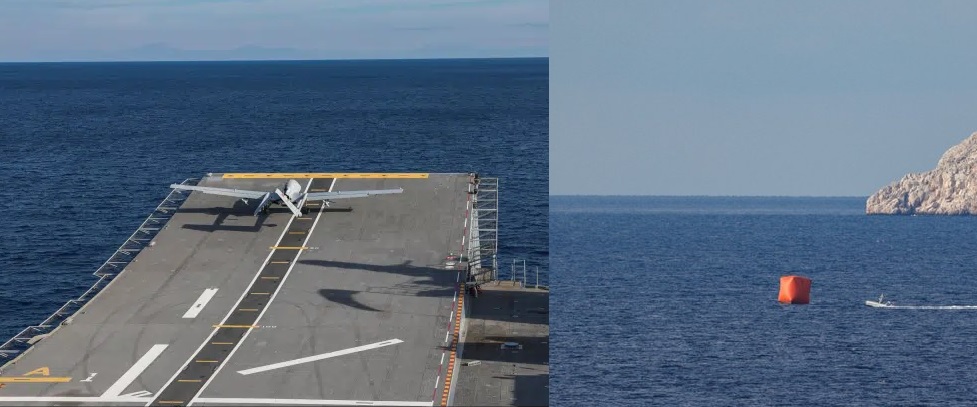
On 4 December 2025, The Turkish Navy has carried out a high-profile experiment in unmanned warfare, pairing an armed aerial drone with a kamikaze surface drone in a coordinated attack launched from the amphibious assault ship TCG Anadolu in the Eastern Mediterranean.
According to officials and industry sources, an ASELSAN Albatros-S Unmanned Surface Vehicle (USV) successfully destroyed a sea target after being remotely controlled via the data link of a Bayraktar TB3 unmanned combat aerial vehicle (UCAV) operating from Anadolu’s flight deck on 4 December 2025. The test is being described in Ankara as a milestone for Türkiye’s emerging “drone carrier” concept and its broader unmanned naval doctrine.
A One-of-a-Kind UxV Strike in the Eastern Mediterranean
The demonstration took place off the Turkish coast in the Eastern Mediterranean, near Antalya, within the framework of a wider naval exercise that has seen the Turkish Navy rehearse large-scale amphibious and joint operations in the region.
In the scenario, Bayraktar TB3 drones launched from TCG Anadolu, climbed out to the designated range and then shifted from a classic strike role into a command-and-control node for unmanned assets at sea. Using its onboard data link systems, one TB3 established a remote control connection with an Albatros-S “kamikaze” USV, built by ASELSAN. Commands to the USV were routed through the TB3, which effectively acted as an airborne relay and controller.
Guided in this way, the Albatros-S sprinted toward a floating “killer tomato” target – an inflatable, instrumented sea target commonly used in naval gunnery and missile trials – and impacted and neutralized the objective, validating the hybrid air–sea unmanned strike concept under realistic conditions.
The event was closely watched not just in Ankara but abroad. Military delegations from several NATO and partner nations – including Italy, the United Kingdom, Spain, Japan and Brazil – were present as observers, underlining foreign interest in Türkiye’s approach to drone-centric naval operations.
Building on Earlier TB3 Trials from TCG Anadolu
The 4 December test did not come out of nowhere. It is the latest step in an intensive, year-long campaign to turn TCG Anadolu into a drone-focused power-projection ship, following the loss of its originally planned F-35B short-takeoff/vertical-landing capability.
The Bayraktar TB3, developed by Baykar, is a carrier-capable UCAV designed with folding wings for deck handling, a maximum take-off weight around 1,200 kg and the ability to carry multiple precision-guided munitions under its wings.
Key milestones leading up to the latest UxV event include:
-
Shipborne flight trials from TCG Anadolu, with TB3 prototypes taking off and landing repeatedly on the ship’s deck during the Denizkurdu 2025 and other large-scale naval exercises earlier this year.
-
Live-fire trials at sea, in which TB3s launched from Anadolu and attacked land targets with Roketsan MAM-L and MAM-T guided munitions, as well as the indigenous KEMANKEŞ-1 loitering/mini cruise missile, during the Sea Wolf-I 2025 drills off Antalya.
Those tests demonstrated the UCAV’s ability to operate as a strike platform from a ship. The new demonstration pushes the concept further by using TB3 as a networked controller of other unmanned effectors rather than just a shooter in its own right.
Albatros-S: From Swarm Concept to Carrier-Linked “Kamikaze” USV
On the maritime side of the experiment, the Albatros-S represents Türkiye’s frontline unmanned surface attack system. Developed by ASELSAN as a swarm-capable, high-speed USV, the platform is designed to operate alone or in groups against surface targets.
Open sources describe Albatros-S as a compact but powerful craft approximately 7.2 metres long, with a beam of about 2 metres, capable of speeds up to 40 knots and ranges around 200 nautical miles depending on payload and profile.
The drone carries a high-explosive warhead and is intended for “kamikaze” missions, detonating on impact with enemy vessels or high-value floating infrastructure. Previous trials in 2023 saw a swarm of eight Albatros USVs rush a 22-metre target ship off Mersin, with one warhead-equipped craft striking and sinking the vessel within minutes – a test Turkish officials presented as one of the first operational demonstrations of a USV swarm attack concept.
By linking Albatros-S through the TB3 rather than controlling it directly from a shipboard console, the Turkish Navy effectively extended the USV’s command horizon, allowing the drone to be driven at much greater distances from TCG Anadolu while maintaining a robust data link.
Why the Joint TB3–Albatros Strike Matters
For Ankara, the 4 December exercise was about more than a single target hit. It showcased several emerging concepts at once:
First, it validated the idea of TCG Anadolu as a multi-domain unmanned hub, able to launch UCAVs, coordinate sea drones and support amphibious operations from a single platform. The ship’s evolution from a traditional helicopter/amphibious carrier into a “drone carrier” is now being underpinned by repeated, public trials.
Second, it demonstrated a sensor-to-shooter chain composed entirely of unmanned systems. The TB3 provided surveillance, targeting and command, while the Albatros-S served as the expendable strike element. That kind of architecture reduces risk to human crews and makes it possible to push engagements farther away from manned platforms, complicating an opponent’s defensive planning.
Third, the test fits into Türkiye’s broader “Blue Homeland” maritime doctrine, which envisions a robust naval presence and deterrent posture in the Eastern Mediterranean and surrounding seas, increasingly backed by indigenous technology. Unmanned teaming like the TB3–Albatros pairing allows Ankara to field more “shooters” per ship and to scale effects more quickly and cheaply than by relying solely on conventional manned vessels.
International Signalling
Beyond its technical content, the demonstration was also a message to foreign navies and defence buyers. Baykar has already turned the Bayraktar TB2 and Akıncı programmes into export successes, and Turkish officials frequently note that interest in TB3 and associated naval concepts is growing. By showing that a carrier-capable UCAV can act as an airborne command node for kamikaze USVs, Ankara is effectively advertising a complete unmanned strike ecosystem – air, sea and mothership – built largely from domestic systems.
For the Turkish Navy itself, the next steps are expected to include:
-
More complex scenarios involving multiple Albatros-S craft under TB3 control, potentially reviving the full swarm attack profile tested in 2023 but now linked to a carrier-borne UAV.
-
Integrating other unmanned platforms, such as larger USVs or future jet-powered UCAVs like Kızılelma, into the same command web.
-
Tighter linkage between unmanned strikes and traditional assets – surface combatants, submarines and marines – in the broader framework of joint exercises in the Eastern Mediterranean.
As navies worldwide look for ways to combine unmanned systems across domains, Türkiye’s 4 December test from TCG Anadolu offers a concrete glimpse of what future air–sea drone teaming might look like in real operations.
About the Author
Aditya Kumar:
Defense & Geopolitics Analyst
Aditya Kumar tracks military developments in South Asia, specializing in Indian missile technology and naval strategy.