Turkey’s Stealth UCAV Kızılelma Locks Onto F-16 and Scores Simulated Direct Hit Using Own Radar and Missile System
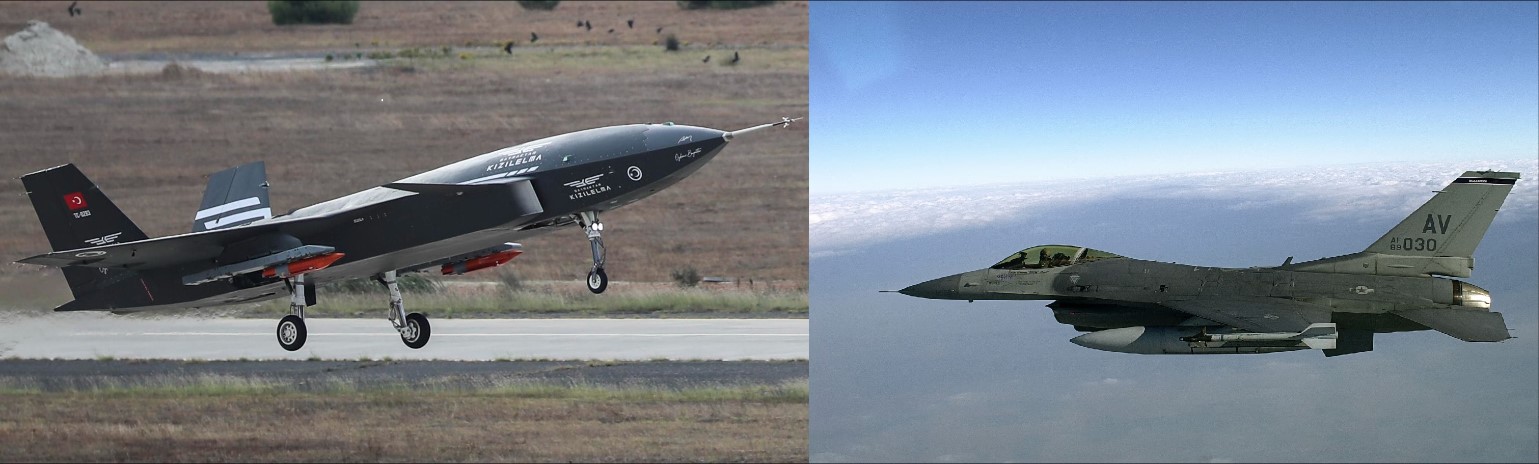
In a breakthrough that marks a new chapter in unmanned air combat, Turkey’s next-generation stealth fighter drone Bayraktar Kızılelma has successfully locked onto a Turkish Air Force F-16 and achieved a simulated direct hit during a high-fidelity test mission. Conducted over Çorlu, the test is being hailed by Turkish defence officials as one of the most important milestones in the country’s aerospace history — and a decisive indication that unmanned platforms are moving into roles once reserved exclusively for manned fighters.
The test showcased not just the maturing air-combat capability of the Kızılelma, but also the advancement of Turkey’s fully indigenous defence ecosystem. With locally produced AESA radar, a home-grown air-to-air missile, and multi-aircraft formation flight, the mission validated several critical technologies at once.
A Fully Realistic Air-Combat Scenario
The mission, lasting 1 hour and 45 minutes, recreated an operational air-combat environment. Two Turkish Air Force F-16s participated in the test:
-
One flew in close formation with Kızılelma to evaluate joint flight performance
-
The second served as the simulated adversary
At an altitude of 15,000 feet, Kızılelma used the ASELSAN-developed MURAD AESA radar to detect the target F-16 from approximately 48 kilometers. After locking onto the aircraft, the UCAV initiated its fire-control sequence and simulated the launch of Turkey’s Gökdoğan air-to-air missile. Engineers confirmed that the missile interface, radar data handover, and engagement logic executed flawlessly, resulting in a virtual direct hit.
This success brought Kızılelma’s cumulative flight time to over 55 hours, steadily advancing its progression toward operational readiness.
Indigenous Technologies at the Core of the Milestone
MURAD AESA Radar
The centrepiece of the achievement was the integration of ASELSAN’s MURAD 100-A Active Electronically Scanned Array (AESA) radar — Turkey’s most advanced airborne sensor to date. Designed originally for modern fighter aircraft, the radar brings fighter-class detection performance to an unmanned platform.
Technical Specifications:
-
Frequency band: X-band AESA
-
Detection range: Reported to exceed 100+ km against fighter-sized targets
-
Tracking capability: Simultaneous tracking of 100+ targets
-
Beam steering: Electronic scanning with rapid beam agility
-
Modes: Air-to-air, air-to-ground, SAR (Synthetic Aperture Radar), GMTI (Ground Moving Target Indicator), terrain tracking
-
Target identification: High-resolution classification via advanced signal processing
-
ECCM: Electronic counter-countermeasures built for contested environments
In the test, the radar demonstrated its long-range performance by detecting the F-16 at ~48 km, locking onto the target, and transferring the guidance data for engagement. Its ability to support a beyond-visual-range (BVR) engagement places Turkey among a small group of nations that operate unmanned combat aircraft equipped with fully indigenous AESA radar systems.
Gökdoğan Missile Integration
While no live missile was fired, the test validated Kızılelma’s full compatibility with Gökdoğan, Turkey’s new-generation beyond-visual-range air-to-air missile developed by TÜBİTAK SAGE. This integration allows the UCAV to execute advanced aerial engagements independently using a national weapons suite.
Missile Specifications:
-
Type: BVR air-to-air missile
-
Range: Estimated 65–80 km class
-
Guidance: Active radar seeker + inertial navigation midcourse guidance
-
Seeker type: Indigenous active RF seeker with home-on-jam capability
-
Control system: High-agility aerodynamic control surfaces
-
Warhead: High-explosive fragmentation
-
Role: Interception of fighter aircraft, UAVs, and cruise missiles
During the mission, the UCAV executed the complete firing sequence —
-
Radar lock
-
Advanced target-tracking algorithm
-
Missile kinematic envelope calculation
-
Fire-control logic validation
This simulation marks the final prerequisite before Kızılelma proceeds to its first live air-to-air missile test, bringing Turkey closer to fielding the world’s first operational unmanned stealth platform capable of autonomous BVR combat.
Kızılelma: Turkey’s Leap Into Unmanned Fighter Aviation
The Bayraktar Kızılelma, developed by Baykar under the ambitious MIUS program, represents Turkey’s bold entry into the era of unmanned fighter aviation. Conceived as a stealthy, jet-powered combat aircraft, Kızılelma is built to take on roles traditionally reserved for manned fighters. From the outset, it has been shaped around the idea that a UCAV should not merely support operations — it should be capable of leading them.
Kızılelma is envisioned to perform air-superiority missions, fly carrier operations from the TCG Anadolu, and execute high-maneuverability engagements that push the limits of autonomous flight. Its projected mission spectrum also includes deep-strike roles, electronic warfare tasks, and coordinated operations alongside manned fighters.
Its design reflects this ambition. The aircraft features a low radar-cross-section stealth profile, a canard-delta aerodynamic structure, and an internal weapons bay built for reduced signature and high survivability. Engineered for the future, it is carrier-compatible, supports short takeoff operations, and relies on sophisticated sensor fusion and autonomous flight systems for complex mission autonomy.
Kızılelma is being developed in multiple variants — the initial subsonic Kızılelma-A, followed by planned supersonic B and twin-engine C versions, signaling a long-term roadmap toward progressively more advanced unmanned fighter capabilities.
Adding to its growing sophistication, Turkey has integrated the Toygun electro-optical targeting system, which complements the aircraft’s AESA radar and enhances its ability to identify, track, and engage targets with high precision.
Together, these features place Kızılelma at the forefront of Turkey’s ambition to redefine what a UCAV can achieve — not just as a support platform, but as a fully capable unmanned fighter in its own right.
Significance for Turkish Defence and Air Power
Defence analysts view this test as a decisive step forward for Turkey’s air-combat strategy. With global air forces increasingly exploring unmanned wingmen concepts, Turkey is positioning Kızılelma as the core of a future fleet in which unmanned jets fly alongside manned fighters like the KAAN and F-16.
The simulated F-16 kill demonstrates:
-
Turkey’s readiness to shift toward AI-supported air combat
-
A new operational model where UCAVs carry out high-risk missions
-
Significant potential for export markets seeking high-end unmanned combat systems
This achievement also projects Turkey as one of the first nations — along with the U.S. and China — to demonstrate a stealth-capable UCAV performing air-to-air engagement tasks.
What Comes Next
Following the successful lock-on test, the programme will advance to:
-
Live air-to-air missile firing trials
-
High-G maneuver validation
-
Carrier-deck integration tests aboard TCG Anadolu
-
Supersonic variant flight trials
-
Transition toward serial production
Baykar officials have indicated that rapid development continues, with mass production expected once testing phases are completed.
Turkey’s Kızılelma UCAV has crossed a monumental threshold, proving that a stealth unmanned fighter equipped with fully indigenous radar and missile technology can detect, track, and engage a manned fighter jet. The simulated direct hit on an F-16 is more than a technological success — it is a strategic signal that Turkey is emerging as a leading force in the next generation of autonomous air combat.
With live-fire tests and expanded capabilities on the horizon, Kızılelma is now positioned at the forefront of a global shift toward unmanned, high-performance fighter aviation.
About the Author
Aditya Kumar:
Defense & Geopolitics Analyst
Aditya Kumar tracks military developments in South Asia, specializing in Indian missile technology and naval strategy.