Turkey Successfully Tests ASELSAN’s Heaviest Winged Guidance Kit KGK-84 in Precision Maritime Strike
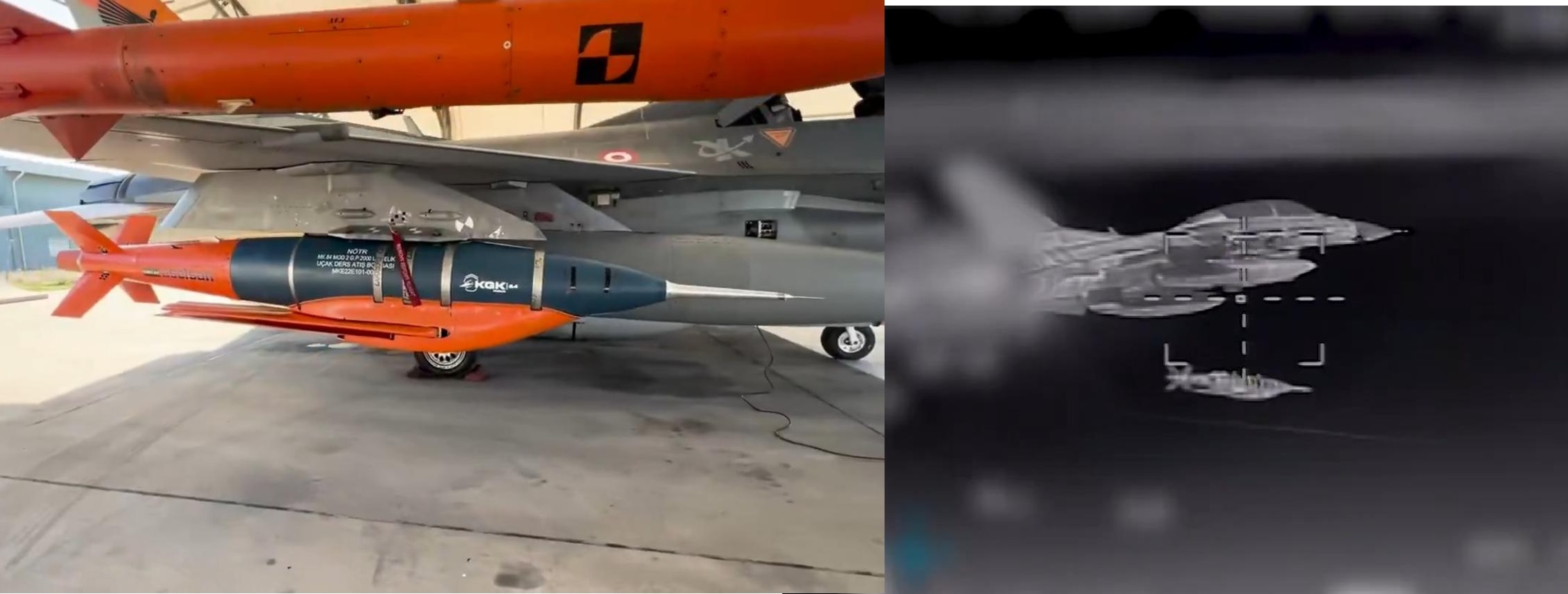
Ankara: Turkey has marked a major milestone in precision-guided munitions with the successful first target-engagement drop test of the KGK-84 Winged Guidance Kit, developed by ASELSAN for 2,000-pound (one-ton) class bombs. The test demonstrated a direct hit on a defined maritime target, underscoring Turkey’s growing maturity in long-range, high-precision strike technologies.
According to official details, the test munition was released from a Turkish Air Force F-16 fighter jet and autonomously navigated through pre-programmed waypoints before striking the target with high accuracy. The trial marked the first live drop involving a real target for the KGK-84 and validated its long-range guidance performance after separation from the aircraft.
Heaviest and Longest-Range Member of the KGK Family
The KGK-84 is the largest and heaviest variant within ASELSAN’s KGK (Winged Guidance Kit) family. During the test, the munition was observed with a nose-mounted pitot tube, used to collect aerodynamic and performance data. The flight profile confirmed the system’s ability to maintain precise navigation over extended ranges, even after long-distance glide following release.
Designed as a non-propulsive, wing-assisted guidance kit, the KGK-84 converts conventional gravity bombs into stand-off precision weapons, allowing launch aircraft to remain outside hostile air-defence envelopes.
Leadership Highlights National Guidance Breakthrough
Commenting on the successful test, Haluk Görgün, head of the Turkish Presidency of Defense Industries, said the achievement once again demonstrated the advanced level reached by Turkey in guidance technologies.
He emphasized that the KGK-84’s ability to follow predetermined waypoints with very high precision from long range and its advanced design features place it among the most capable systems of its class globally. Görgün added that the program reflects Turkey’s long-term vision of developing indigenous technologies and achieving global competitiveness through national solutions.
ASELSAN: A ‘Game-Changer’ for Heavy Precision Strike
ASELSAN CEO Ahmet Akyol described the KGK-84 as a “game-changer”, highlighting its unique combination of long-range strike capability for one-ton munitions, cost-effective design, and high resistance to electronic jamming.
He noted that the system offers selectable impact angles, enabling optimized attacks against hardened targets, while its INS/GPS-based navigation with a jamming-resistant antenna ensures reliable performance in all-weather, day-and-night conditions. Akyol also stated that ASELSAN will continue work on even longer-range, higher-accuracy, and more cost-effective solutions tailored to modern conflict environments.
Technical Profile and Operational Role
The KGK-84 is designed for integration with 2,000-pound general-purpose bombs, including MK-84, MK-84-T, NEB, and NEB-T variants. It is intended primarily for stationary hard and soft ground targets, but the successful maritime strike test indicates broader operational flexibility.
The system enables stand-off launches exceeding 100 kilometres, allowing strike aircraft to avoid enemy airspace while maintaining high accuracy. This capability makes the KGK-84 a cost-effective alternative to cruise missiles, particularly for missions requiring heavy payloads such as bunker-buster operations.
Strategic Impact for the Turkish Air Force
With the induction of KGK-84, the Turkish Air Force is expected to gain a significant enhancement in deep-strike capability, especially against high-value, well-defended targets. The ability to deliver heavy munitions with precision from long distances strengthens Turkey’s options for suppression and destruction of enemy air defences (SEAD/DEAD) and strategic strike missions.
The successful test of the KGK-84 not only validates ASELSAN’s engineering expertise but also reinforces Turkey’s position as a rising developer of advanced, indigenous precision-guided weapon systems on the global stage.
About the Author
Aditya Kumar:
Defense & Geopolitics Analyst
Aditya Kumar tracks military developments in South Asia, specializing in Indian missile technology and naval strategy.