Turkey Moves ANKA III Stealth UCAV Toward Air-to-Air Combat With MURAD AESA Radar Integration
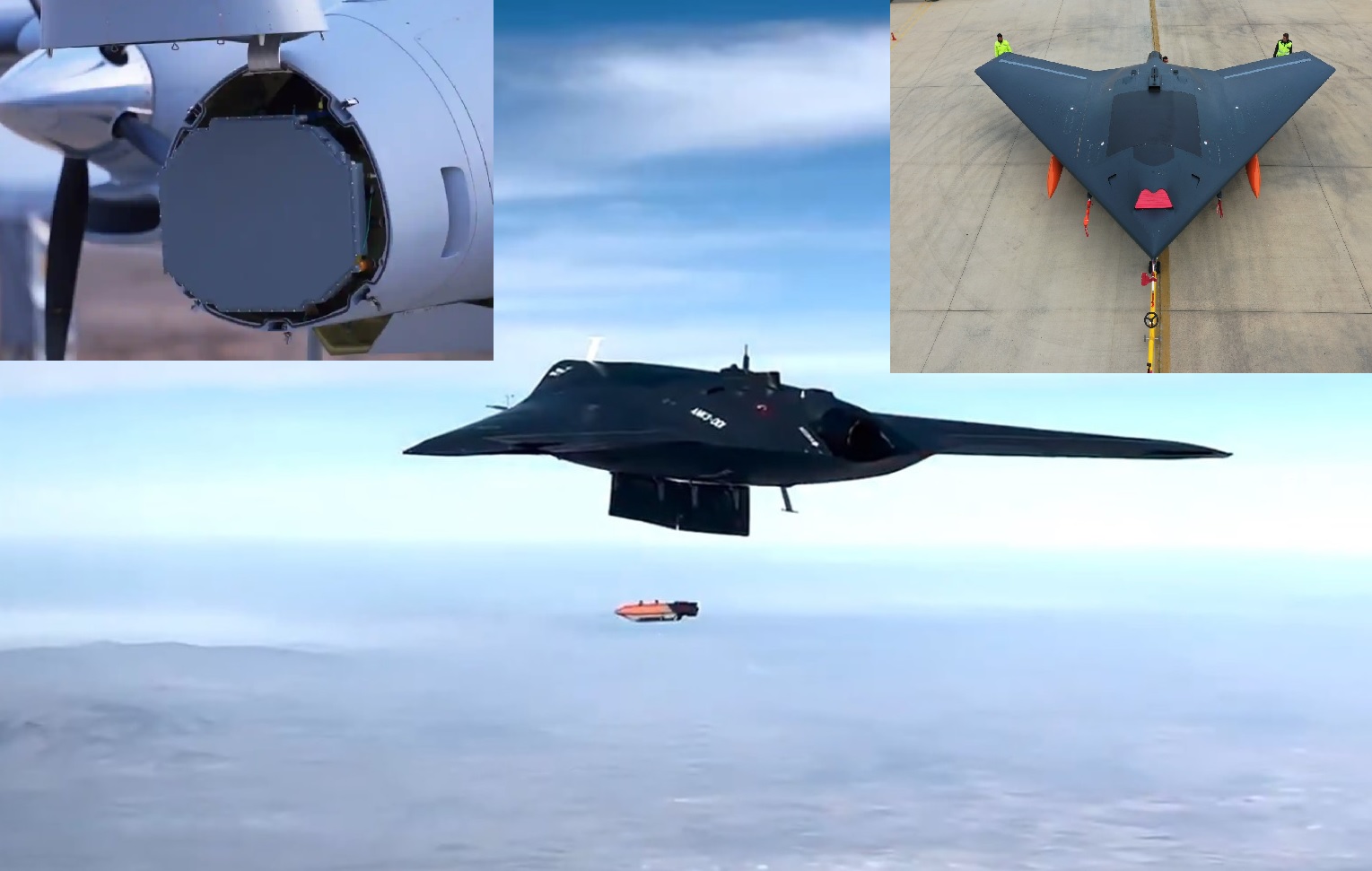
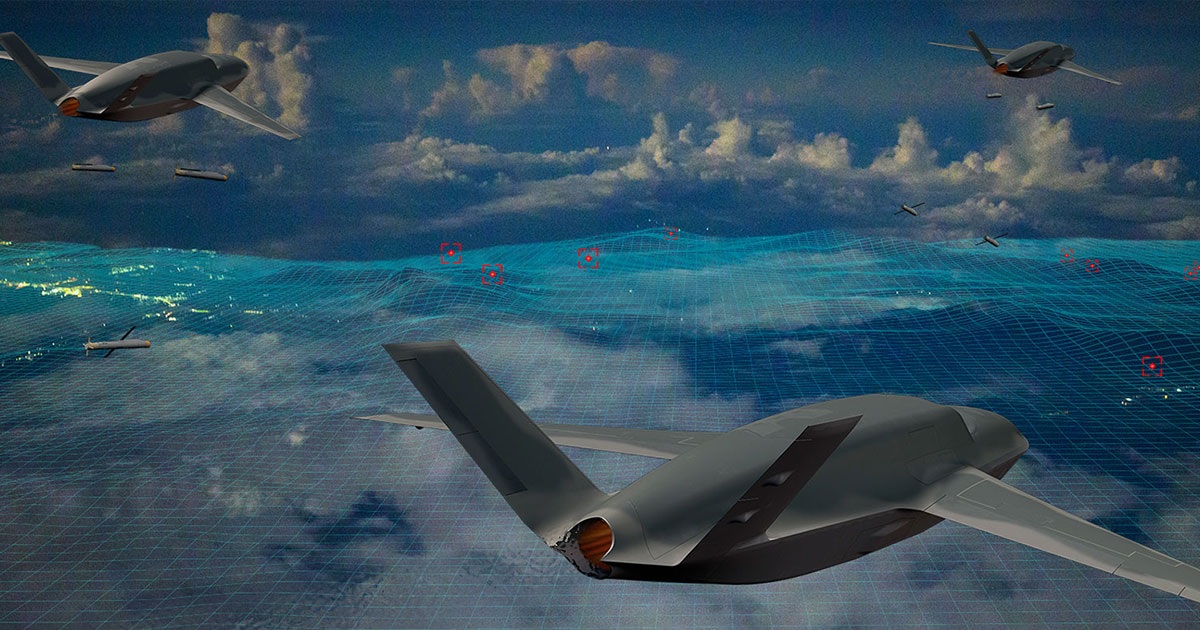
Ankara : Turkey is preparing a significant leap in unmanned air combat capability as work advances to integrate ASELSAN’s MURAD active electronically scanned array (AESA) radar onto ANKA III, the country’s jet-powered stealth unmanned combat aerial vehicle (UCAV). The move underlines Ankara’s intent to push its low-observable drone fleet beyond precision strike and electronic-warfare missions and into contested airspace dominance, including air-to-air engagement roles.
Linking a National AESA Radar With a Low-Observable Flying Wing
MURAD’s integration represents a critical convergence of high-performance national sensor technology with a low-observable flying-wing airframe designed for deep-penetration missions. The MURAD family has already accumulated flight hours on upgraded F-16 Özgür, Bayraktar AKINCI, and Kızılelma platforms, giving Turkish engineers a mature baseline for adapting the radar to ANKA III’s unique stealth geometry.
From a technical standpoint, installing a sizeable AESA antenna into ANKA III’s slender nose section is expected to require refinements in internal volume management. Options include a conventional planar nose array or more advanced distributed and conformal arrays embedded along leading edges—an approach enabled by AESA modularity and particularly attractive for missions demanding wide-angle synthetic aperture radar (SAR) mapping, air-to-air search, and electronic-warfare coverage without compromising radar cross-section.
What MURAD Brings to a Stealth UCAV
ASELSAN’s MURAD radar family is designed as a multirole, software-defined AESA, optimized for both manned and unmanned combat aircraft. Publicly disclosed capabilities indicate that MURAD supports air-to-air search and track, BVR missile cueing, high-resolution SAR and inverse SAR imaging, ground moving-target indication (GMTI), and robust electronic counter-countermeasures (ECCM). Its solid-state transmit/receive modules, rapid beam steering and low probability of intercept (LPI) waveforms make it well suited for stealth platforms operating inside defended airspace.
For unmanned aircraft in particular, MURAD is designed to integrate seamlessly with electro-optical/infrared (EO/IR) sensors, infrared search-and-track (IRST), mission computers and datalinks, enabling sensor fusion and cooperative engagement with other air and ground assets. This architecture allows a UCAV like ANKA III not only to detect and track targets autonomously, but also to share targeting data across a manned-unmanned team.
Kızılelma Sets the Operational Benchmark
The clearest indicator of what MURAD can deliver on an unmanned combat platform comes from Kızılelma’s 2025 test campaign. During autumn trials, the unmanned fighter flew with MURAD integrated alongside the TOYGUN electro-optical targeting system, validating sensor fusion and radar cueing in flight. This was followed by a simulated engagement in which Kızılelma successfully executed an F-16 kill scenario using the Gökdoğan beyond-visual-range air-to-air missile guided by MURAD.
The programme culminated on 30 November 2025, when Kızılelma detected, tracked and destroyed a high-speed aerial target over the Black Sea with a live-fired Gökdoğan missile. Widely described as the first recorded BVR air-to-air kill by a jet-powered UAV, the event demonstrated that the MURAD radar family can support full air-combat kill chains on fast, manoeuvring unmanned platforms—capabilities now being extended to ANKA III.
ANKA III: From Stealth Strike to Air-Combat Support
As radar integration progresses, the broader performance envelope of ANKA III is coming into sharper focus. The jet-powered UCAV is designed with a payload capacity of approximately 1,200 to 1,600 kilograms, enabling it to internally carry a combination of sensors, precision-guided munitions and electronic-warfare payloads while preserving low observability.
Dimensionally, ANKA III measures 7.9 to 8.9 metres in length, with a wingspan of 12.5 to 13.1 metres and a compact height of around 2.5 to 2.6 metres, reflecting an emphasis on stealth shaping and internal volume efficiency. Its maximum take-off weight, estimated between 6,500 and 7,250 kilograms, places it firmly in the medium-weight UCAV category, capable of missions traditionally associated with light strike aircraft.
Propulsion is provided by a single Ivchenko-Progress AI-322 turbofan engine, supporting a maximum speed of about 787 km/h (Mach 0.7) and a cruise speed near 460 km/h (Mach 0.42). This performance enables rapid ingress and egress for penetration missions while maintaining endurance for prolonged operations.
Operationally, ANKA III offers a combat radius of up to 1,075 kilometres, with 750 kilometres considered more typical when optimized for either air-to-air or air-to-ground roles. Endurance of up to 10 hours provides substantial loiter time for ISR, strike coordination and electronic-warfare tasks, while a service ceiling of 12,000 metres (40,000 feet) places the aircraft above many short-range air-defence threats.
Internal Carriage and Emerging Air-to-Air Roles
A defining feature of ANKA III is its two internal weapons bays, a design choice essential for maintaining a reduced radar cross-section in high-threat environments. These bays are sized to accommodate INS/GPS-guided precision weapons, imaging-infrared and laser-guided munitions, and increasingly, radar- or infrared-guided air-to-air missiles.
When paired with MURAD AESA radar and an infrared search-and-track sensor, this internal carriage enables ANKA III to perform self-escorted strike missions, provide air-combat support, and contribute directly to aerial engagements without relying on external stores that would compromise stealth.
A Cornerstone of Türkiye’s 2026 Manned-Unmanned Vision
Together, the integration of ASELSAN’s MURAD AESA radar and the evolving capabilities of ANKA III signal that the platform is no longer an experimental stealth demonstrator. Instead, it is emerging as a combat-credible UCAV capable of exploiting advanced sensors for strike, electronic warfare and air-to-air missions.
As Türkiye continues to mature its manned-unmanned teaming doctrine into 2026, ANKA III’s blend of stealth, endurance, internal payload capacity and indigenous sensor integration positions it as a cornerstone of the country’s future air-combat architecture, extending unmanned operations from permissive environments into the most contested airspaces.
About the Author
Aditya Kumar:
Defense & Geopolitics Analyst
Aditya Kumar tracks military developments in South Asia, specializing in Indian missile technology and naval strategy.