Trump’s ‘Golden Dome’ Space Shield Risks Breaking 1967 Outer Space Treaty — And Reviving Nuclear War in Space
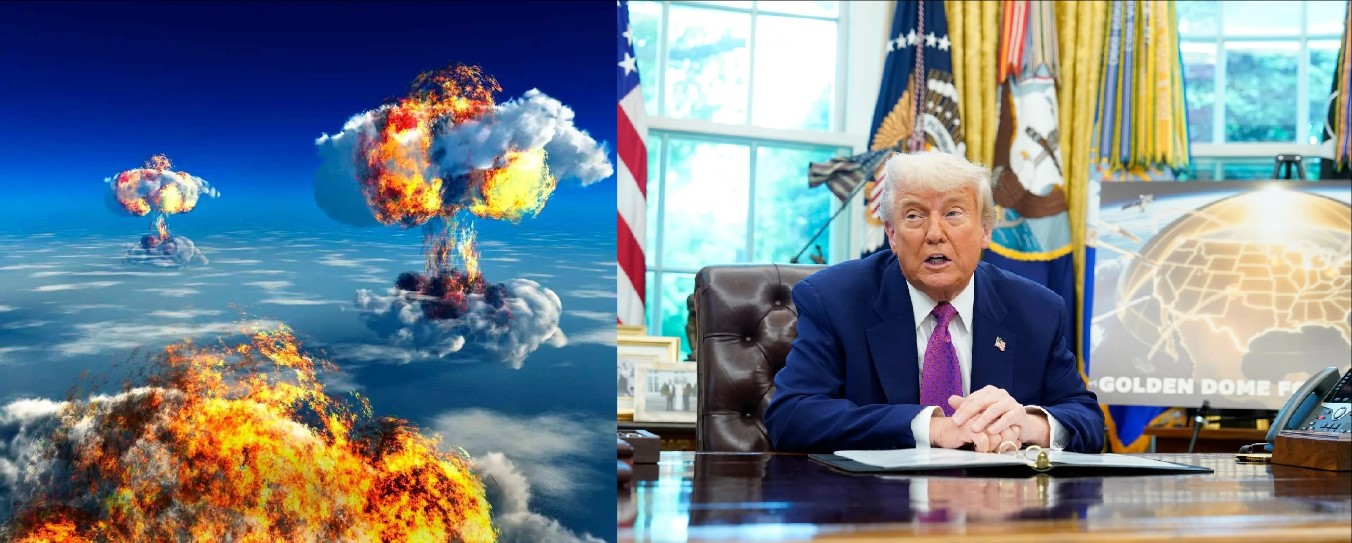
In recent months, a controversial plan proposed by former U.S. President Donald Trump has stirred serious tensions around the world. Called the Golden Dome, this ambitious missile defense system aims to place advanced sensors and interceptors in space by 2029, creating a shield against nuclear missiles.
But this bold move has alarmed many countries — not just rivals like Russia, China, and North Korea, but also experts and diplomats around the world. Critics warn that this project could turn outer space into a nuclear battlefield, violating international agreements that have kept space free of weapons of mass destruction for decades.
Why Is Everyone Worried About the Golden Dome?
China, Russia, and now North Korea have publicly condemned the Golden Dome plan. They argue that this would dangerously increase the risk of a space arms race — a competition among nations to control space using powerful weapons, including nuclear devices.
China’s Foreign Ministry even called it a move that could "shake the international security system" and push nations to develop new weapons to counterbalance America’s advantage in space. Russia, meanwhile, accused the U.S. of rejecting the principle that offensive and defensive weapons are inseparably connected — meaning, a powerful defense system can provoke others to build more powerful weapons to overcome it.
But is the fear of a nuclear war in space realistic? To answer that, we need to look back at history.
When the World Already Exploded Nukes in Space
Though it sounds like a science fiction nightmare, nuclear weapons have already been detonated in space — not during war, but as part of experiments. Between 1958 and 1962, both the U.S. and Soviet Union conducted several nuclear explosions above Earth’s atmosphere to study their effects.
One of the most famous was Operation Starfish Prime in July 1962. The U.S. detonated a nuclear bomb 250 miles above the Pacific Ocean, roughly the altitude of today’s satellites.
The results were shocking:
-
A surge of electrical energy knocked out about 300 streetlights in Hawaii.
-
Auroras lit up the night sky in strange colors.
-
About a third of the satellites in orbit at that time were damaged or destroyed.
-
High-energy particles remained trapped in Earth’s magnetic field for years, harming satellites and electronics.
These experiments revealed that a nuclear blast in space would be different from one on Earth. There’s no air to carry a shockwave or fireball. Instead, the explosion would release massive amounts of electromagnetic radiation, X-rays, and gamma rays. It would instantly disable any satellite nearby and create a radiation belt that could damage other satellites for years.
That’s why, in 1967, the U.S. and Soviet Union led the creation of the Outer Space Treaty, banning the placement of nuclear weapons in orbit or on celestial bodies like the Moon.
Why This Treaty Is Being Tested Today
The Outer Space Treaty has largely held for over half a century. But in recent years, major powers have been quietly testing the limits of space warfare:
-
The U.S. withdrew from key arms control treaties like the INF Treaty in 2019 and the Open Skies Treaty in 2020.
-
In 2023, Russia suspended the New START Treaty, the last major nuclear agreement between Washington and Moscow.
-
Both Russia and China have developed anti-satellite weapons, including missiles and orbiting satellites capable of disabling or destroying other spacecraft.
-
In 2022, Russia launched the Cosmos 2553 satellite, suspected of being a test platform for a nuclear warhead in orbit.
-
In 2024, the U.S. accused Russia of developing a nuclear-tipped missile capable of attacking satellites.
-
Meanwhile, China is advancing its Fractional Orbital Bombardment System (FOBS), an orbiting missile system potentially capable of carrying nuclear warheads.
Now, with Trump’s Golden Dome project aiming to deploy U.S. weapons and defenses in space, other countries fear it could force them to respond in kind — igniting a dangerous new phase of the space arms race.
What Would Happen If a Nuke Explodes in Space Today?
If a nuclear bomb were detonated in space today, the consequences could be even more devastating than in 1962. Back then, only about two dozen satellites were in orbit. Now, there are more than 10,000 active satellites, essential for everything from GPS navigation, weather forecasting, banking transactions, internet services, and global communications.
A space-based nuclear explosion would:
-
Instantly destroy or disable any satellites within its line of sight.
-
Create radiation belts that could damage other satellites for years.
-
Knock out essential services like GPS, communication networks, and weather systems.
-
Potentially trigger misunderstandings or retaliatory strikes on Earth, escalating into a global crisis.
Are Only the U.S. Making Nuclear Moves in Space?
While much of the spotlight is on the Golden Dome, it’s not just the U.S. pushing military programs in space. Russia and China have been aggressively developing space-based and anti-satellite weapons.
-
Russia’s Oreshnik intermediate-range hypersonic missile, launched at Ukraine last year, was capable of carrying a nuclear warhead.
-
China’s suspected FOBS missile tests suggest Beijing is also preparing for space-based nuclear delivery systems.
These developments show that space is no longer a neutral territory — and the line between conventional and nuclear weapons in orbit is becoming dangerously thin.
A Shared Responsibility for a New Space Race
The growing space arms race is not the result of one country’s actions alone. Over the last decade, Russia, China, the U.S., and even North Korea have contributed to this risky situation.
The Golden Dome plan, while bold and potentially transformative for U.S. missile defense, threatens to shatter the hard-won global consensus against weaponizing space. If one country takes the first step to militarize orbit with nuclear-capable systems, others will likely follow.
Without urgent new agreements and international cooperation, the risk of a nuclear detonation in space — accidental or deliberate — is now higher than it has been since the Cold War.
✍️ This article is written by the team of The Defense News.