Trump Threatens 200% Tariff on French Wine After Macron Rejects ‘Board of Peace
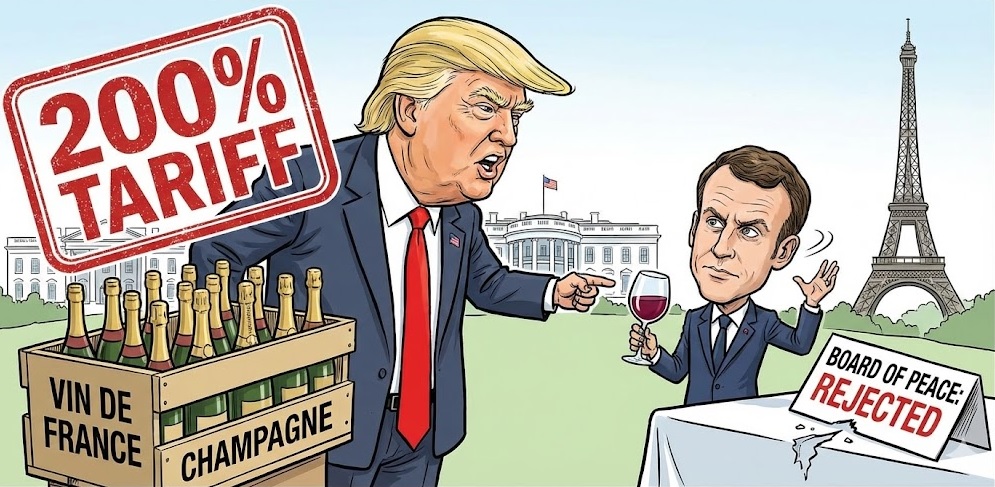
WASHINGTON / PARIS : Transatlantic relations slid into open confrontation this week after U.S. President Donald Trump threatened to impose a sweeping 200 percent tariff on French wine and champagne, directly linking the punitive measure to France’s refusal to join his newly unveiled international body, the so-called “Board of Peace.”
The threat, delivered during a volatile White House press briefing on Monday, marked one of the sharpest escalations in U.S.–European tensions since Trump returned to office, intertwining trade coercion, personal diplomacy, and an ambitious — and controversial — attempt to reshape the global security order.
A Diplomatic Ultimatum to Paris
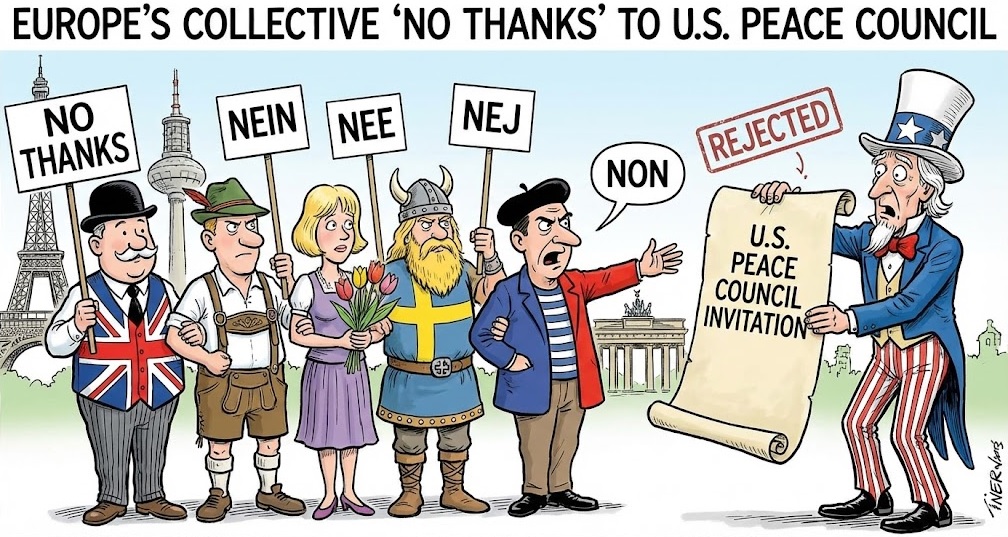
The standoff centers on French President Emmanuel Macron, who has formally declined Washington’s invitation to participate in the Board of Peace, an initiative Trump is promoting as an alternative mechanism for resolving global conflicts.
Trump reacted with unusually blunt rhetoric, dismissing Macron’s decision and questioning his political relevance ahead of France’s 2027 presidential transition. He warned that refusal would carry economic consequences, explicitly threatening to raise tariffs on French wine and champagne to levels that would effectively shut them out of the U.S. market.
“France can make its own choice,” Trump said, before adding that a 200 percent tariff would “change the conversation very quickly.” He later published what he described as a private text exchange with Macron on his Truth Social platform, further personalizing the dispute. In the message, Macron reportedly invited Trump to a dinner in Paris while expressing concern over Washington’s recent unilateral foreign-policy moves, including renewed U.S. interest in acquiring Greenland.
French officials moved swiftly to condemn the tariff threat. A senior source close to the Élysée Palace described it as an “unacceptable and ineffective attempt” to pressure French sovereignty, warning that Paris would respond through European Union trade mechanisms if the measures were enacted.
Putin Welcomed as France Steps Away
While publicly chastising France, Trump simultaneously confirmed that Russian President Vladimir Putin has been formally invited to join the Board of Peace. The confirmation underscored growing European unease that the initiative could realign U.S. diplomacy away from long-standing Western alliances.
“He’s been invited,” Trump said, declining to elaborate on whether Moscow had accepted. The prospective inclusion of Russia — alongside leaders such as Hungarian Prime Minister Viktor Orbán — has fueled concerns in Paris, Berlin, and Brussels that the body is designed around transactional politics rather than multilateral consensus.
European diplomats privately warned that inviting Russia while pressuring a NATO ally risks legitimizing Moscow at a time when many Western governments remain committed to isolating the Kremlin diplomatically.
What Is the “Board of Peace”?
Formally announced on January 15, 2026, the Board of Peace is a U.S.-led intergovernmental organization chaired by President Trump himself. The initiative was first floated in late 2025 as part of a post-conflict framework for the governance and reconstruction of Gaza following the October 2025 ceasefire between Israel and Hamas.
Since then, the concept has expanded dramatically. According to U.S. officials, the Board now aims to function as a permanent global forum for conflict resolution, crisis management, and post-war rehabilitation — a role traditionally associated with the United Nations and its Security Council.
Leaked draft documents have intensified criticism. They describe a tiered membership system in which standard participation lasts three years, while countries seeking permanent status must make a financial contribution reportedly starting at $1 billion. The chairman — Trump — would retain veto authority over all decisions, granting the White House decisive control over outcomes.
The Board’s executive committee is expected to include several prominent Trump allies, including Secretary of State Marco Rubio, senior advisor Jared Kushner, and former British prime minister Tony Blair, according to officials familiar with the planning.
Economic Stakes for France
The threatened tariffs carry profound economic implications. The United States is France’s largest export market for wine and spirits, with French producers recording more than $4 billion in U.S. sales last year. The sector is already absorbing the impact of a 15 percent tariff imposed in 2025 as part of earlier trade disputes.
Industry analysts warn that a jump to 200 percent would be catastrophic, effectively pricing iconic products such as Champagne and Bordeaux out of American retail and restaurant markets. French winegrowers’ associations cautioned that thousands of jobs across rural regions could be at risk if the threat materializes.
U.S. importers and distributors have also voiced concern, noting that such tariffs would disrupt supply chains, raise consumer prices, and invite retaliatory measures from the European Union.
Davos Overshadowed by Washington–Paris Rift
The confrontation comes as political and business leaders converge in Davos for the World Economic Forum, where the Board of Peace had been expected to hold its inaugural high-profile meetings. Instead, the gathering has been overshadowed by the deepening rift between Washington and Paris.
As of Monday, January 19, 2026, French officials confirmed unequivocally that Macron does not intend to join Trump’s initiative, regardless of economic pressure. “France will not allow its foreign policy to be dictated by threats,” one official said.
With tariff deadlines looming and diplomatic channels strained, the dispute now threatens to evolve from a war of words into a broader transatlantic crisis — one that could reshape trade, alliances, and the architecture of global governance in the months ahead.
About the Author
Aditya Kumar:
Defense & Geopolitics Analyst
Aditya Kumar tracks military developments in South Asia, specializing in Indian missile technology and naval strategy.