Trump Stuns Washington With $18 Trillion Investment in 10 Months Claim, Analysts Demand Clarity
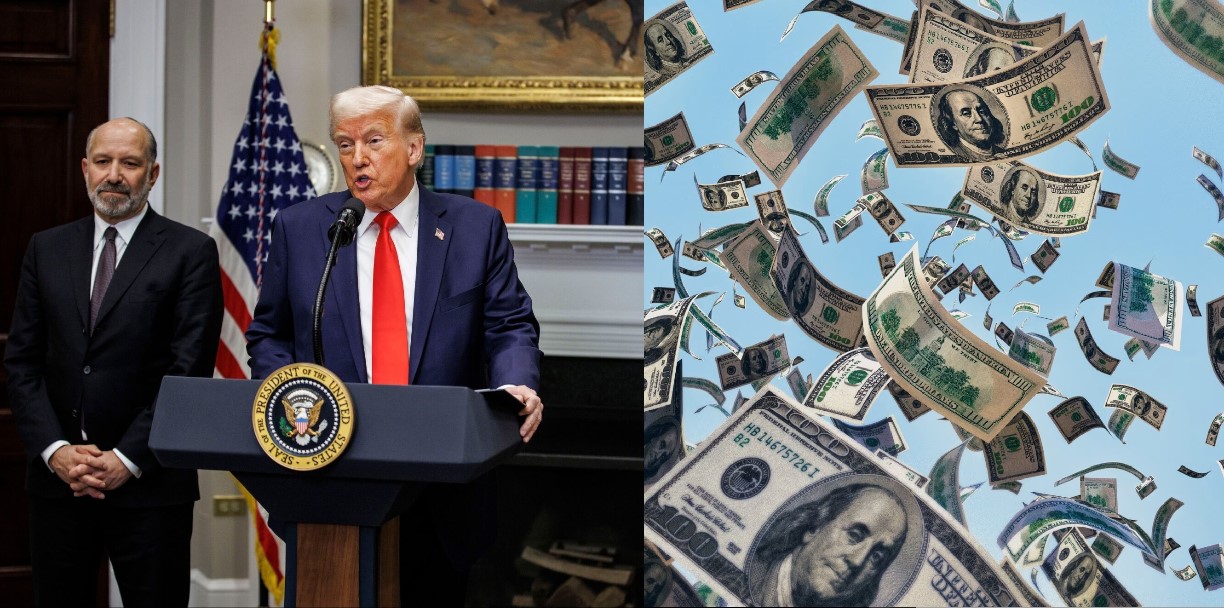
President Donald Trump is claiming that his new administration has unlocked an investment boom “never seen in history,” declaring that more than $18 trillion in investment commitments have been secured in just 10 months – compared with “just $1 trillion” over President Joe Biden’s four years.
The dramatic comparison, repeated in a now-viral video and in a Cabinet meeting in Washington, has electrified Trump supporters and alarmed economists, who say the headline numbers mix very different kinds of promises and are not directly comparable.
Where Trump’s $18 trillion number comes from
Trump made the $18 trillion claim during an extended Cabinet session, describing what he called the “strongest economic turnaround in U.S. history.” He told his team that, in 10 months, the administration had “secured commitments of over $18 trillion” and argued that no country had ever attracted such investment before.
Behind that figure is a mix of:
-
Corporate investment announcements in the U.S. – especially in AI, data centers, chips, manufacturing and energy – listed on a new “US & Foreign Investments” page on the Trump White House website. The page showcases hundreds of billions of dollars in planned spending by companies such as Apple, Nvidia, Meta, TSMC, Micron, Google, Amazon, Eli Lilly, Ford, Hyundai, Nippon Steel and many others.
-
Foreign-government pledges to invest in or buy from the U.S. The same White House list includes very large headline commitments such as:
-
Qatar – $1.2 trillion
-
United Arab Emirates – $1.4 trillion
-
Japan – $1 trillion
-
Saudi Arabia – $600 billion
-
India – $500 billion
-
Bahrain – $17 billion
-
An additional $600 billion associated with EU firms under a trade deal.
-
-
A separate $1 trillion Saudi pledge for AI-related investments with U.S. companies, highlighted during Saudi Crown Prince Mohammed bin Salman’s recent visit to Washington, where Trump framed AI and data centers as the core of his economic strategy.
If you add together corporate factory and data-center plans, energy projects and these sovereign pledges, you can approach the kind of multitrillion-dollar totals Trump is now citing – at least on paper. But many of these are long-term, conditional or not yet financed, and some overlap with investments first developed under Biden-era industrial policies.
Fact-check: What independent analysts say about Trump’s investment totals
Trump’s newest $18 trillion boast didn’t appear out of nowhere. For months he has steadily escalated the figure:
-
Earlier this year he talked about $10 trillion in investments; a detailed fact-check of that claim found that the White House’s own public lists added up to about $5.1 trillion in “promised” investments, of which only around $2.1–4.3 trillion could be reasonably treated as genuinely new – and even those were not guaranteed to materialise.
-
By October, he was citing $17 trillion in new investments, a claim the Associated Press described as relying on announcements, foreign pledges, budget items and some double counting, concluding that the actual number of new, confirmed projects was “likely much less.”
-
FactCheck.org has documented how Trump’s claimed totals have grown from $3 trillion to over $10 trillion over just a few months, even though the underlying published investment lists did not support those rapidly rising numbers.
More recently, a Reuters review of the Trump White House “Trump Effect” investment website found that nearly half of the $2.6 trillion in projects listed at the time either began under Biden, pre-dated Trump’s return to office, or were routine corporate capital spending that would likely have happened anyway.
Taken together, the independent assessments suggest:
-
Many projects Trump counts as “his” were already in motion under Biden or earlier.
-
Not all “commitments” are firm investments: some are memorandums of understanding, tentative pledges or marketing numbers that could be scaled back.
-
The real, new capital actually being spent in the U.S. is significantly lower than the advertised $17–18 trillion.
Economists also point out that $18 trillion is close to three-quarters of total annual U.S. GDP – making it implausible that such an amount of fresh, additional investment has truly been locked in over a few months.
How Biden’s “$1 trillion” figure was calculated
Trump contrasts his $18 trillion claim with “just $1 trillion” under Biden. That comparison is technically anchored in a real Biden-era figure – but it is narrower and more carefully defined than Trump suggests.
In late 2024, the Biden White House announced that its “Investing in America” agenda – the Bipartisan Infrastructure Law, CHIPS and Science Act and Inflation Reduction Act – had catalyzed more than $1 trillion in private-sector investment announcements in the United States.
That $1 trillion number:
-
Covers specific sectors: semiconductors and electronics, clean energy, EVs and batteries, biomanufacturing, heavy industry and clean power.
-
Comes from announced factory and project plans tracked on the public invest.gov database, not from global financial flows or foreign sovereign commitments.
-
Is meant to show how Biden-era laws nudged private companies to build plants in the U.S., not to measure every dollar of investment in the wider economy.
In other words, Biden’s $1 trillion refers to a narrow slice of domestic industrial investment, while Trump’s $18 trillion appears to mix global sovereign wealth pledges, long-term LNG purchase agreements, AI-infrastructure deals, data-center clusters, pharmaceutical expansions and more over an undefined time frame.
Analysts therefore describe Trump’s comparison as “apples to oranges”: he is stacking a broad set of global, multi-year promises against a more conservative, sector-focused tally compiled by the previous administration.
What kinds of investments are actually being discussed?
The investments being discussed cover several major sectors of the U.S. economy. In advanced manufacturing and semiconductor production, companies such as TSMC, Micron, GlobalFoundries and Intel have announced massive factory and packaging projects across states including Arizona and New York. Many of these initiatives first emerged in response to Biden’s CHIPS Act subsidies, yet the Trump administration now points to later expansions, additional phases and renegotiated agreements as part of its investment totals.
In the field of artificial intelligence and data infrastructure, companies like Nvidia, Google, Meta and Amazon are pursuing multi-billion-dollar plans to build AI super-computing hubs and large-scale data centers. These facilities require extraordinary amounts of power, which is why many of them are tied to long-term electricity supply arrangements and natural-gas contracts.
Energy and LNG commitments add another layer to the numbers. Major U.S. LNG export projects and grid-modernization efforts are supported by long-term agreements from foreign buyers such as Japan’s JERA and major South Korean energy firms, whose purchase contracts help finance these large developments.
There is also a significant category of foreign sovereign investment deals. Countries including Saudi Arabia, Qatar, the United Arab Emirates, Japan and India have announced large, long-term pledges—sometimes in the hundreds of billions or even over a trillion dollars—to invest in U.S. industries ranging from AI and energy to manufacturing and technology partnerships. These commitments are often connected to each nation’s own economic-transformation strategies.
All of these investment areas involve genuinely large sums of planned spending. The real debate is not about whether the investments exist but about how they are counted, over what time period they apply, and which administration deserves credit for the commitments.
The political stakes
Trump’s message is clear: he wants voters to believe that massive investment commitments, lower inflation and tax cuts are proof that his second term is delivering an economic turnaround that “shocks the experts.”
But independent fact-checkers and financial analysts are just as clear:
-
The $18 trillion headline is not a verified, universally accepted economic statistic.
-
It bundles together many different types of promises, some of which may never fully materialise, and some of which were seeded by Biden-era legislation or pre-existing corporate plans.
For now, Trump’s dramatic line – “Four years, a trillion. Ten months, more than eighteen trillion” – functions more as campaign messaging than as a precise accounting of U.S. investment flows.
✍️ This article is written by the team of The Defense News.