Trump Sparks U.S.–Canada Rift at Davos, Says ‘Canada Lives Because of the United States
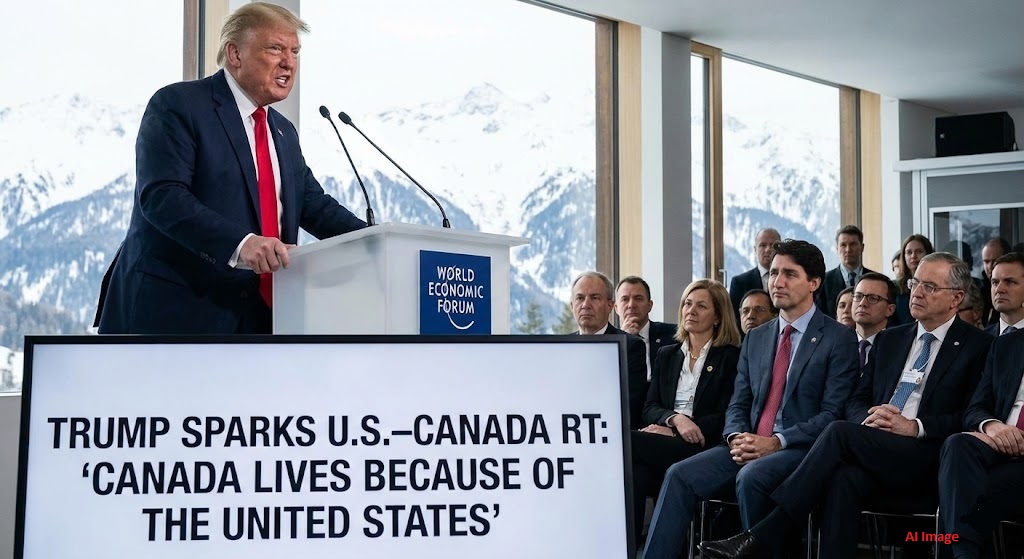
DAVOS, Switzerland : Diplomatic relations between the United States and Canada came under rare public strain this week after U.S. President Donald Trump delivered a sharp rebuke of Canadian leadership during a high-profile appearance at the World Economic Forum, declaring that “Canada lives because of the United States” and accusing Ottawa of benefiting from American security guarantees without sufficient gratitude.
The remarks, delivered Wednesday on the sidelines of the annual gathering of global political and business leaders in Davos, were widely interpreted as a direct response to comments made a day earlier by Canadian Prime Minister Mark Carney, whose speech criticized the erosion of the post–Cold War international order and warned against the weaponization of economic interdependence.
The exchange marked one of the most confrontational moments in U.S.–Canada relations in years, playing out on an international stage more commonly associated with consensus-building than open diplomatic sparring.
Trump’s Davos Broadside
Speaking before an audience of executives, diplomats, and heads of state at the World Economic Forum, President Trump framed Canada as a beneficiary of American military power, singling out a proposed U.S. missile defense initiative he calls the “Golden Dome.”
“The Golden Dome is going to be defending Canada,” Trump said, arguing that the country would receive protection from advanced American missile defenses simply by virtue of geography. “Canada gets a lot of freebies from us. They should be grateful — but they’re not.”
Trump went further, adopting an unusually personal tone toward the Canadian leader. Referring to Carney by his first name, the president told the audience he had watched the prime minister’s Davos address the previous day and found it lacking in appreciation for U.S. support. “Canada lives because of the United States,” Trump said. “Remember that, Mark, next time you make your statements.”
The “Golden Dome” and Security Tensions
Central to Trump’s comments is the administration’s push for the “Golden Dome,” a proposed, multi-layered missile defense system intended to counter emerging threats from hypersonic glide vehicles, intercontinental ballistic missiles, and advanced cruise missiles. While still largely conceptual, the system is envisioned as an evolution of existing U.S. missile defense architecture, with expanded coverage over North America.
U.S. officials argue that such a shield would, by necessity, extend protection beyond American borders, including over Canadian territory. Trump has repeatedly framed this as evidence that allies benefit from U.S. defense spending without proportional contributions — a theme consistent with his long-standing criticism of allies in NATO and other security partnerships.
Canadian officials, however, have historically emphasized that continental defense is not a one-sided arrangement, but a shared strategic enterprise.
What Sparked the Clash
Prime Minister Carney’s Davos speech on Tuesday did not mention Trump by name, but it carried pointed critiques of major powers that use trade, technology, and financial systems as instruments of coercion. He warned that the “rules-based international order” had suffered a “rupture,” language that many delegates interpreted as a rebuke of rising protectionism and unilateralism.
Carney also addressed Arctic security and sovereignty, underscoring Canada’s alignment with Denmark and Greenland amid renewed U.S. strategic interest in the region. That stance appeared to clash directly with messages coming from the American delegation.
By Wednesday, the president’s response left little doubt that he viewed the Canadian leader’s remarks as a challenge to U.S. policy — and to his own leadership.
A Closer Look at the U.S.–Canada Defense Relationship
Trump’s assertion that Canada “lives because of the United States” touches on a long-running debate over dependency versus partnership in North American security.
From Washington’s perspective, the United States provides the overwhelming share of military power on the continent, including the nuclear deterrent that underpinned Western defense throughout the Cold War. American strategists have long assumed that any major attack on Canada would automatically trigger U.S. intervention, given the integrated nature of continental defense.
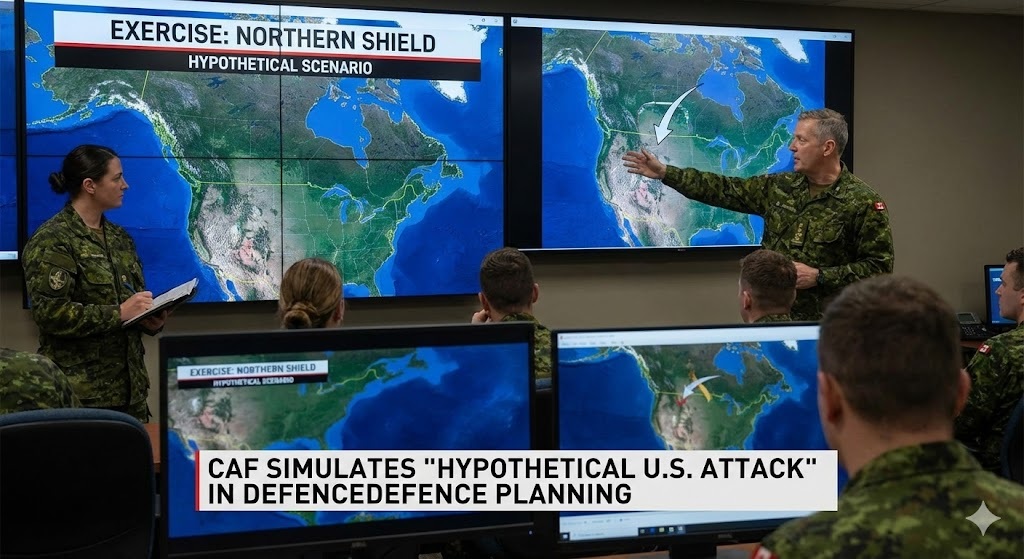
From Ottawa’s perspective, however, security has never been a one-way street. Since 1958, the two countries have jointly operated the North American Aerospace Defense Command, a bi-national command responsible for monitoring and defending North American airspace. Canada’s geography provides critical early-warning radar coverage and airspace depth, assets that U.S. defense planners consider indispensable.
Historical precedents also underscore reciprocity. During the September 11, 2001 attacks, Canada launched Operation Yellow Ribbon, diverting hundreds of U.S.-bound aircraft to Canadian airports to clear American skies. Earlier still, the 1940 Ogdensburg Agreement laid the foundation for modern continental defense cooperation, not as an act of charity, but as a shared response to global war.
The Arctic and the Greenland Factor
Adding another layer of complexity is the renewed strategic focus on the Arctic. U.S. officials in Davos, including Treasury Secretary Scott Bessent, described Greenland as “essential” to any future missile defense architecture, citing its location along potential missile trajectories from Eurasia to North America.
Carney explicitly voiced support for Denmark and Greenland’s right to self-determination, a position that contrasts sharply with Trump’s rhetoric about U.S. strategic requirements in the Arctic. That divergence, diplomats say, likely sharpened tensions ahead of the president’s remarks.
Diplomatic Fallout and What Comes Next
Despite the heated language, officials on both sides were quick to stress that institutional ties between Washington and Ottawa remain strong. Privately, diplomats described the exchange as an extension of Trump’s negotiating style rather than a signal of imminent policy rupture.
Still, the unusually blunt rhetoric at Davos underscored how shifts in global security, missile defense, and Arctic geopolitics are testing even the closest of alliances. As debates over burden-sharing, sovereignty, and strategic autonomy intensify, the public clash between the United States and Canada served as a reminder that no partnership — however longstanding — is immune to political friction.
About the Author
Aditya Kumar:
Defense & Geopolitics Analyst
Aditya Kumar tracks military developments in South Asia, specializing in Indian missile technology and naval strategy.