Trump Rules Out Military Force on Greenland, Turns to Tariffs on Europe
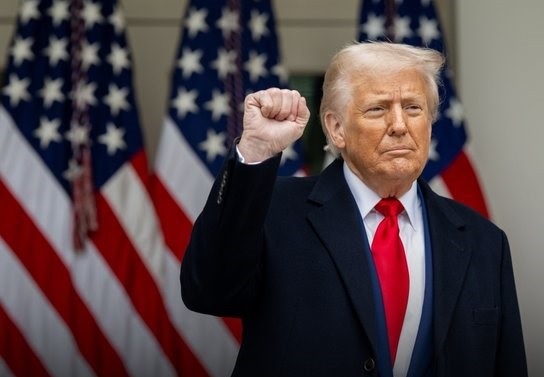
WASHINGTON / BRUSSELS : President Donald Trump said he will not use military force to pursue U.S. ambitions over Greenland, even as his administration escalates economic pressure on Europe through a sweeping new tariff regime explicitly tied to the Arctic island.
“I don’t have to use force, I won’t use force,” Trump said, addressing questions about Greenland during remarks that came alongside the announcement of a new round of tariffs on key European economies. The statement sought to temper international concern after Trump confirmed that acquiring Greenland remains his top strategic priority, framing the effort as a matter of negotiation and leverage rather than coercion.
Tariffs as Leverage in a High-Stakes Negotiation
Under the plan outlined by the White House, the United States will impose a 10 percent tariff beginning February 1 on imports from Denmark, Norway, Sweden, France, Germany, the United Kingdom, the Netherlands, and Finland—countries Trump described as central to Europe’s political and economic alignment with Denmark. The tariffs are scheduled to rise sharply to 25 percent on June 1 and, according to the president, will not be lifted until a deal is reached on Greenland.
Trump has defined that deal in stark terms. Any agreement, he said, must constitute a “complete and total purchase of Greenland,” language that immediately drew criticism across Europe and reignited debate over sovereignty, international law, and the use of trade policy as a geopolitical weapon.
The European Commission has yet to announce retaliatory measures, but senior officials in Brussels signaled that the bloc views the tariffs as unjustified and politically motivated. Privately, diplomats acknowledged that the explicit linkage between trade penalties and territorial acquisition marks an unprecedented escalation in transatlantic relations.
The Tariff Playbook Returns
Market analysts say the strategy fits a familiar pattern. In a detailed analysis published by The Kobeissi Letter, researchers described the current episode as the latest iteration of what they call President Trump’s “exact tariff playbook,” a sequence of announcements, threats, and delays designed to maximize pressure while stopping short of lasting economic damage.
According to the report, Trump typically begins with a sudden, punitive threat—often announced late in the week or over a weekend—when markets are closed or illiquid. The uncertainty alone drives an initial selloff, even though the tariffs are not scheduled to take effect for several weeks. That lead time, analysts argue, is the true negotiating window.
A similar pattern played out in October, when Trump threatened a 100 percent tariff on China with just three weeks’ notice. Equity futures slid sharply, but the standoff ultimately ended with a new trade deal and concessions from Beijing on rare earth exports, allowing Trump to declare victory without the tariffs ever being fully implemented.
“This is not chaos,” the Kobeissi analysis argues. “It is by design.”
Markets Brace for Volatility
With the latest announcement coming over a holiday weekend, U.S. equity futures are expected to react only when trading resumes, potentially amplifying the emotional response. Strategists caution, however, that the impact may be less severe than past episodes, as investors have grown accustomed to Trump’s sequencing and increasingly look beyond the headline shock.
Still, the stakes this time are higher. Unlike prior disputes centered on trade balances or export controls, the Greenland issue touches on sovereignty and national identity, making compromise politically sensitive for Denmark and its European partners.
“Turbulence may be longer-lived,” the Kobeissi report notes, “because this is a bigger ask than previous trade war demands.”
The Bond Market as a Brake
One critical difference from earlier tariff cycles is the role of the U.S. bond market. During a previous flare-up in April 2025, a rapid rise in Treasury yields preceded a sudden 90-day tariff pause, which Trump later acknowledged was influenced by market stress. Analysts now believe the 10-year Treasury yield has become an informal red line for the White House.
If yields rise sharply above the mid-4 percent range, investors expect the administration to soften its stance or delay implementation, particularly with midterm elections approaching. Higher borrowing costs threaten economic growth and undermine the very market confidence Trump often cites as a measure of success.
A Strategy Built on Timing
At the core of Trump’s approach is timing. By announcing tariffs weeks before they are due to take effect, he creates sustained pressure while preserving room to claim a negotiated win. In past trade wars, deals were frequently unveiled on or just before the date tariffs were set to begin, allowing markets to rebound and reset the cycle.
Whether that formula can work again—this time over Greenland—remains uncertain. European leaders face domestic constraints that make concessions politically risky, and public opinion in Greenland itself has consistently opposed any transfer of sovereignty.
A Test for Markets and Diplomacy
For now, Trump’s declaration that he will not use military force has eased immediate fears of confrontation, but it has done little to calm economic and diplomatic tensions. Investors are bracing for renewed volatility, European officials are weighing their response, and global markets are once again being asked to price a negotiation conducted through shock and suspense.
As one senior European diplomat put it privately, “This is not just a trade dispute. It is a test of how far economic pressure can be pushed in pursuit of geopolitical ambition.”
Whether the episode ends in another last-minute deal—or marks a more prolonged rupture between Washington and its allies—may depend less on rhetoric than on markets, timing, and the limits of the tariff playbook itself.
About the Author
Aditya Kumar:
Defense & Geopolitics Analyst
Aditya Kumar tracks military developments in South Asia, specializing in Indian missile technology and naval strategy.