Trump Blasts UK Plan to Hand Chagos Islands to Mauritius, Warning of Threat to Diego Garcia Base
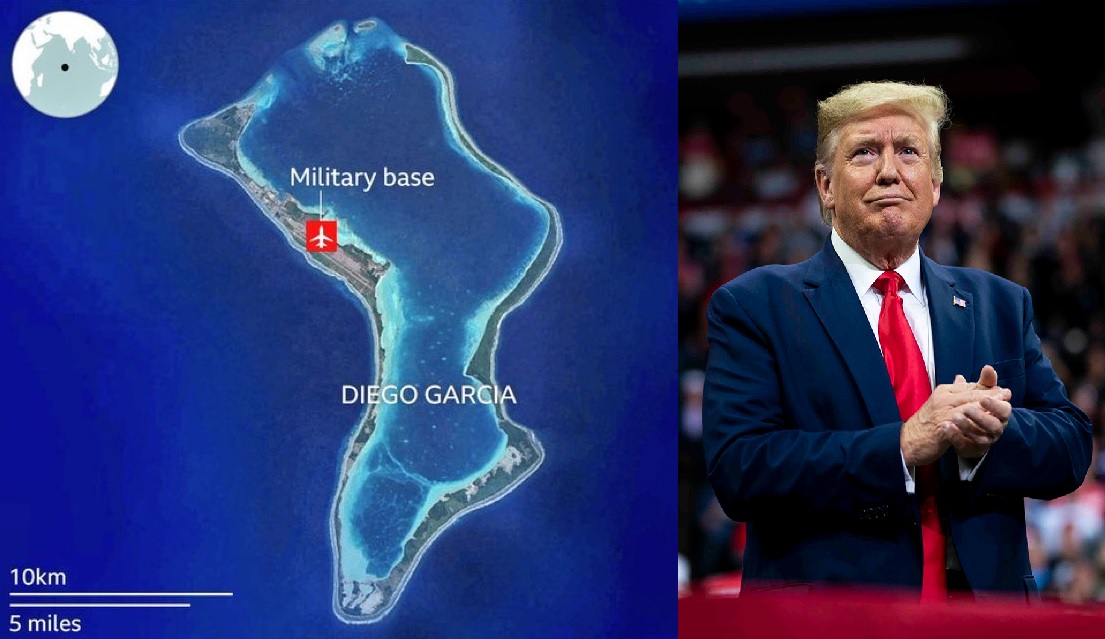
LONDON / WASHINGTON : A bitter transatlantic dispute has erupted over the future of one of the United States’ most strategically important overseas military installations, after Donald Trump launched a furious attack on the United Kingdom’s plan to transfer sovereignty of the Chagos Islands to Mauritius—a move that would formally end British rule over the territory hosting the critical Diego Garcia air and naval base.
The controversy centers on a treaty signed in May 2025 between London and Port Louis, designed to resolve decades of legal challenges over Britain’s colonial-era separation of the Chagos Islands from Mauritius. While the agreement preserves U.S. and UK military access through a long-term lease, Trump has branded the handover a reckless concession that endangers Western security and emboldens geopolitical rivals.
Trump Condemns Chagos Deal as Strategic “Weakness”
In a sharply worded statement published this week on Truth Social, Trump accused the British government of undermining U.S. military interests by relinquishing sovereignty over Diego Garcia, which he described as irreplaceable to American global power.
“Giving away extremely important land that hosts a vital U.S. military base is an act of great stupidity,” Trump wrote, arguing that adversaries such as China and Russia would interpret the decision as evidence of declining Western resolve.
Trump, who is again a dominant figure in U.S. Republican politics, explicitly linked the Chagos issue to his long-standing calls for the United States to acquire strategically located territory elsewhere, portraying direct sovereignty as the only reliable guarantee of long-term security.
Diego Garcia: Cornerstone of U.S. Power Projection
Often described by military planners as an “unsinkable aircraft carrier,” Diego Garcia occupies a unique position in the central Indian Ocean, far from population centers yet within operational reach of multiple global flashpoints.
From this remote atoll, the United States has conducted and supported operations across the Middle East, East Africa, and South Asia for decades.
The base hosts long-range strategic bombers, nuclear-capable submarines, and vast pre-positioned stockpiles of fuel, ammunition, and armored vehicles. During the wars in Afghanistan and Iraq, Diego Garcia served as a primary launch point for sustained air campaigns. Today, it remains central to counter-terrorism missions, maritime surveillance, and contingency planning involving Iran and the wider Indo-Pacific.
Beyond conventional military power, Diego Garcia also plays a quiet but critical role in global intelligence and space operations, supporting communications, satellite tracking, and navigation infrastructure used by the U.S. and its allies.
Legal Pressure and Britain’s Rationale
The British government insists the sovereignty transfer was not a voluntary retreat but a legal necessity. In 2019, the International Court of Justice issued an advisory opinion concluding that the UK’s continued administration of the Chagos Islands was unlawful and that decolonization had never been properly completed. Subsequent votes at the United Nations intensified diplomatic pressure on London to resolve the dispute.
Under the treaty negotiated by the government of Keir Starmer, sovereignty would formally pass to Mauritius, while the UK and U.S. retain exclusive control of Diego Garcia through a 99-year lease with options for extension. British officials argue that the arrangement transforms a legally vulnerable military presence into one backed by international law.
A UK government spokesperson said the agreement “secures the operation of the joint U.S.–UK base for generations,” adding that strict security clauses are designed to prevent any third-party military access or intelligence activity.
China Concerns and Regional Anxiety
Despite those assurances, critics on both sides of the Atlantic warn that Mauritius’s expanding economic relationship with China introduces long-term strategic risk. Beijing has invested heavily in infrastructure projects across the Indian Ocean region, fueling fears that political influence could eventually translate into security leverage.
While the treaty explicitly bars foreign military forces from Diego Garcia, skeptics argue that sovereignty still matters—and that future governments in Mauritius could face pressure to reinterpret or renegotiate terms decades down the line.
Political Fallout in London and Washington
The dispute has exposed rare public tension in the U.S.–UK “special relationship.” While the previous U.S. administration had signaled support for the deal as a pragmatic solution to a legal impasse, Trump’s intervention has emboldened British opponents of the transfer.
Senior figures within the Conservative Party and Reform UK have condemned the agreement as a strategic surrender, arguing that Britain is voluntarily discarding leverage over one of the West’s most valuable military assets. They warn the decision could weaken NATO credibility at a time of rising global instability.
A Base Secured—Or a Precedent Set?
For now, the Union Jack still flies over Diego Garcia, and U.S. aircraft continue to operate uninterrupted. Yet the political storm surrounding the Chagos transfer underscores a deeper question confronting Western alliances: how to reconcile decolonization, international law, and hard-power security in an era of renewed great-power competition.
As the treaty moves toward implementation, Diego Garcia remains firmly in American hands—but the debate over who ultimately controls its future has only just begun.
About the Author
Aditya Kumar:
Defense & Geopolitics Analyst
Aditya Kumar tracks military developments in South Asia, specializing in Indian missile technology and naval strategy.