Türkiye’s Bayraktar Kizilelma Becomes First Unmanned Fighter to Shoot Down an Aerial Target with Air-to-Air Missile
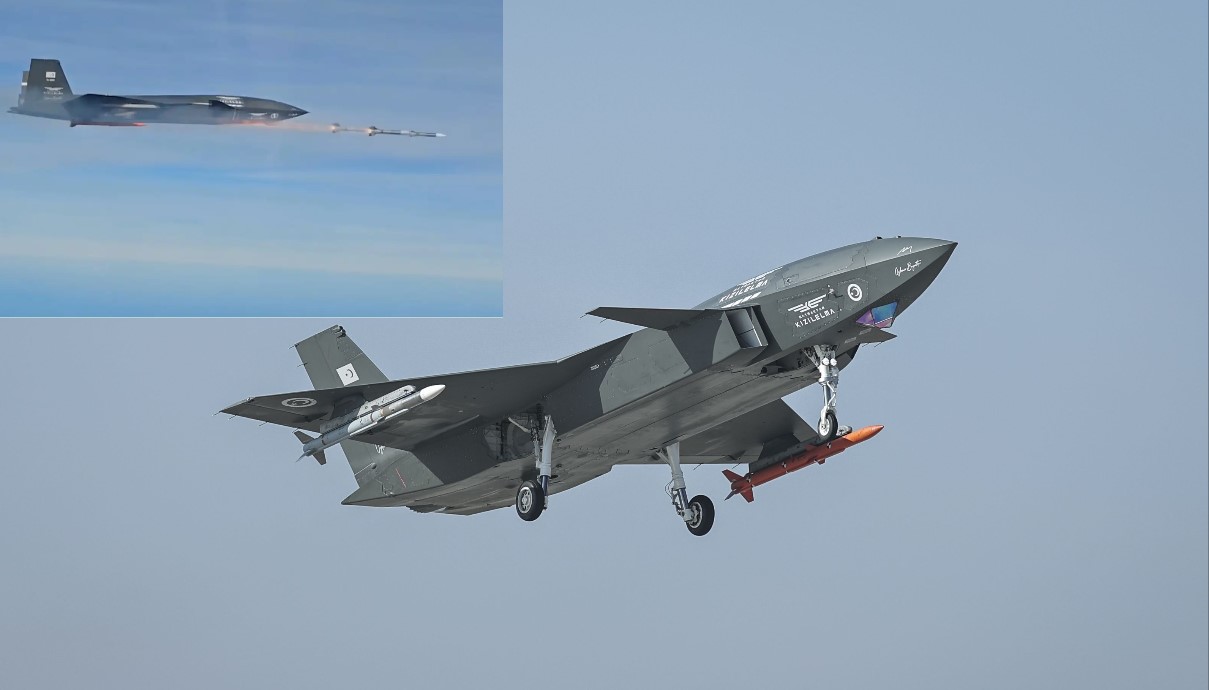
On 30 November 2025, Türkiye marked a defining moment in unmanned aviation, as Baykar announced that its Bayraktar Kizilelma unmanned fighter successfully destroyed an aerial target using a radar-guided air-to-air missile, becoming the first UCAV in the world to achieve a verified intercept of this type. Conducted over the Black Sea near Sinop, the live-fire event showed Kizilelma detecting, tracking and engaging a high-speed jet target drone with a Gökdoğan missile guided by Aselsan’s MURAD AESA radar. The successful hit, confirmed by Army Recognition analysis and onboard footage, proves that a jet-powered unmanned combat aircraft can now perform real air-to-air strikes at significant standoff distance.
A Mixed Crewed–Uncrewed Formation Demonstration
The test was executed as a complex, integrated air operation involving both UAVs and manned fighters. Five Turkish Air Force F-16s from Merzifon’s 5th Main Jet Base assembled with Kizilelma over Sinop, rehearsing future air combat where unmanned and manned aircraft share the same operational battlespace. Selçuk Bayraktar, Baykar’s chairman and CTO, flew in the back seat of an F-16 to observe the trial as Kizilelma—tail number TC-OZB5—joined the line-abreast formation.
Once the jet-powered target drone was launched, Kizilelma used its MURAD AESA radar to detect it at distance, establish a track and classify its movement. The UCAV then fired a single Gökdoğan missile, mounted on its right wing. A Bayraktar Akıncı UAV orbited nearby to record the sequence. The missile struck the target directly, prompting Selçuk Bayraktar to declare that the test had opened “a new era in aviation history” for radar-guided unmanned aerial combat.
A National System-of-Systems Achieving Combat Capability
The milestone reflects the integration of several Turkish defence technologies on a single platform. Kizilelma is a low-observable, jet-powered unmanned fighter, weighing approximately 8.5 tonnes, carrying up to 1.5 tonnes of payload, reaching speeds near Mach 0.9, and operating from short-runway ships such as TCG Anadolu. It offers a combat radius of around 500 nautical miles, placing it in the category of unmanned fighters intended to work beside crewed aircraft.
Its main sensor, Aselsan’s MURAD 100-A/110-A AESA radar, features beam steering, multi-target tracking and air-to-air/air-to-ground modes using GaN technology. The radar provides precision guidance for radar-homing missiles at medium-range distances.
Supporting it is Aselsan’s Toygun electro-optical targeting system, which supplies high-resolution MWIR imaging, long-range passive tracking, automatic target identification and laser designation. Together, MURAD and Toygun allow Kizilelma to fight in both active and passive modes, giving it flexibility in contested airspace.
The interceptor used in the test, TÜBİTAK SAGE’s Gökdoğan, is an active-radar-guided air-to-air missile with a range of around 65 km, mid-course datalink updates, and lock-on-after-launch capability. While in this test it was mounted externally, Kizilelma is designed to carry such missiles inside an internal bay, enabling reduced radar signature during high-risk missions.
A Rapid, Structured Development Path
The live-fire strike adds a major new achievement to Kizilelma’s fast-paced development. Work began under the MIUS programme in 2013, with public design images emerging in 2021. The unmanned jet completed its maiden flight on 14 December 2022, and soon after began formation flights with Turkish F-16s and public displays.
On 20 October 2025, Kizilelma flew its first test with the MURAD AESA radar. One month later, on 20 November 2025, it conducted a simulated engagement against an F-16, tracking the fighter with its radar and digitally “firing” a Gökdoğan. This validated Türkiye’s national radar-to-missile interface for real combat scenarios.
The Sinop event completes the chain with a live missile launch and physical destruction of a jet target.
Shaping the Tactical Future of Air Combat
Kizilelma’s achievement carries significant implications for future air engagements. With its performance, range and sensors, the unmanned jet can function as a loyal wingman for F-16s and the future TF Kaan stealth fighter. Its role can include flying ahead of manned fighters into contested zones, acting as a forward sensor, a missile carrier, or a decoy.
Using both radar and passive electro-optics, Kizilelma can identify and engage high-speed aircraft at medium distances. Its ability to carry weapons internally or externally gives commanders the option of stealthy penetration or maximum loadout, depending on mission demand.
In high-threat environments, unmanned fighters like Kizilelma can enter first to trigger enemy radars, conduct medium-range engagements, and support manned aircraft through networked sensing, reducing risk to pilots and expanding tactical flexibility. As autonomous algorithms mature, formations of Kizilelma could execute multi-axis attacks, maintain persistent air patrols, or operate as distributed sensor nodes across contested airspace.
Strategic and Industrial Impacts
The test strengthens Türkiye’s position as a country with a national air-combat kill chain built on sovereign radar, datalink, missile and mission-computer technologies. This reduces dependence on foreign export approvals and enhances strategic autonomy.
Regionally, a combat-capable Kizilelma affects planning in the Aegean, Eastern Mediterranean, Middle East and Black Sea, injecting an unmanned medium-range interceptor into the air domain.
Industrial implications are also significant. Through the new Italy–Türkiye LBA Systems joint venture, composite production and final assembly of Kizilelma will begin in Grottaglie, signalling European interest and potential NATO integration of the platform.
The capability also feeds into Türkiye’s sixth-generation ecosystem centered around TF Kaan, Anka-3, Kizilelma and Aselsan’s advanced communication networks. In this architecture, TF Kaan acts as a command node directing unmanned assets for air-defence suppression, electronic warfare and deep-strike missions.
The Road Ahead for Kizilelma
The Sinop test confirms that unmanned combat aircraft are transitioning from experimental technology to operational weapon systems. Baykar is developing Kizilelma-B and Kizilelma-C variants—including a twin-engine model—to achieve higher speed, range and payload capacity.
Internal missile carriage opens the path to low-observable medium-range air-to-air tactics, where the UCAV approaches silently, fires from its internal bay, and then returns to a stealth profile.
A New Phase in Unmanned Air Combat
Türkiye has demonstrated that a jet-powered UCAV can independently detect, track and destroy a fast aerial target using a radar-guided missile, establishing a milestone for global unmanned aviation. The achievement reinforces a strategic transition in which mixed formations of manned and unmanned fighters will deliver air superiority, and where decisive engagement at medium range may increasingly come from unmanned platforms.
For air forces worldwide, the message is clear: the age in which only crewed fighters could contest the air domain is ending, and the future battlespace will be shaped by stealthy unmanned wingmen capable of autonomous air-to-air combat.
About the Author
Aditya Kumar:
Defense & Geopolitics Analyst
Aditya Kumar tracks military developments in South Asia, specializing in Indian missile technology and naval strategy.