Türkiye Pitches Carrier-Capable Bayraktar TB3 to Japan as Maritime Drone Cooperation Expands
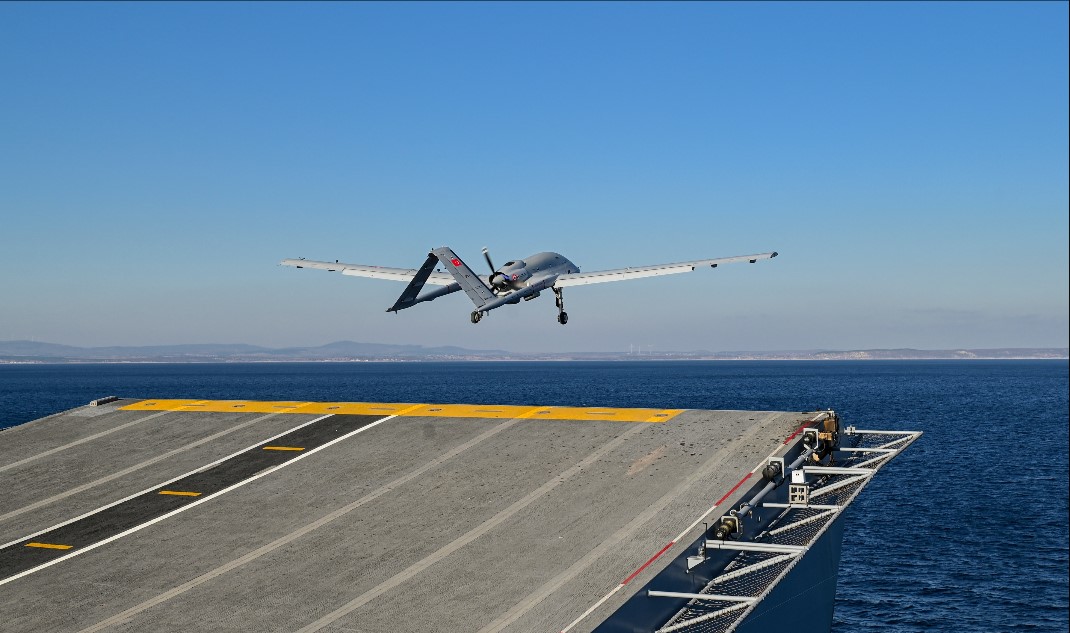
Ankara / Tokyo : Türkiye has offered Japan its Bayraktar TB2 unmanned combat aerial vehicle and the ship-capable Bayraktar TB3 as part of deepening bilateral defense cooperation focused on maritime security and unmanned systems. The proposal signals a potential new approach to drone-enabled naval operations in the Pacific, aligned with Japan’s evolving maritime posture.
According to a January 7 report by Anadolu Agency, Turkish National Defense Minister Yaşar Güler said the Bayraktar TB2 and TB3 “could contribute to Japan’s defense capabilities,” highlighting their long endurance, persistent surveillance, and cost-effectiveness for maritime missions. Güler noted that constructive discussions have continued since Japanese Defense Minister Gen Nakatani visited Ankara, covering maritime security, unmanned systems, training, and air-defense technologies. A Turkish defense ministry delegation is expected to visit Japan in March 2026 to advance defense-industry cooperation and explore a framework agreement.
TB3 Designed for Short-Deck Naval Operations
Developed by Baykar, the Bayraktar TB3 is engineered specifically for operations from compact flight decks. Available specifications indicate an airframe approximately 8.35 meters long with a wingspan of about 14 meters, supporting a payload around 280 kilograms and endurance exceeding 21 hours. The UAV is powered by a turboprop-class engine rated near 170 horsepower and supports both line-of-sight and beyond-line-of-sight communications.
Operationally, the TB3 is associated with cruise speeds near 125 knots, maximum speeds around 160 knots, an operating altitude of roughly 20,000 feet, and a service ceiling near 25,000 feet. Test reports indicate significant altitude margin, with documented flights exceeding 33,000 feet and one widely cited test reaching 36,310 feet, providing flexibility for weather, sensor performance, and communications.
The UAV’s operational reach of about 1,100 nautical miles is frequently highlighted in naval terms, allowing sensors to extend well beyond a task group’s organic horizon and strengthening early warning and maritime domain awareness.
Sea Trials from TCG Anadolu
The TB3’s naval credentials have been reinforced through a series of sea trials. In November 2024, a TB3 prototype successfully launched from the amphibious assault ship TCG Anadolu using the vessel’s 12-degree ski-jump, completed a short maritime flight, and recovered back onto the moving deck without arresting gear or external recovery systems. Follow-on trials through late 2024 and into 2025 reportedly repeated launches and recoveries under varying wind, deck-motion, and payload conditions, focusing on repeatability and operational margins rather than one-off demonstrations.
Turkish officials describe these trials as evidence that routine UAV operations from short decks are achievable, enabling persistent sea-based aviation without the complexity of catapults or arresting systems.
Implications for Japan and the Pacific
For Japan, the offer comes as it strengthens maritime surveillance, deterrence, and distributed operations across the Western Pacific. A ship-capable UAV like the TB3 could complement manned aviation by providing persistent ISR, extending sensor coverage, and supporting flexible deployment from non-traditional aviation ships. The inclusion of the proven TB2 alongside the navalized TB3 suggests a layered approach combining land- and sea-based unmanned operations.
While no procurement decision has been announced, the talks underline growing Türkiye–Japan defense ties and highlight how unmanned, ship-operated aircraft could shape future naval operations in the Pacific and beyond.
About the Author
Aditya Kumar:
Defense & Geopolitics Analyst
Aditya Kumar tracks military developments in South Asia, specializing in Indian missile technology and naval strategy.