Thailand Deploys U.S.-Made Strykers Into Combat as Border Clashes With Cambodia Intensify
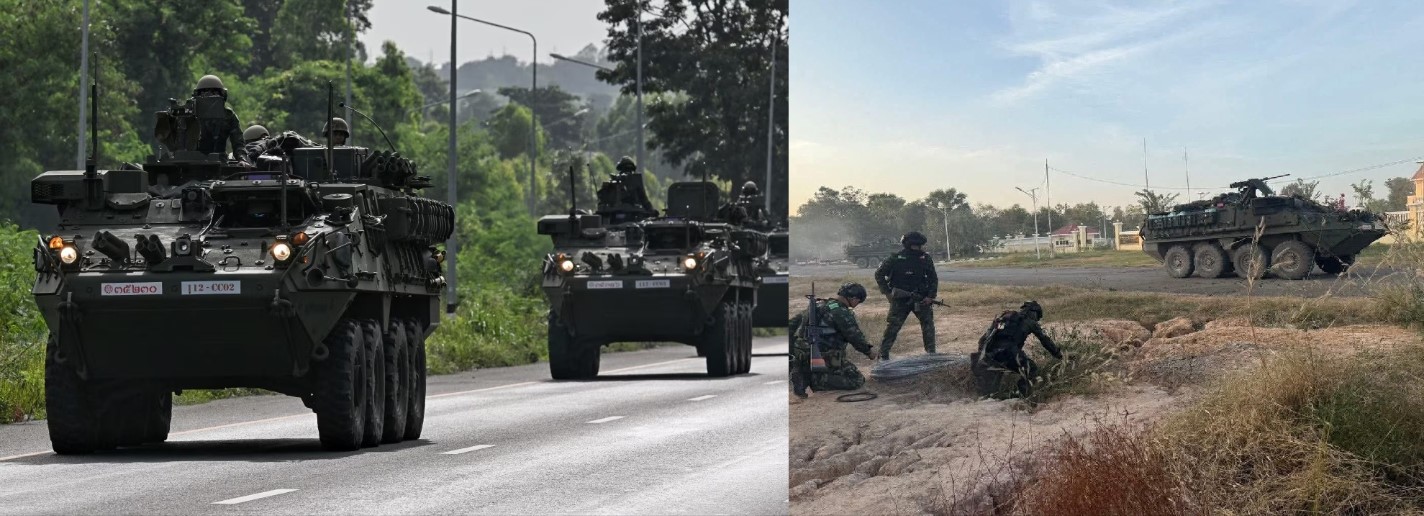
Thailand’s Royal Thai Army has deployed U.S.-made Stryker 8x8 armored vehicles into active frontline combat along the disputed Thai-Cambodian border, marking a significant escalation in hostilities despite parallel diplomatic claims of de-escalation. Open-source intelligence reports dated December 10, 2025, indicate that Stryker infantry carrier vehicles are operating near the Bueng Takwan checkpoint in Ta Phraya district, Sa Kaeo province, directly opposite Cambodia’s Ban Ta Phraya border trade crossing.
The vehicles have been used to transport infantry, reinforce defensive positions, and secure contested terrain as clashes continue across multiple border sectors. By mid-December 2025, the situation remained active and fluid, with Thai forces observed erecting concertina wire, raising national flags, and consolidating ground under Stryker-supported infantry protection. These actions confirm that the vehicles are now fully committed to frontline operations, rather than limited to training or rear-area roles.
Ceasefire Claims Clash With Battlefield Reality
The latest escalation has unfolded alongside conflicting political messaging. U.S. President Donald Trump publicly stated that Thailand and Cambodia had agreed in principle to halt fighting, following high-level communications involving Thai Prime Minister Anutin Charnvirakul and Cambodian Prime Minister Hun Manet, with an effective timeframe cited for Friday evening.
However, neither Bangkok nor Phnom Penh confirmed the implementation of a binding ceasefire, and Thai military messaging continued to acknowledge ongoing engagements. Artillery, mortar, and rocket exchanges have been reported along several stretches of the approximately 817-kilometer border, surpassing the intensity of clashes recorded in July 2025.
Thai media cited BM-21 multiple-launch rocket impacts in Sisaket province, while Cambodian authorities alleged that Thai fighter aircraft struck targets inside Cambodian territory. Both governments framed their actions as defensive, accusing the other side of initiating fire and violating prior understandings.
Diplomatic Frameworks Under Strain
Efforts to stabilize the border had already weakened before the latest fighting. A Kuala Lumpur Peace Accord signed on October 26, 2025, outlined confidence-building measures including troop withdrawals, monitoring mechanisms, and de-mining initiatives. Thailand later suspended its participation following a November landmine incident that injured Thai soldiers, a decision that became a focal point for subsequent accusations.
As hostilities resumed, the absence of effective enforcement mechanisms left military units on both sides postured for continued contact rather than disengagement. Against this backdrop, Thailand’s decision to deploy armored vehicles such as the Stryker signals preparation for sustained operations, not a short-term crisis response.
Thailand’s Stryker Procurement and Force Integration
Thailand’s Stryker fleet is the product of a multi-year procurement program involving refurbished transfers, follow-on orders, and extensive training and sustainment arrangements. Available data indicates that orders were placed in fiscal years 2019, 2020, and 2021 for 70, 50, and 10 vehicles respectively, bringing the reported total to 130 Strykers.
The overall program cost is estimated at approximately 9.1 billion baht, equivalent to about $282.8 million. Early program phases included infantry carrier variants and support equipment, such as M2 .50-caliber machine guns, communications and vision systems, smoke grenade launchers, spare parts, training packages, and field service support.
Thai media previously reported an initial batch of refurbished vehicles, with additional deliveries bringing early operational groups to full strength. Vehicles arrived via Laem Chabang port, underwent inspection at Saraburi, and were delivered to frontline formations including units of the 11th Infantry Division based in Chachoengsao province.
Training, Sustainment, and Readiness
Training was a core element of the acquisition. Initial groups of approximately 30 Thai soldiers were sent to the United States to qualify as drivers, mechanics, and technicians. U.S. technical personnel supported maintenance and sustainment during the fleet’s entry into service, ensuring operational readiness under field conditions.
These arrangements enabled the Royal Thai Army to rapidly integrate the Stryker into active formations, a factor now evident in its deployment along the contested border.
Capabilities of the Stryker in Border Warfare
The Stryker is an 8x8 wheeled armored vehicle derived from the Canadian LAV-III, itself based on the Mowag Piranha, and produced for the U.S. Army by General Dynamics Land Systems–Canada. Thailand operates the M1126 infantry carrier variant, crewed by two personnel and capable of carrying up to nine infantry soldiers.
The vehicle measures 6.95 meters in length, 2.72 meters in width, and 2.64 meters in height, with a combat weight in the mid-16-ton range. Its drivetrain allows switching between 8x4 and full 8x8, enabling road speeds of up to 97 km/h and an operational range of approximately 500 km—attributes well suited for extended border operations.
Armament and Protection
Thai Strykers have been observed operating with heavy machine guns, consistent with remote weapon station configurations capable of mounting a 12.7 mm M2 machine gun or a 40 mm Mk19 automatic grenade launcher, and in some cases 7.62 mm weapons. Smoke grenade launchers provide rapid battlefield obscuration.
The use of remote weapon systems allows gunners to engage targets from under armor, reducing vulnerability to small-arms fire, artillery fragments, and indirect fire, which are prevalent in the current conflict environment.
Modernization and Networked Operations
Thailand is integrating its Stryker fleet into broader command-and-control modernization efforts. A $7 million contract announced in February 2025 covers the integration of a new Battle Management System and C4I components, including mounted computer systems from Leonardo DRS and Systematic’s Sitaware software.
A memorandum of understanding signed on November 11, 2025, involving Leonardo DRS and Thai firm Chaiseri, has been linked to these upgrades, along with references to the integration of the M153 CROWS II remote weapon station. These enhancements are intended to improve situational awareness, coordination, and real-time decision-making for deployed units.
Outlook
The deployment of Stryker armored vehicles to the Thai-Cambodian border highlights the widening gap between diplomatic assurances and battlefield realities. As clashes continue and ceasefire claims remain unverified, the visible use of modern armored platforms suggests that Thailand is preparing for a prolonged confrontation rather than an imminent de-escalation. Whether renewed diplomatic engagement can translate into sustained stability on the ground remains uncertain, but for now, Stryker-supported infantry operations have become a defining feature of the conflict’s latest phase.
About the Author
Aditya Kumar:
Defense & Geopolitics Analyst
Aditya Kumar tracks military developments in South Asia, specializing in Indian missile technology and naval strategy.