Texas Governor Abbott Launches Crackdown as Fears Rise Over Radical Islamist Spread and Sharia Courts in Texas
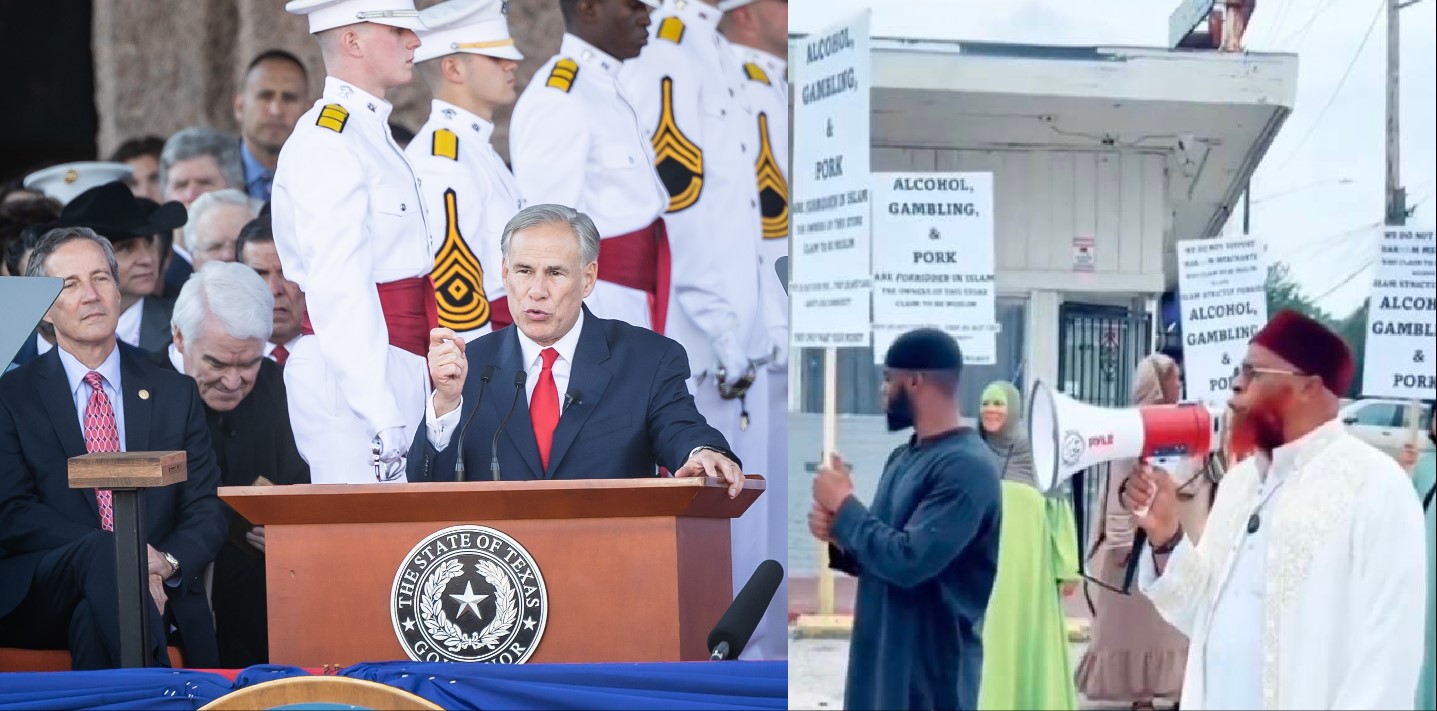
Austin, Texas – Texas Governor Greg Abbott has escalated his campaign against what he calls “Sharia courts” in the state, ordering the Texas Department of Public Safety (DPS) and local prosecutors to investigate Muslim mediation bodies in the Dallas area and elsewhere in Texas.
The move comes just days after Abbott also designated the Muslim Brotherhood and the Council on American-Islamic Relations (CAIR) as “foreign terrorist and transnational criminal organizations” under Texas law – a step legal experts say has no force under federal terrorism statutes but carries major political and civil-rights implications.
Abbott vows to “root out” Sharia tribunals
In a message amplified on conservative media and social platforms, Abbott declared that “at least two Sharia courts” are operating in the Dallas area and said he is deploying DPS to “root out any Sharia courts anywhere in the state of Texas.” Posts circulating online closely track language in a formal governor’s letter sent this week to North Texas district attorneys, sheriffs, the Texas Attorney General and DPS, urging investigations into “Sharia tribunals masquerading as legal courts.”
Abbott has repeatedly argued that the Texas Constitution and state statutes do not permit Sharia law to be enforced in place of U.S. or Texas law. In 2017, Texas enacted House Bill 45, often described as an “anti-Sharia law” measure, barring state courts from enforcing foreign legal codes that conflict with constitutional rights.
More recently, Abbott signed a 2025 law targeting what he labeled “Sharia compounds,” after attacking EPIC City, a proposed Muslim-centered community near Dallas, as an alleged attempt to create an enclave governed by Islamic rules – a claim developers have strongly denied.
“Our statutes have banned Sharia law, and we will purge any attempt to impose it in Texas,” Abbott said in comments promoted by his supporters.
What are these “Sharia courts” in Texas?
At the center of Abbott’s latest offensive are Islamic mediation services in North Texas – sometimes described by critics as “Sharia courts” but by organizers as voluntary forums for religious arbitration on family and civil disputes, similar to long-standing Jewish Beth Din or Christian arbitration panels used around the United States.
Under U.S. law, parties can agree to settle certain civil disputes – such as business disagreements or some family matters – through private arbitration, including religious bodies. However, any decision still depends on enforcement by secular courts, which must reject outcomes that violate constitutional protections or public policy. Legal scholars note that this framework has long applied to Jewish and Christian tribunals and, more recently, to some Muslim arbitration panels.
Critics of Abbott say his framing of these bodies as illegal “courts” misleads the public about how they actually operate and feeds suspicion of ordinary Muslim religious practice.
Muslim groups call move “Islamophobic,” launch lawsuits
Abbott’s actions have triggered immediate backlash from CAIR and other Muslim organizations. Multiple CAIR chapters in Texas have filed suit against the governor and Attorney General Ken Paxton, arguing that labeling CAIR a “foreign terrorist organization” and ordering DPS investigations is unconstitutional discrimination based on religion and political viewpoint.
CAIR, a U.S. civil-rights group that frequently sues over anti-Muslim discrimination, says it has never been designated a terrorist entity by the federal government and regularly condemns terrorism and political violence. It accuses Abbott of stoking anti-Muslim hate for electoral gain and warns that the “Sharia courts” rhetoric could further endanger mosques and Muslim communities in Texas.
Civil-liberties advocates and some legal experts add that while states can regulate fraud, unauthorized legal practice and criminal conduct, they cannot outlaw a religion’s internal rules or selectively target one faith’s arbitration practices while permitting others.
How large is Islam in the U.S. – and in Texas?
Despite the heated rhetoric, Muslims remain a very small minority in the United States:
-
Nationally, Muslims account for roughly 1–1.3% of the U.S. population – around 3.5 to 4.5 million people – making Islam the third-largest religion after Christianity and Judaism.
-
A 2025 estimate suggests about 4 million Muslims, or roughly 1.2% of Americans, with concentrations in major urban areas such as New York, Chicago, Detroit, Houston and Dallas.
In Texas, cities like Houston and Dallas–Fort Worth have seen visible growth in mosques, Islamic schools and halal businesses, reflecting broader immigration trends and the fact that about 40–45% of U.S. Muslims are now U.S.-born citizens.
Researchers point out that, in demographic terms, there is no realistic pathway for any religious minority, including Muslims, to impose a parallel legal system that could replace constitutional democracy in the United States.
Is Islam or “Sharia law” a threat to American democracy?
Supporters of Abbott argue that even small networks that promote strict interpretations of Sharia could, over time, undermine equal rights for women, LGBTQ+ people or religious minorities if allowed to operate without scrutiny. They also point to extremist organizations abroad that invoke Islamic law as a justification for violence and repression, arguing that Western democracies must be vigilant against similar ideologies gaining footholds at home.
However, constitutional scholars and mainstream security experts counter several key points:
-
U.S. courts are bound by the Constitution, not religious law. Any attempt to enforce a religious rule that violates due process, equal protection or basic rights is void.
-
Faith-based arbitration is not unique to Islam; Jewish and Christian tribunals have operated for decades without being portrayed as existential threats to democracy.
-
Most American Muslims express strong support for democratic values and religious freedom, and surveys show they are about as likely as other Americans to believe in the “American dream” and to participate in civic life.
National security analysts caution that framing Islam itself – rather than specific violent groups – as a “biggest threat” risks fueling radicalization and hate crimes, while diverting attention from empirically documented threats such as far-right extremism, white supremacist violence, and other domestic terrorism trends identified by federal agencies.
Political stakes for Abbott – and for U.S. debates on religion and law
Abbott’s offensive against alleged Sharia courts and his unilateral designation of CAIR and the Muslim Brotherhood as terrorist entities come as he seeks to energize conservative voters ahead of future statewide and national political contests. The campaign dovetails with his high-profile clashes with the Biden administration over immigration, border security and culture-war issues.
For supporters, the governor is defending American and Texan law against what they see as creeping “foreign” legal norms. For critics, he is weaponizing fear of Islam to expand state powers, restrict property rights and chill the activities of Muslim civil-rights organizations.
What is clear is that no parallel Islamic legal system can replace constitutional courts in Texas or anywhere else in the United States. The unfolding clash is less about an imminent legal takeover and more about how a pluralistic democracy manages religious diversity, protects civil rights and responds to concerns about extremism—without turning an entire faith community into a political enemy.
About the Author
Aditya Kumar:
Defense & Geopolitics Analyst
Aditya Kumar tracks military developments in South Asia, specializing in Indian missile technology and naval strategy.