Target Missed ? Official Video Exposes Flaw in Pakistan’s ‘Successful’ Taimoor Missile Test
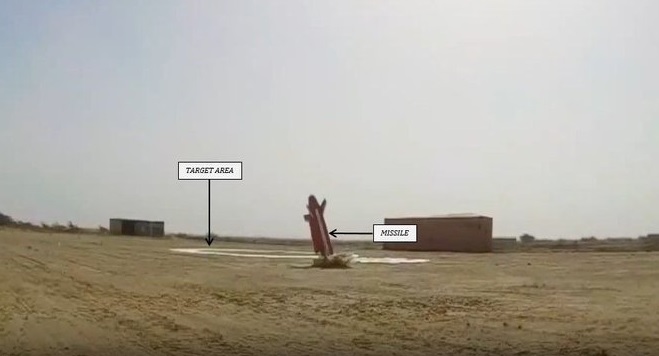
Islamabad: Pakistan has carried out a flight test of its indigenously developed Taimoor Air-Launched Cruise Missile (ALCM), projecting it as another milestone in the country’s evolving missile and aerospace programme. However, an official video released after the test appears to show the missile missing the designated target area, triggering questions about its real-world accuracy and operational maturity.
According to an official statement, the Pakistan Air Force conducted the test as part of ongoing efforts to validate long-range stand-off strike capabilities. The Taimoor Weapon System is advertised as capable of engaging both land and sea targets at a maximum range of 600 kilometres, giving combat aircraft the ability to launch from well outside hostile air defence zones.
Yet, frame-by-frame analysis of the released footage suggests that the missile impacted outside the marked target circle, contradicting claims of a clean precision hit and raising concerns over terminal guidance performance.
What Is the Taimoor Weapon System
The Taimoor Weapon System is Pakistan’s latest air-launched cruise missile designed for conventional strike roles. It is intended to be integrated with Pakistan Air Force fighter aircraft, offering a stand-off attack option against high-value targets without requiring deep penetration into defended airspace.
Military officials described the launch as “successful,” stating that it validated system integration, aerodynamic performance, navigation and command-and-control links. The test is also positioned as part of Pakistan’s broader effort to strengthen domestic defence manufacturing and reduce reliance on foreign suppliers.
Range, Guidance and Strike Role
With a claimed 600-km stand-off range, the Taimoor ALCM theoretically allows launch platforms to remain beyond most enemy surface-to-air missile envelopes. This range places it in the same category as other regional subsonic cruise missiles designed for precision strikes rather than speed-based penetration.
The missile reportedly carries a conventional warhead and employs a modern navigation suite, believed to combine inertial navigation with satellite guidance, supported by terrain-following or terrain-contour matching during low-altitude flight. Such systems are intended to ensure mid-course accuracy and precise terminal engagement.
However, the apparent miss visible in the official footage suggests that terminal guidance accuracy remains a weak point, especially in comparison with mature cruise missile systems that routinely demonstrate circular error probable (CEP) well within a few metres.
Speed and Flight Profile
Pakistan has not disclosed official speed figures for the Taimoor missile. Defence analysts assess that it operates at high-subsonic speeds close to Mach 0.8–0.95, placing it in the near-Mach category. This profile is consistent with traditional cruise missile design, prioritising range, fuel efficiency and sustained low-altitude flight over raw speed.
While such a flight envelope improves endurance, it also presents a vulnerability. Against modern, layered air defence networks, subsonic cruise missiles face increasing interception risks, particularly when detected early by airborne or over-the-horizon sensors. As a result, Taimoor’s survivability depends heavily on very-low-altitude terrain-hugging flight, which reduces radar exposure but leaves little margin for guidance errors.
Accuracy Under Scrutiny
The most significant concern emerging from the test is accuracy. The visible deviation from the target zone undermines claims of “high-precision strike capability,” a core requirement for modern stand-off weapons. In contemporary conflicts, accuracy — not just range — determines operational value, especially when missiles are used against hardened or time-sensitive targets.
Analysts note that even a small CEP error can drastically reduce effectiveness while increasing the risk of collateral damage. Until Pakistan demonstrates consistent, verifiable target hits under varied operational conditions, the Taimoor’s role as a reliable precision weapon remains unproven.
Operational Significance and Limitations
Despite these concerns, the Pakistan military maintains that the Taimoor ALCM enhances conventional deterrence and operational flexibility. Integrating long-range cruise missiles with fighter aircraft does expand strike options and complicates adversary defence planning.
However, the test highlights a familiar pattern in regional missile development: capability claims outpacing demonstrated performance. Without clear evidence of repeatable accuracy and resilience against modern air defences, the Taimoor currently represents a work in progress rather than a fully mature stand-off strike system.
For now, while Pakistan has showcased ambition and incremental progress in indigenous missile design, the latest test suggests that precision — the defining attribute of modern cruise warfare — remains the critical challenge yet to be conclusively solved.
About the Author
Aditya Kumar:
Defense & Geopolitics Analyst
Aditya Kumar tracks military developments in South Asia, specializing in Indian missile technology and naval strategy.