Taiwan's New Generation Frigate Faces Development Challenges and Changes
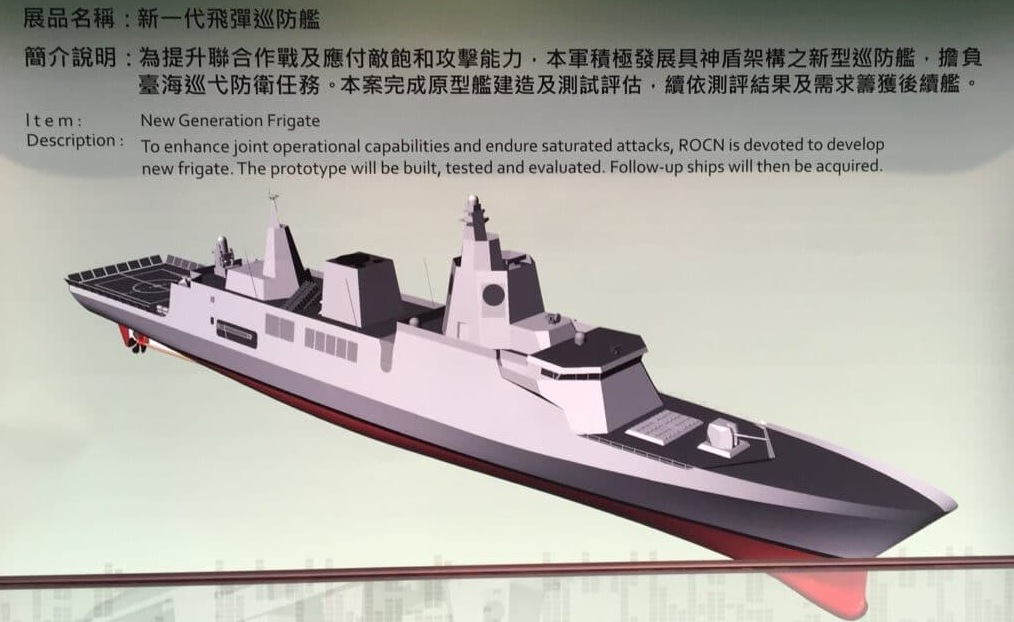
Taiwan's New Generation Frigate project faces significant challenges due to changing requirements and technical limitations.
On May 25, 2024, local media outlet LTN reported that Taiwan's New Generation Frigate would have a displacement of 6,000 tons, significantly larger than initially planned. This information came from a high-level government official, who noted that the frigate would feature the U.S.-made AN/SPY-7 active phased radar.
The official also highlighted an overly optimistic initial expectation from the Republic of China (ROC) Navy. They had hoped to develop a 4,500-ton ship with capabilities comparable to the 6,000-ton ships of other nations. Another local media source, UP MEDIA, quoted an anonymous insider stating that a 4,500-ton vessel could not accommodate all the necessary weapon systems and equipment for modern warfare.
The New Generation Frigate was part of a 12-item force-building plan revealed by the ROC Navy in 2016. During the TADTE 2017 defense exhibition, a scale model of the frigate was displayed, emphasizing its role in enhancing joint operational capabilities and withstanding intense attacks. The Mandarin description mentioned that the ship would be developed with an "Aegis structure," though this term was not used in the English description.
The term "Aegis" remains ambiguous regarding Taiwan's naval plans. In a 2018 parliamentary session, a deputy head of the National Chung-Shan Institute of Science and Technology (NCSIST) clarified that an "Aegis ship" refers to a warship with an electronically scanned array (ESA). However, it is unclear if the U.S. will sell the complete Aegis Combat System to Taiwan.
Initially, the plan aimed to create a 4,500-ton vessel with passive ESA radar systems. NCSIST had developed a land-based passive ESA radar system, but the ROC Navy later requested an active ESA system. This requirement could not be met within the 4,500-ton limit, leading to the decision to increase the ship's displacement to 6,000 tons.
The Control Yuan, Taiwan's ombudsman, investigated and criticized the Ministry of National Defense (MND) and ROC Navy Command in December 2023. They found that frequent changes in project requirements caused significant delays and complications.
The New Generation Frigate project exemplifies the challenges of modern military development, where evolving requirements and technical constraints often necessitate substantial adjustments. Taiwan's efforts to enhance its naval capabilities continue amid these difficulties, highlighting the complex nature of defense planning and execution.
✍️ This article is written by the team of The Defense News.