TaiwTaiwan Launches NT$43.16 Billion Frigate Modernization as Kang Ding Enters Dry Dock for Major Combat System Upgrade
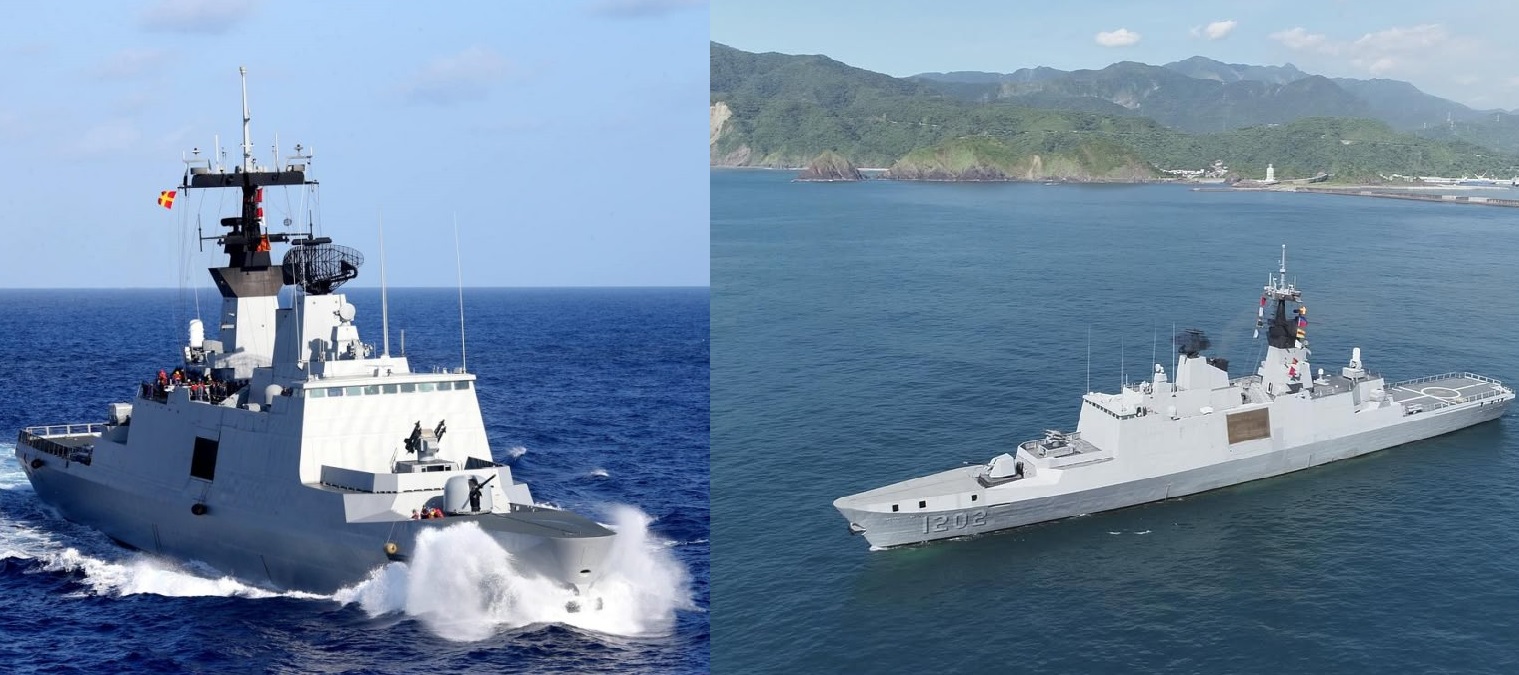
Kaohsiung: The Republic of China Navy (ROCN) has formally commenced the most extensive modernization of its Kang Ding–class surface combatants, as the frigate Kang Ding (PFG-1202) entered a CSBC Corporation Taiwan dry dock in Kaohsiung on January 3, 2026. The refit is part of a fleetwide combat system performance improvement program valued at approximately NT$43.1599 billion, aimed at significantly enhancing air-defense, sensor, and missile capabilities across all six ships of the class by 2030.
According to reporting by United Daily News, the frigate entered dock already showing clear signs of pre-refit preparation, confirming that the long-planned upgrade effort has transitioned from planning into active execution.
Visible Radar Changes Signal Deep Sensor Modernization
Even before docking, external modifications on Kang Ding highlighted the depth of the forthcoming upgrades. Roughly two-thirds of the supporting structure for the Hai Shen G (Triton-G) low-altitude search radar, located aft of the main mast, had already been removed. This visible change signals preparation for the installation of a new primary air-search sensor.
Under the modernization plan, the ROCN is replacing the legacy DRBV-26D Jupiter II two-dimensional radar and the Triton-G system with the Type 997 Artisan three-dimensional radar. The Artisan represents a generational leap in capability, offering full 3D air-search performance, markedly improved resistance to clutter and electronic countermeasures, and the ability to simultaneously track hundreds of air and surface targets.
The radar’s instrumented range is commonly cited at over 200 kilometers, with significantly higher track refresh rates than the older 2D systems. These improvements directly enhance detection range, altitude discrimination, and engagement-quality tracking—capabilities that are essential for supporting modern, vertically launched surface-to-air missiles.
Missile Capability Expanded Through Vertical Launch System
At the heart of the upgrade is the integration of a new domestically developed Hua Yang vertical launch system (VLS), a transformational addition for the Kang Ding class. The original ships, derived from the French La Fayette design, were constrained by limited air-defense missile capacity and reliance on trainable launchers.
The new VLS architecture is designed to support Taiwan’s indigenous Tien Chien II (Sky Sword II) surface-to-air missiles, dramatically increasing reaction speed, engagement envelopes, and the number of simultaneous threats the ship can counter. By combining 360-degree missile coverage with the 3D tracking performance of the Artisan radar, the refitted frigates gain a substantially improved layered air-defense capability against aircraft, cruise missiles, and emerging aerial threats.
Combat System Integration Across the Fleet
Beyond radars and missiles, the NT$43.1599 billion program encompasses comprehensive upgrades to combat management systems, electro-optical sensors, and mission software. A key technical challenge is ensuring seamless integration between the French-origin ship architecture and Taiwan’s domestically developed weapons and sensors.
The ROCN plans to refit the six frigates sequentially, generally at a pace of one ship per year, balancing modernization with operational availability to avoid significant gaps in surface combatant readiness. Completion of the entire program is targeted for 2030.
Kang Ding–Class Frigate Specifications
Originally commissioned in the 1990s, the Kang Ding–class frigates are Taiwan’s locally designated variant of the French La Fayette class. According to publicly available specifications:
Kang Ding (PFG-1202) displaces approximately 3,800 tonnes full load, measures 125 meters in length, and has a beam of 15.4 meters. Propulsion is provided by a CODAD arrangement using four SEMT Pielstick diesel engines, enabling a maximum speed of around 25 knots and a range exceeding 7,000 nautical miles at cruising speed. The ship operates with a crew of roughly 160 personnel.
Prior to modernization, the class was equipped with limited-area air-defense missiles, anti-ship missiles, a 76 mm main gun, close-in weapon systems, and embarked helicopters for anti-submarine warfare. The current upgrade fundamentally reshapes this configuration, particularly in the air-defense domain.
Strategic Context
The refit of Kang Ding marks a critical milestone in Taiwan’s broader naval modernization drive, as the ROCN seeks to extend the operational relevance of its surface fleet amid a rapidly evolving regional security environment. By combining modern sensors, vertical launch missiles, and upgraded combat systems, the Kang Ding–class frigates are set to transition from lightly defended patrol combatants into significantly more capable multi-role escorts.
With the first ship now in dry dock, the program’s execution phase is underway—setting the pace for a decade-defining transformation of Taiwan’s frontline frigate force.
About the Author
Aditya Kumar:
Defense & Geopolitics Analyst
Aditya Kumar tracks military developments in South Asia, specializing in Indian missile technology and naval strategy.