Taipei Unveils 200-Kilometer Defense Strategy, Outlines Multi-Layered Plan Against China
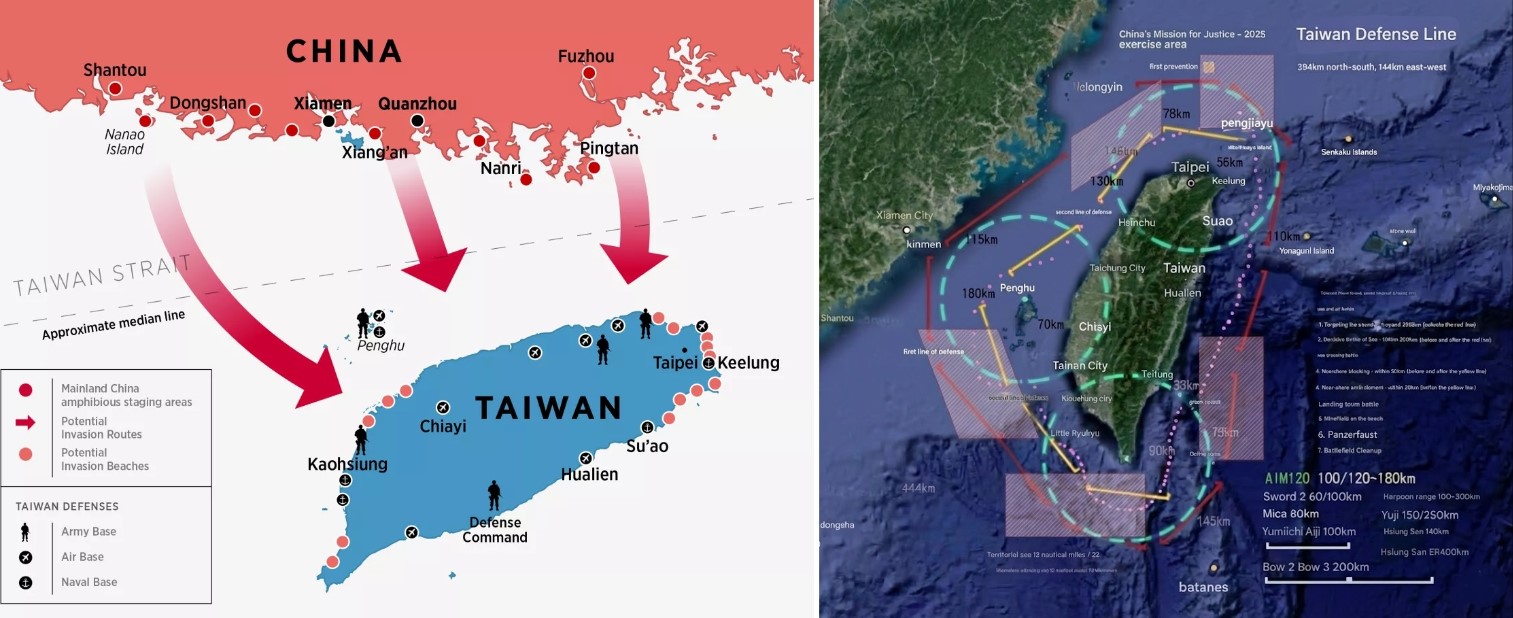
Taipei / Beijing : Taiwan has moved to publicly underline its evolving national defense strategy as tensions with China intensified during last month’s major Chinese military drills around the island, releasing a rare graphic that outlines how it would respond to a potential mainland invasion.
The graphic, shared by Taiwan’s ruling Democratic Progressive Party, appeared during Beijing’s large-scale “Justice Mission 2025” exercise and was widely viewed as both a domestic reassurance signal and a message aimed at Beijing and Taiwan’s international partners. While simplified, the illustration offered insight into how Taipei plans to delay, disrupt and defeat an amphibious assault by the People’s Liberation Army.
China’s Drills and Rising Pressure
Justice Mission 2025 represented the latest escalation in a series of increasingly targeted Chinese exercises focused on Taiwan. According to material released by the PLA Eastern Theater Command and the China Coast Guard, the drills emphasized joint firepower strikes, maritime blockade operations, and the interdiction of foreign military support.
Chinese statements indicated that a key objective was rehearsing the blocking of U.S. forces and arms shipments bound for Taiwan. The exercise included port seizure scenarios, coordinated naval and air patrols, and long-range strike missions by H-6 bombers operating around the island. Taiwan’s defense officials assessed that several phases simulated the opening stages of a quarantine or blockade, rather than an immediate landing.
A 200-Kilometer Defense Perimeter
At the center of Taipei’s newly highlighted posture is what it calls the “Taiwan Defense Line”, an engagement perimeter extending about 200 kilometers from the island’s shores. The map shows two main defensive zones forming part of a seven-layer defense strategy, covering operations from blue-water combat to coastal ground defense.
The outermost layer focuses on “targeting the source” of an invasion. Taiwanese planners believe disrupting PLA staging, ports and logistics hubs on the mainland would be critical in the early hours of a conflict. Taiwan has developed domestically produced cruise missiles capable of striking targets deep inside China.
Recent acquisitions of HIMARS and Army Tactical Missile Systems further expand this capability, enabling the Republic of China Army to conduct long-range precision strikes across the Taiwan Strait. At least one component of Justice Mission 2025 appeared to simulate PLA efforts to neutralize these mobile missile systems.
Preparing for a Decisive Sea Battle
Taiwan’s plan also calls for a “decisive sea battle” before and after Chinese forces cross the outer defense line. Although the Republic of China Navy is far smaller than the PLA Navy, it relies on missile-centric warfare rather than fleet-on-fleet combat.
The navy operates fast missile corvettes, small attack craft and a growing number of shore-based anti-ship missile units under the Haifeng Brigade. The graphic identifies Penghu, Pingtung and northern Taiwan as key locations for these area-denial forces.
Among the systems highlighted is an extended-range Hsiung Feng III anti-ship missile, capable of striking maritime targets at distances of up to 400 kilometers, significantly expanding Taiwan’s ability to hold invasion forces at risk.
Nearshore Blocking And Littoral Defense
Closer to shore, the second major layer emphasizes nearshore blocking operations within roughly 100 kilometers of Taiwan’s coastline. In 2024, the navy announced plans to establish a dedicated littoral defense force, integrating Marine Corps fast boats, missile-armed patrol craft and land-based missile batteries to defend Taiwan’s 24-nautical-mile contiguous zone.
This force is designed to exploit coastal geography, using speed, concealment and precision weapons to ambush landing craft and logistics vessels in confined waters.
Shift Toward Asymmetric Warfare
The public release of the defense map reflects a broader shift in Taiwan’s military thinking. Facing a rapidly modernizing PLA and increasingly assertive rhetoric from Beijing, Taipei has accelerated its move toward asymmetric capabilities intended to raise the cost of invasion.
Alongside conventional platforms, Taiwan has invested in loitering munitions, sea drones, unmanned systems and dispersed command networks, while expanding its anti-ship missile stockpiles and long-range strike capacity.
While officials stress that the graphic does not reveal sensitive operational details, its release was a deliberate act of strategic messaging—underscoring Taiwan’s determination to deter aggression by demonstrating that any attempt to seize the island would result in a prolonged and costly conflict stretching from the mainland’s ports to Taiwan’s shores.
About the Author
Aditya Kumar:
Defense & Geopolitics Analyst
Aditya Kumar tracks military developments in South Asia, specializing in Indian missile technology and naval strategy.