Soyuz MS-28 Launches Successfully With Astronaut, But Russia Loses Its Only Crewed Spaceflight Pad
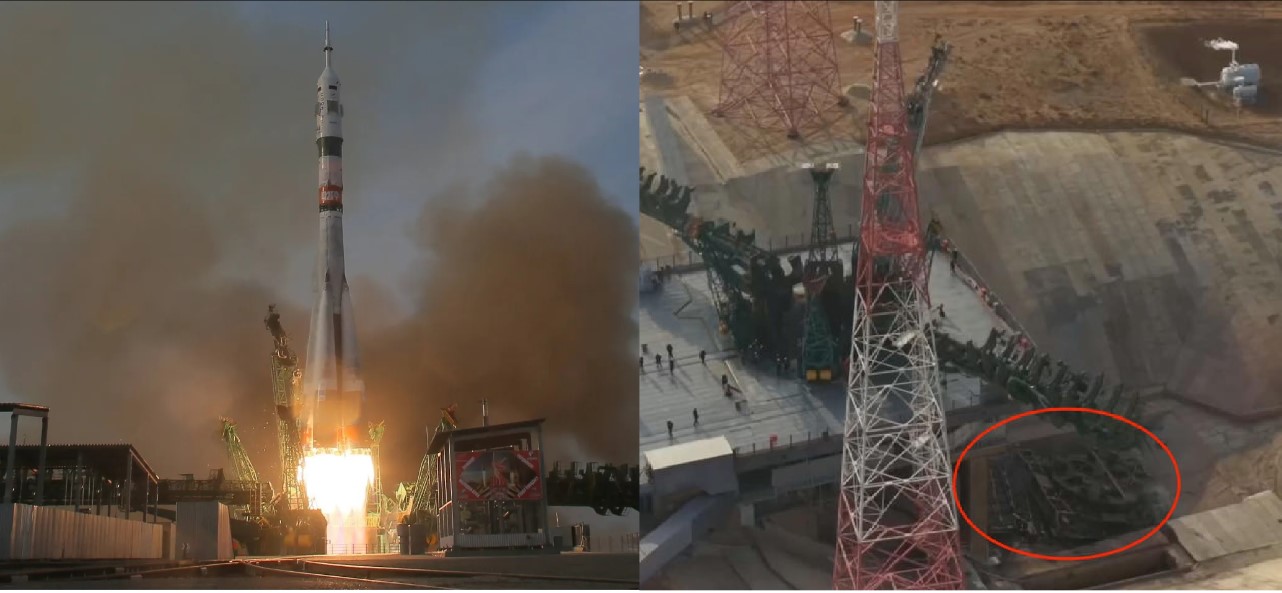
On 27 November 2025, the Soyuz MS-28 spacecraft lifted off from Site 31/6 at the Baikonur Cosmodrome in Kazakhstan carrying two Russian cosmonauts — Sergei Kud-Sverchkov and Sergei Mikayev — along with NASA astronaut Christopher Williams. The mission, intended to transport the crew to the International Space Station (ISS), was completed successfully, and the astronauts docked with the station a few hours later in good health.
Yet what was heralded as a routine crew launch quickly turned into a major setback for Russia’s human spaceflight program: post-launch inspection revealed that the launch pad itself had suffered serious structural damage.
What exactly went wrong — and how badly damaged is the pad?
According to the state space agency Roscosmos, several “elements” of the launch complex at Baikonur’s Site 31/6 were damaged during the launch.
Independent experts and analysts, however, describe the damage as more severe than the official statement suggests. The primary casualty appears to be the pad’s mobile service platform — also referred to as a service cabin or maintenance cabin — which collapsed into the flame trench below the pad as the rocket blasted off. This platform is essential: it both secures the rocket before launch and gives technicians access to the vehicle’s lower stages. Without it, the pad is effectively unusable for crewed (and many cargo) launches.
One analyst cited in reporting estimates that repairs could take as long as two years.
Roscosmos has said that all “necessary spare parts” are on hand and that restoration will begin soon.
Does this mean Russia has truly “lost” its crewed launch capability — at least for now?
In effect, yes — at least temporarily. Site 31/6 has been, since 2020, the only active launch pad for Russian human (and many cargo) missions to the ISS, after retirement of the iconic Gagarin's Start (Site 1) pad.
With the mobile service platform destroyed, no other pad at Baikonur is currently ready for crewed launches, and there is no known alternative Russian facility that meets all the requirements for Soyuz-class missions. Attempts to shift launches to other currently inactive or under-equipped sites would require extensive upgrades.
In other words, for the first time since the early days of crewed spaceflight (the 1960s), Russia appears unable to send cosmonauts into space. That is a major — and symbolic — blow to a program that over six decades has been synonymous with human access to orbit.
Why was Soyuz MS-28 launched — and why going to space still matters
The mission carried out by Soyuz MS-28 is a routine crew-transport to the ISS, under the ongoing roster of expeditions aboard the orbiting station. The spacecraft is planned to remain docked for roughly eight months, with the crew’s return slated for July 2026.
Beyond maintaining continuous human presence aboard the ISS, such missions are essential for carrying out scientific experiments, maintenance tasks, resupply operations, and ensuring the ISS remains operational and safe. They also represent one of the few remaining sectors of practical cooperation between Russian and international space agencies — even amid geopolitical tensions.
For Russia, crewed missions continue to hold importance — both scientifically and symbolically. Operating a human spaceflight program signals technological capability, national prestige, and continued relevance in global space efforts. The Soyuz missions, even when routine, reinforce that standing.
What happens next — and how long might the disruption last?
With the damaged pad at Baikonur out of commission, all future crewed launches are effectively paused until repairs are completed. Roscosmos claims to have spare parts and intends to begin restoration “very soon.”
Yet independent assessments warn that reconstruction could be long and complex, potentially stretching up to two years.
This disruption may also affect cargo resupply missions to the ISS — especially those depending on Russian vehicles — complicating station operations. While other partners (e.g. those using non-Russian spacecraft) could mitigate some effects, critical tasks such as reboosting the station or controlling certain Russian-module systems might suffer.
At the same time, the incident raises new questions about Russia’s longer-term human spaceflight infrastructure. With aging launch pads and previously mothballed facilities like Gagarin’s Start decommissioned after 2019 — and alternate sites such as Vostochny Cosmodrome not yet ready for crewed Soyuz launches — Russia may need to reconsider its reliance on Baikonur alone.
Aging infrastructure, underfunding — and risks of over-reliance
The damage at Baikonur bids a stark reminder: decades-old infrastructure, even if carefully maintained, carry inherent risks — especially under repeated heavy use. The collapse of a service platform during what appeared to be a routine launch suggests the pad may have been under-inspected or under-reinforced.
Analysts note that after the retirement of Gagarin’s Start and the consolidation of crewed launches at a single pad, a single failure now threatens the entire human spaceflight program for a nation that once dominated crewed missions. The incident underscores how over-reliance on a sole facility — especially one with a 60-plus year legacy — poses systemic vulnerability.
For Russia, historically among the world’s leading space powers, the setback is both practical and symbolic. The next steps — how quickly Roscosmos can repair the pad, whether alternative sites can be adapted, or whether international cooperation can fill the gap — will shape not just near-term missions, but the future trajectory of Russian human spaceflight.
About the Author
Aditya Kumar:
Defense & Geopolitics Analyst
Aditya Kumar tracks military developments in South Asia, specializing in Indian missile technology and naval strategy.