South Korea Unveils MAH-1 Attack Helicopter With New ALE Drone System for Coastal Strike
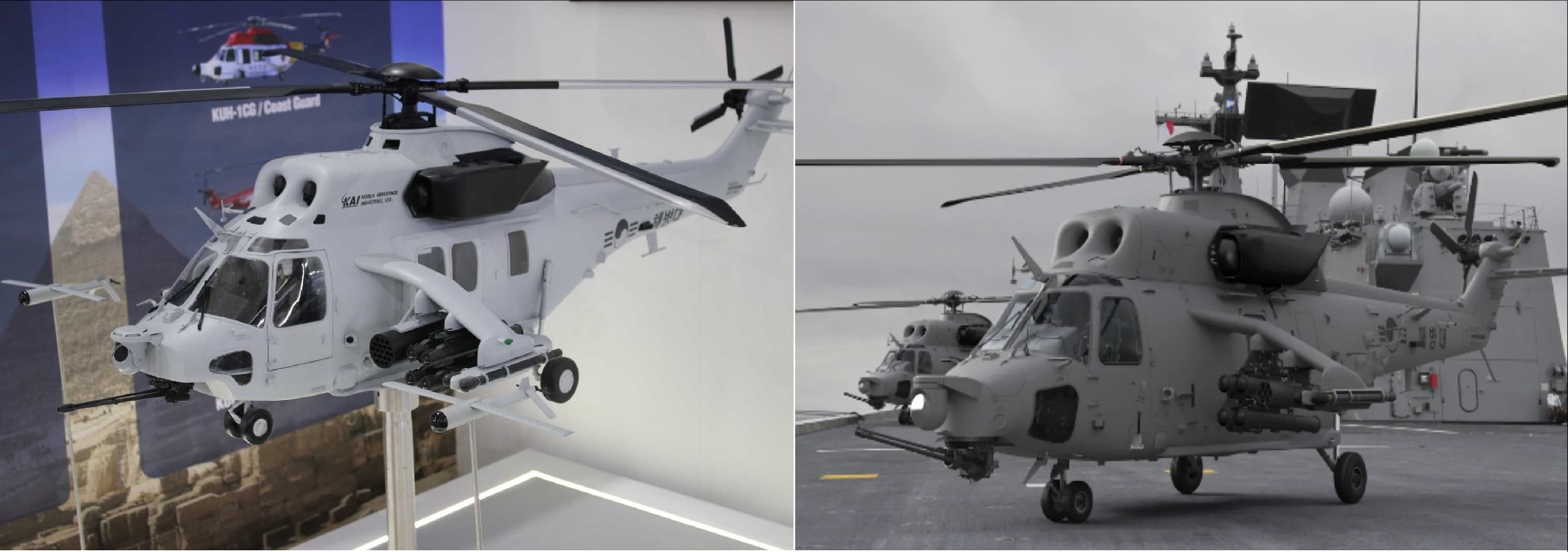
Korea Aerospace Industries (KAI) used the stage of EDEX 2025 to unveil, for the first time in a unified public display, the MAH-1 Marine Attack Helicopter integrated with its Air Launched Effect (ALE) drone concept. The demonstration reflected a significant shift in South Korea’s approach to manned-unmanned teaming (MUM-T) as the Marine Corps moves toward a more independent, network-centric aviation force tailored for naval and amphibious warfare.
A New MUM-T Capability for Amphibious Warfare
KAI’s presentation showed the MAH-1 and ALE as a combined operational package—an approach increasingly adopted by the United States, Japan, and NATO forces to counter coastal air-defense systems and threats in island chains or littoral chokepoints.
The ALE drone, launched directly from the helicopter and controlled by the crew, extends reconnaissance and strike reach without exposing the manned aircraft to front-line fire. With a 2 km operating altitude, 200 km/h speed, nearly two-hour endurance, and compact 1.20 m × 2.50 m × 0.50 m dimensions, it can scout ahead of the formation, conduct real-time target confirmation, and perform swarm-enabled surveillance or kinetic tasks.
Interactive diagrams at the booth illustrated bidirectional data links, enabling the ALE to feed sensor data back to the MAH-1 for faster threat detection, landing zone identification, and maritime target acquisition.
This pairing is particularly relevant as the South Korean Marine Corps prepares for ship-to-shore movement, contested landings, and coastal security missions from platforms like the Dokdo-class amphibious assault ships.
MAH-1: A Heavily Modified Marineon Optimized for Attack Missions
The MAH-1 Marine Attack Helicopter is derived from the KUH-1 Surion family—South Korea’s first domestically developed utility helicopter program, launched in 2006 with Airbus cooperation. Drawing on this lineage, the MAH-1 features:
-
Crashworthy airframe and self-sealing fuel tanks
-
Digital glass cockpit and four-axis automatic flight control system
-
Integrated Health Usage Monitoring System (HUMS)
-
Twin T700-701K engines, each producing over 1,800 shp with Full Authority Digital Engine Control (FADEC)
-
Salt-resistant surface treatments and folding main rotor for shipboard deployment
-
Survivability systems including ballistic protection, IR-suppressed exhausts, missile/laser/radar warning receivers, and countermeasure dispensers
-
Maritime adaptations such as flotation equipment and corrosion-resistant components
In terms of weapons, the MAH-1 is outfitted with:
-
Chin-mounted turreted three-barrel 20 mm gun
-
Air-to-air missiles (e.g., Mistral)
-
Air-to-ground precision missiles (e.g., Cheongeom)
-
2.75-inch guided or unguided rockets
-
Six wing stations for diverse load configurations
The helicopter features a maximum takeoff weight of 8.7 tons, total length 19 m, width 6.1 m, and height 5 m, making it one of the largest Marine Corps-oriented attack helicopters currently in development outside the U.S. and China.
From Concept to Flight: A Rapid Development Timeline
Momentum accelerated in October 2022, when the South Korean Defense Acquisition Program Administration (DAPA) awarded KAI a formal contract to build an armed Marineon derivative.
Key development milestones include:
-
2024 – First prototype completion
-
December 2024 – Maiden flight lasting roughly 20 minutes, validating basic handling
-
2025 – Day and night firing tests with Cheongeom anti-tank missiles, Mistral air-to-air missiles, unguided rockets, and the 20 mm gun
-
2025–2026 – Ongoing maritime environmental trials, expanded weapons integration, hot/cold-weather tests
-
Late 2026 – Target date for development completion
The pace mirrors South Korea’s urgency to equip its Marine Corps with platforms suitable for rapid island reinforcement, amphibious assault escort, and shipborne close air support.
Strengthening South Korea’s Independent Marine Aviation Arm
For decades, the Republic of Korea Marine Corps relied on Army or Navy aviation assets. That changed in the 2010s with the introduction of the MUH-1 Marineon transport helicopter, 30 of which have already been delivered.
The Marineon provides the lift capability; the MAH-1 now forms the dedicated attack squadron, with a planned fleet of 24 aircraft. This structure—two assault helicopter squadrons supported by one attack squadron—aligns with Seoul’s long-term plan for a self-sufficient Marine Corps aviation brigade.
Interestingly, the MAH-1 retains a modified cabin derived from the Surion’s utility design, providing limited secondary troop transport or light cargo capability—an unusual but strategically helpful trait for expeditionary scenarios.
The introduction of ALE drones adds another layer of capability, offering deep reconnaissance, electronic sensing, and distributed lethality across maritime approaches.
Strategic Context: South Korea’s Push for Littoral Dominance
The MAH-1 and its Air Launched Effect drone form part of a broader South Korean strategy aimed at strengthening control over its littoral environment and ensuring rapid response capabilities in contested coastal regions. A key priority is countering North Korean coastal missile batteries and infiltration units, which pose persistent threats along narrow maritime approaches. The system also supports the urgent requirement to reinforce offshore islands such as Baengnyeong-do and Yeonpyeong-do, where the Marine Corps must be able to deploy combat aviation assets quickly during crises.
The MAH-1/ALE combination is being developed to operate seamlessly with future South Korean LPH-II amphibious ships, giving the Marine Corps a more potent aviation arm for ship-to-shore operations. At the same time, the program advances Seoul’s long-term push to build indigenous aerospace capabilities and reduce dependence on foreign suppliers for critical defense technologies.
Globally, only a handful of countries—including the United States, the United Kingdom, and China—are pursuing comparable helicopter-launched unmanned systems. With the MAH-1 and ALE, Korea Aerospace Industries is positioning South Korea among the emerging leaders in next-generation amphibious assault aviation, marking a significant step forward in the country’s maritime defense posture.
A Major Step Toward Future Naval Aviation
The public unveiling of the MAH-1 and ALE drone at EDEX 2025 underscores South Korea’s evolution toward a modern, highly networked Marine Corps capable of conducting complex littoral operations. By merging a robust attack helicopter with forward-deployed unmanned systems, KAI has introduced a capability that could reshape the tactical playbook for shipborne aviation, coastal strike, and amphibious warfare in East Asia.
As testing continues through 2026, the MAH-1 is set to become one of the most advanced indigenous attack helicopters tailored specifically for maritime missions—an asset designed not merely to support amphibious forces, but to extend their reach, survivability, and operational autonomy in contested environments.
About the Author
Aditya Kumar:
Defense & Geopolitics Analyst
Aditya Kumar tracks military developments in South Asia, specializing in Indian missile technology and naval strategy.