South Korea Unveils Hypersonic Air-to-Ground Missile (HAGM) with the KF-21 Boramae Fighter Jet at ADEX 2025
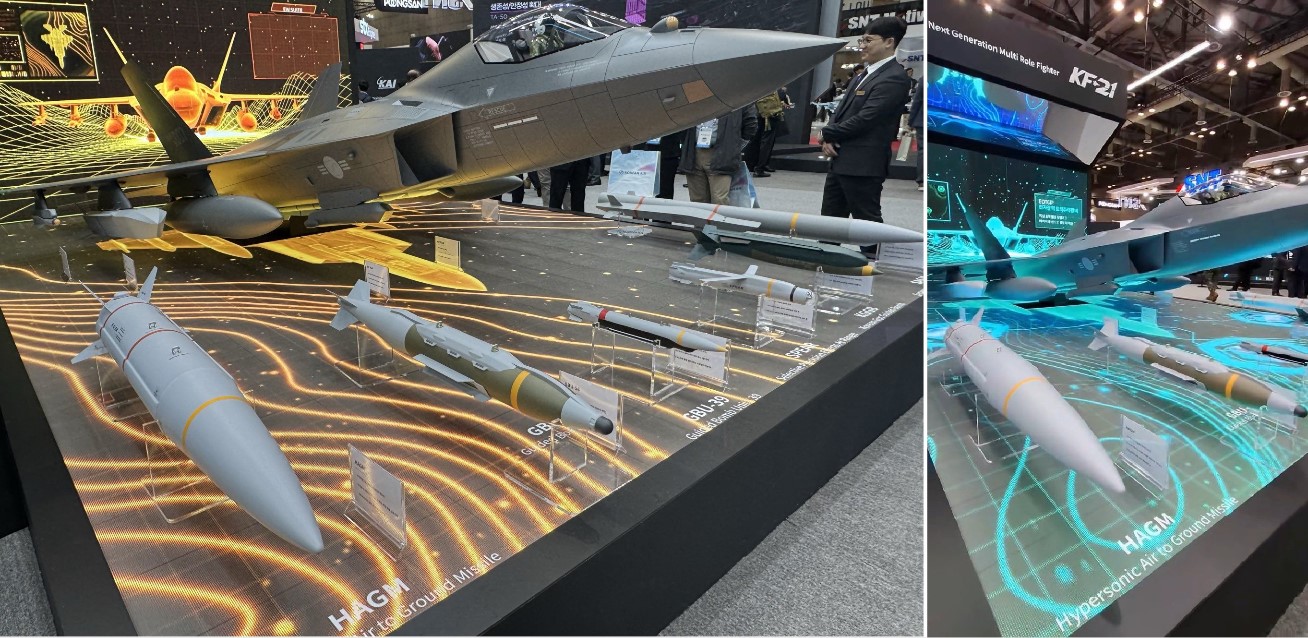
At the Seoul International Aerospace & Defense Exhibition (ADEX) 2025, South Korea officially unveiled the model of its Hypersonic Air-to-Ground Missile (HAGM) — a cutting-edge weapon that signals the nation’s entry into the elite circle of countries developing operational hypersonic strike systems. Designed primarily for integration with the KF-21 Boramae 4.5++ generation fighter jet, the HAGM marks a defining step in Seoul’s ambition to establish self-reliance in next-generation airpower and precision-strike capabilities.
The HAGM is being developed under South Korea’s Defense Acquisition Program Administration (DAPA) and the Agency for Defense Development (ADD). The program’s goal is to produce a high-speed, maneuverable, precision-strike missile capable of penetrating advanced air defenses and destroying hardened or time-sensitive targets deep inside enemy territory.
According to early specifications displayed at ADEX 2025, the HAGM is estimated to have:
-
Length: Approximately 5–6 meters
-
Weight: Around 1,500–1,800 kg
-
Speed: Over Mach 5, with sustained hypersonic glide capability
-
Range: Between 500–700 km, allowing deep-strike missions beyond frontline zones
-
Propulsion: Dual-stage system with a solid rocket booster for initial acceleration and a scramjet engine for sustained hypersonic cruise
-
Guidance: Combined INS/GPS midcourse navigation with electro-optical and radar seekers for terminal precision
-
Warhead: Modular design supporting both high-explosive and penetrator variants
Integration with KF-21 Boramae
The missile has been optimized for the KF-21, South Korea’s indigenous multirole fighter developed by KAI (Korea Aerospace Industries). The HAGM’s dimensions and aerodynamic layout allow it to be carried underwing or possibly semi-recessed on future KF-21 variants. Once operational, the combination of KF-21 + HAGM will give the Republic of Korea Air Force (ROKAF) a formidable strike platform capable of rapid, long-range, and survivable missions against high-value ground targets.
Hypersonic Ambitions and Regional Significance
The unveiling of the HAGM model underscores Seoul’s strategic shift toward developing independent hypersonic capabilities, a domain previously dominated by the U.S., China, and Russia. It follows South Korea’s earlier hypersonic research under the Hycore project — a scramjet-powered test vehicle jointly developed by ADD and Hanwha Aerospace, which successfully demonstrated sustained hypersonic flight in recent trials.
The HAGM is seen as the weaponization stage of Hycore technology, turning a demonstrator into an operational system. By combining hypersonic speed with precision targeting, South Korea aims to neutralize critical missile launchers, command centers, and air defense networks before they can threaten the Korean Peninsula.
Strategic Implications
The development comes at a time of intensifying missile competition in East Asia. North Korea continues to test various hypersonic glide vehicles and long-range systems, while China’s DF-ZF and Japan’s ongoing Hyper Velocity Gliding Projectile (HVGP) program have pushed regional powers to accelerate their own efforts. The HAGM thus serves not only as a deterrent tool but also as a technological equalizer in a rapidly evolving threat environment.
For South Korea, the HAGM will play a critical role in its “three-axis” defense framework, particularly under the Kill Chain preemptive strike concept — giving the ROKAF the ability to conduct first-strike operations with unprecedented speed and precision.
Sources at ADEX indicate that prototype flight testing is expected to begin by 2027, with full operational capability projected around 2030, depending on KF-21 integration timelines. Once in service, the missile could also be adapted for surface launch platforms, including ground-based or naval versions, potentially transforming the Republic of Korea’s entire long-range strike doctrine.
The unveiling of the HAGM is more than a technological showcase — it represents South Korea’s emergence as a serious player in the global hypersonic arena. By investing in indigenous research, propulsion, and guidance technologies, Seoul is setting the foundation for a future where its air force is not just reactive but strategically dominant in precision, speed, and autonomy.
✍️ This article is written by the team of The Defense News.