South Korea Launches Indigenous Short-Range Air-to-Air Missile Program for KF-21 Aircraft
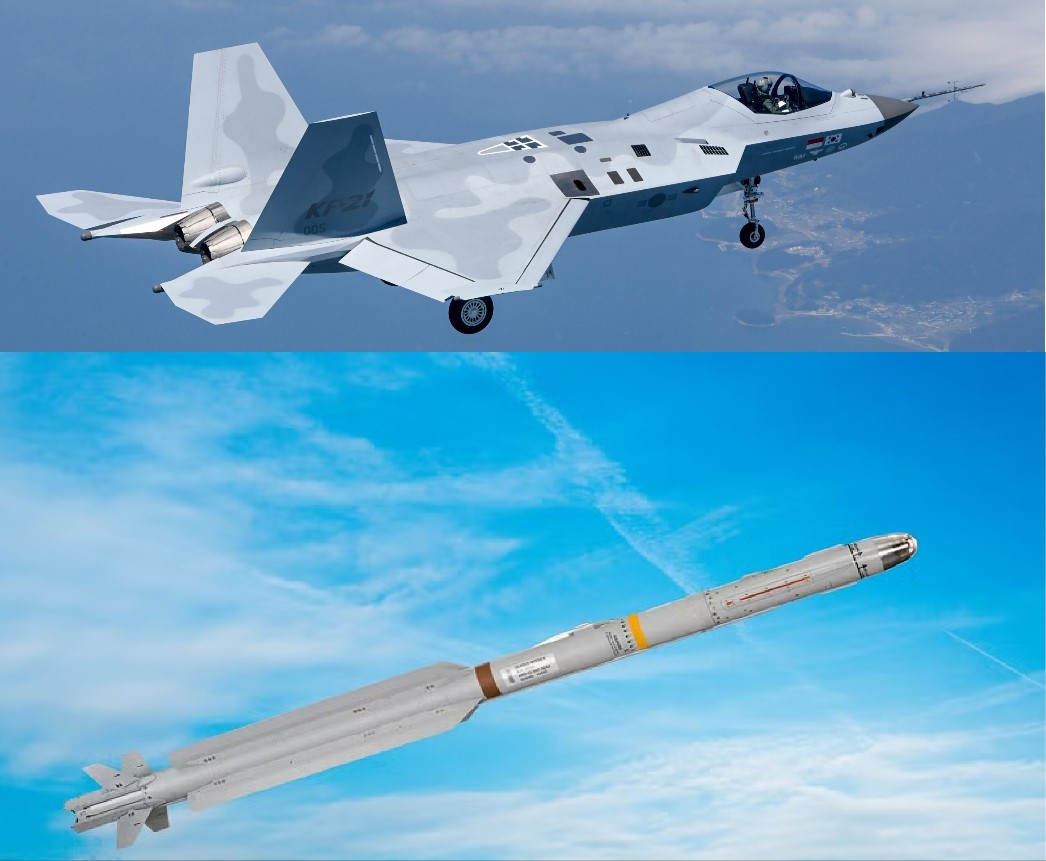
South Korea has approved a 435.9 billion won (USD 296 million) program to develop an indigenous short-range air-to-air missile for its next-generation KF-21 Boramae fighter jet. The decision—confirmed on 2 December 2025 by the Defense Acquisition Program Administration (DAPA)—marks the first effort to equip the KF-21 with a fully homegrown air-to-air weapon, reinforcing Seoul’s strategy to secure long-term autonomy in key defense technologies.
The program, scheduled to run until 2032, is designed not only to support the Republic of Korea Air Force’s (ROKAF) operational needs but also to enhance the KF-21’s appeal in the global fighter market at a time when many countries seek capable yet affordable alternatives to high-cost Western jets.
A Significant Shift in the KF-21’s Armament Roadmap
At present, the KF-21 relies on foreign missiles, including the IRIS-T for short-range engagements and the Meteor for beyond-visual-range (BVR) combat. Future integration of AIM-120 AMRAAM and AIM-9X Sidewinder is also under consideration.
The new missile program does not replace these weapons immediately. Instead, it establishes a parallel domestic capability that can be shaped specifically around the KF-21’s:
-
advanced AESA radar,
-
electronic warfare suite,
-
helmet-mounted display system,
-
and future stealth enhancements.
This shift provides the ROKAF with a layered mix of imported, combat-proven missiles and a gradually expanding indigenous family of air-to-air weapons. For export customers, it offers a package less exposed to foreign licensing restrictions—an increasingly important factor in the Indo-Pacific and Middle East markets.
ADD, LIG Nex1, and Hanwha to Lead Development
The missile’s development will be led by the Agency for Defense Development (ADD), with major industrial involvement from:
-
LIG Nex1 — seeker technology, guidance systems, datalinks, electronics
-
Hanwha Aerospace — propulsion and airframe engineering
-
Korea Aerospace Industries (KAI) — integration with the KF-21 test fleet
These firms already collaborate on advanced missile programs such as the Cheonryong cruise missile, the TAipers missile, and the Cheongung (KM-SAM) system. Their combined experience suggests the new weapon will compete with leading Western short-range missiles.
Expected Features: High Agility, Imaging Infrared Seeker, and Wide Engagement Angles
Defense analysts believe the new missile will incorporate several advanced features even though DAPA has not released detailed specifications. The weapon is expected to use an imaging infrared seeker capable of resisting modern countermeasures, combined with high off-boresight engagement angles that allow the KF-21 to target enemy aircraft across extreme positions during close-range combat.
Engineers are also likely to adopt agile control surfaces or thrust-vectoring technology to give the missile strong maneuverability, along with a datalink for mid-course corrections when operating in a networked environment. Most importantly, the missile will be designed from the outset to integrate seamlessly with the KF-21’s sensors, electronic warfare suite, and helmet-mounted sight.
If these projections are fulfilled, the new weapon will give South Korea a sovereign alternative to systems such as the AIM-9X, IRIS-T, or ASRAAM, but without the export limitations or modification restrictions associated with foreign technology.
Strategic Autonomy in a Changing Security Environment
The broader security context makes this development particularly significant. North Korea continues to expand its missile testing activities, China is rapidly modernizing its air and naval forces, and regional competition among major powers is intensifying across Northeast Asia.
At the same time, Europe and the United States have introduced tighter export-control policies that increasingly influence global arms transfers. Against this backdrop, DAPA has emphasized that the new missile program is essential for maintaining strategic autonomy, ensuring that South Korea can control upgrades, software changes, and export decisions without relying on foreign approval.
This independence also strengthens Seoul’s leverage within its alliance with the United States and offers greater flexibility during crisis scenarios. For countries considering the KF-21—such as Indonesia, Malaysia, the Philippines, and several Middle Eastern partners—the availability of a fully domestic missile reduces the risks associated with third-party licensing or external political constraints..
Budget and Industrial Impact
Although the missile program’s budget of 435.9 billion won, spread between 2025 and 2032, represents only a small portion of the KF-21’s overall 8.8 trillion won development cost, it carries substantial industrial benefits.
For South Korea’s defense sector, the program secures long-term work for LIG Nex1 and Hanwha, supports high-skilled employment, and advances the country’s expertise in infrared seekers, propulsion systems, and guidance algorithms. It also strengthens the foundations for future missile exports tied to KF-21 sales.
As the fighter approaches full operational capability in the early 2030s, the new missile ensures that its weapons suite evolves in parallel, optimized specifically for the aircraft’s architecture.
Building a Fully Sovereign Air Combat Ecosystem
This initiative is part of South Korea’s broader plan to build a fully sovereign air combat ecosystem around the KF-21. In addition to the new short-range missile, the country is pursuing a long-range air-to-air weapon, precision air-to-ground munitions, air-launched cruise missiles, and upgraded electronic warfare pods, along with future stealth-related enhancements.
Together, these developments position the KF-21 not merely as a next-generation fighter but as the core of an integrated, domestically controlled combat system designed to endure and adapt over the coming decades.
About the Author
Aditya Kumar:
Defense & Geopolitics Analyst
Aditya Kumar tracks military developments in South Asia, specializing in Indian missile technology and naval strategy.