South Korea Launches First Four PKX-B Batch-II Fast Attack Craft in Major Naval Modernization Push
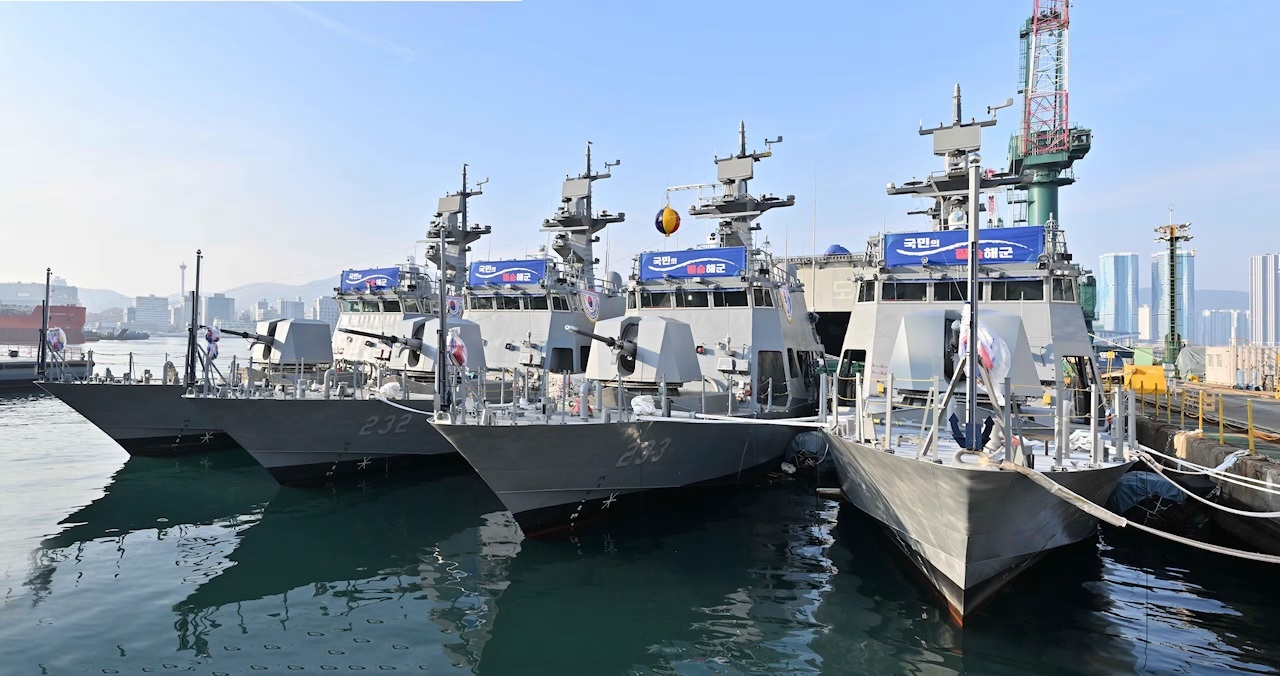
The Republic of Korea Navy (ROKN), in partnership with the Defense Acquisition Program Administration (DAPA), successfully launched four advanced Chamsuri-class PKMR (Patrol Killer Medium Rocket) fast attack craft on December 8 at the HJ Shipbuilding & Construction shipyard in Busan, marking a major step forward in Seoul’s coastal defense modernization.
The newly unveiled vessels — Chamsuri-231, Chamsuri-232, Chamsuri-233, and Chamsuri-235 — are the first four units of the PKX-B Batch-II program, a domestically designed and built series of high-speed patrol boats intended to replace aging Chamsuri-class PKM craft that have served for decades.
Strategic Enhancement in Coastal Defense
The 230-ton Batch-II patrol boats, each approximately 44 meters long with a 7-meter beam, are tailor-made for littoral engagements and rapid response missions close to Korean shores, particularly along the Northern Limit Line (NLL) where tensions with North Korean naval forces have periodically flared.
At the launching ceremony, attended by some 70 military, government, and industry representatives, including Rear Admiral Ahn Sang-min, Commander of the ROK Navy Logistics Command, officials emphasized the strategic importance of these vessels for enhanced maritime surveillance, coastal interdiction, and neutralization of infiltration threats.
Advanced Capabilities and Design Upgrades
The Batch-II PKMRs bring significant improvements over both the legacy PKM fleet and the earlier PKX-B Batch-I boats. Key systems and capabilities include:
-
Heavier and more versatile armament: A 76 mm main gun, dual 12.7 mm machine gun remote weapon stations (RWS), and a 12-cell 130 mm guided rocket launcher with rapid salvo capability provide both precision and area-denial firepower.
-
Next-generation combat management and sensor suites: Integrated fire-control consoles unify weapon engagement and missile targeting, while enhanced radar and electro-optical sensors improve situational awareness in complex coastal environments.
-
Improved survivability: Advanced electronic warfare systems, anti-jamming communications, and performance-enhanced MASS soft-kill decoy systems bolster resistance to modern anti-ship missiles.
-
Structural and safety upgrades: Batch-II boats incorporate fire dampers and ventilation controls that limit fire spread and improve crew protection.
Propulsion is provided by state-of-the-art marine gas turbine and diesel engines in a CODAG (Combined Diesel and Gas) configuration, delivering maximum speeds of up to 40 knots — critical for swift reaction to surface threats. A supplier contract with GE Aerospace will provide additional LM500 marine gas turbines for future Batch-II units, underscoring the program’s industrial scale and long-term sustainment plan.
Program Timeline and Outlook
The PKX-B Batch-II program began with a construction contract signed in 2022, followed by steel-cutting in 2024 and keel-laying in 2025. After final outfitting and sea trials, the four newly launched vessels are slated for delivery between August and November 2026, ahead of their full integration into the ROK Navy’s operational forces.
Once commissioned, these patrol boats will operate alongside Yoon Youngha-class patrol vessels (PKG) and previous Batch-I PKMRs, forming a layered coastal defense architecture designed to protect South Korea’s northern and western maritime approaches.
Broader Security Context
South Korea’s emphasis on advanced small combatants reflects an evolving maritime doctrine that prioritizes distributed lethality, rapid response, and network-centric operations in congested and contested littoral waters — where swift interception and precision firepower often outweigh sheer size.
The addition of Batch-II PKMRs comes as regional naval competition intensifies and the ROK Navy seeks to maintain robust defensive and deterrent posture along disputed maritime boundaries, such as those near the Yellow Sea and the Yellow Sea’s Northern Limit Line, historically the site of clashes including the 2002 Battle of Yeonpyeong.
With a total of 18 units planned in the Batch-II series, South Korea is steadily building a modern, highly mobile coastal patrol force capable of confronting both traditional and asymmetric naval threats well into the next decade.
✍️ This article is written by the team of The Defense News.