Solar Defense Aerospace Selected to Development of India’s 150kg-Class Stealth Loitering Munition Range 900 Km
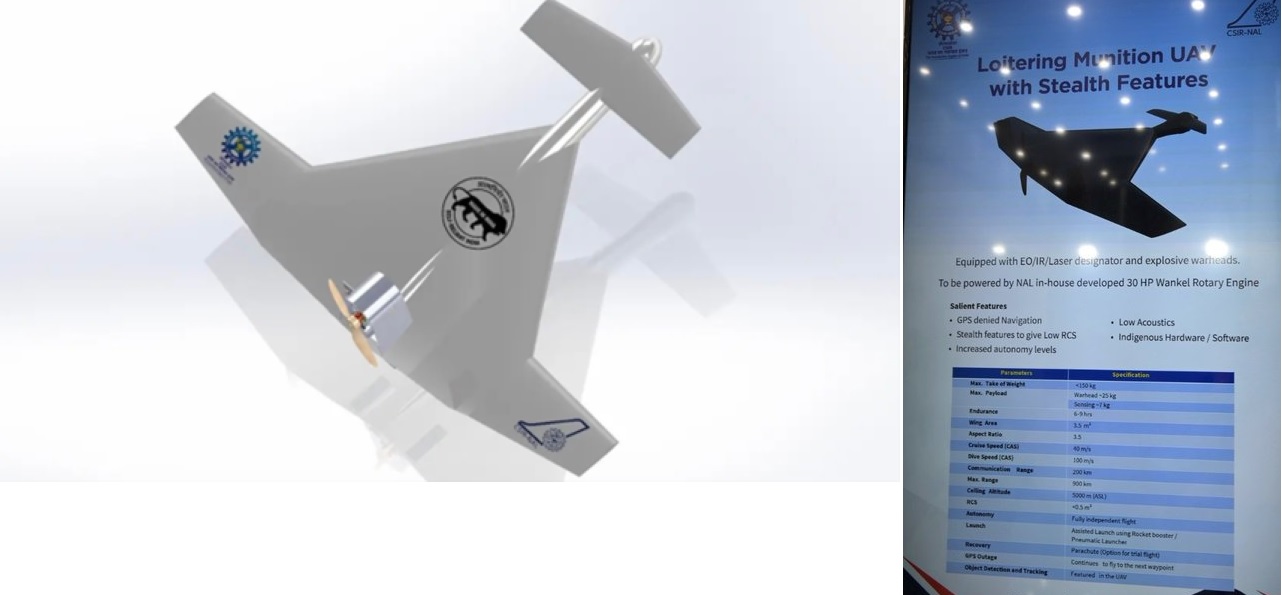
In a significant advancement for India’s indigenous unmanned weapons program, SolarDefense & Aerospace Ltd. (SDAL), in collaboration with Economic Explosives Ltd., Nagpur, has been ranked first and shortlisted by CSIR-National Aerospace Laboratories (CSIR-NAL) to develop and manufacture a next-generation 150 kg-class stealth loitering munition. This program is a key part of India’s drive to develop a long-range, precision-guided, stealth unmanned aerial weapon system under full domestic control.
The selection, announced via an official CSIR-NAL office memorandum dated 27th June 2025, places SDAL ahead of other leading contenders, including Bharat Dynamics Ltd., Raphe mPhibr, Bharat Electronics Ltd., and NewSpace Research & Technologies. SDAL scored 80.30 points in the Combined Technical Cum Commercial Based System (CTCCBS), securing the opportunity to enter into formal joint collaboration with CSIR-NAL.
A Stealthy Lethal Loiterer: The Proposed System
As per official technical presentations and documentation reviewed, the proposed LM-UAV (Loitering Munition UAV) is set to redefine India’s air-launched precision strike capabilities. Below are its key performance features:
Technical Highlights:
-
Total Weight (AUW): ~150 kg
-
Wingspan: 3.5–4.0 meters
-
Cruise Speed: 143 km/h
-
Dive Speed: 360 km/h
-
Endurance: 6–9 hours
-
Range: Up to 900 km
-
Cruise Drag: 16 kg (estimated)
-
Maximum Altitude: 5 km
Payload and Sensors:
-
Warhead Payload: ~15 kg high-explosive
-
Sensing Payload: 10–15 kg, including EO/IR (electro-optical/infrared), laser designator
-
Navigation: GPS-denied capable
-
Launch Method: Assisted (possibly pneumatic or catapult)
Propulsion:
The LM-UAV will be powered by NAL’s indigenous 30 HP Wankel engine, a compact rotary engine design optimized for low-noise and fuel-efficient flight—an essential component for a stealth platform.
Designed for Stealth and Deep Precision
Stealth is a core design priority for this UAV. The proposed airframe adopts a low radar cross-section (RCS) profile using modern stealth shaping and materials. It is specifically engineered to survive in heavily contested airspace and can loiter over the battlefield for hours, scanning and engaging high-value or time-sensitive targets with precision.
This system aims to bridge the gap between tactical drones and heavier cruise missiles, providing India's armed forces with an affordable, long-range, air-launched loitering munition that can be deployed from manned or unmanned platforms.
Operational Flexibility and Strategic Role
With a range of 900 km and up to 9 hours of flight time, the LM-UAV can support a variety of missions, including:
-
SEAD (Suppression of Enemy Air Defenses)
-
Deep strike operations in contested zones
-
Maritime surveillance and anti-ship strikes
-
Border area precision attacks on mobile launchers or radar assets
Its assisted launch system also opens the door for ship-based or ground mobile launcher deployment, greatly increasing operational flexibility.
A Competitive Selection Process
According to CSIR-NAL’s evaluation (Memo No. PBMD/LM-UAV/RFP/2025-26), SDAL emerged as the top scorer among five commercial bidders. The full list and scores are as follows:
| Rank | Firm | CTCCBS Score |
|---|---|---|
| 1 | SolarDefense & Aerospace Ltd. (Nagpur) | 80.30 |
| 2 | Bharat Dynamics Ltd. (Hyderabad) | 78.62 |
| 3 | Raphe mPhibr Pvt. Ltd. (Noida) | 76.78 |
| 4 | Bharat Electronics Ltd. (Bangalore) | 73.43 |
| 5 | New Space Research & Technologies (Bangalore) | 66.85 |
Some major players, including Adani Defence Systems, Tata Advanced Systems, and Triveni Engineering, qualified technically but failed to submit a commercial bid.
As per CSIR-NAL’s protocol, if SDAL fails to enter a collaboration agreement within the stipulated timeframe, the opportunity will be offered to the next highest-ranked bidder.
The Road Ahead
With SDAL now poised to lead this critical R&D and production program, prototype development is expected to begin in the coming months, followed by rigorous static and flight trials. If successful, this loitering munition will significantly bolster India’s offensive capabilities in both conventional and hybrid warfare environments.
The system not only underscores India’s growing aerospace self-reliance but also places Indian industry among a select few globally—alongside Israel, China, Turkey, and the United States—capable of producing long-endurance, stealth loitering munitions.
India’s decision to move ahead with a stealth-capable, indigenous loitering munition platform reflects a maturing defence ecosystem. With SolarDefense at the helm, the country is set to enter a new era of autonomous, precise, and survivable strike capabilities from the skies.
✍️ This article is written by the team of The Defense News.