Saudi-Pakistan Defence Pact Signals Strategic Shift: Implications for Middle East, Delhi & Beyond
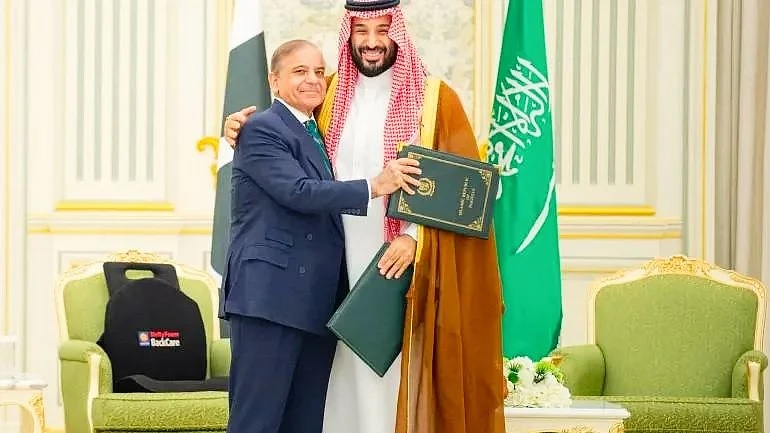
In a landmark move, Saudi Arabia and Pakistan have signed a Strategic Mutual Defence Agreement (SMDA) in Riyadh, under which “any aggression against either country shall be considered an aggression against both.” The pact was signed by Crown Prince Mohammed bin Salman and Prime Minister Shehbaz Sharif, with Army Chief Field Marshal Asim Munir present — underscoring the endorsement of Pakistan’s powerful military.
Key Provisions & Signals
-
Pakistan’s Defence Minister declared that Pakistan’s nuclear capability “will be made available” to Saudi Arabia under this pact, marking a historic acknowledgement of what had long been speculated as an informal nuclear umbrella.
-
The agreement has been described as comprehensive, covering all military means of defence. Saudi officials stopped short of naming adversaries, but the timing — just after Israel’s strike on Doha, which killed senior Hamas leaders — highlights the urgency behind the move.
-
The pact signals a deliberate shift by Riyadh from a purely US-centric security order toward a more diversified and independent security framework.
Regional & Global Implications
For Gulf & Middle East Security
This pact marks a departure from total reliance on US security guarantees. Saudi Arabia, long anxious about Washington’s willingness to act decisively in its defence, is now anchoring its security directly with Pakistan. This provides Riyadh with a credible nuclear deterrent, altering calculations across the region.
For Israel, the agreement complicates military planning. Any strike against Gulf targets could now theoretically provoke a response tied to Pakistan’s nuclear umbrella. It could slow Israel’s normalization talks with Riyadh and force Tel Aviv to proceed with far greater caution in its regional operations.
The pact also has consequences for the Gulf’s approach to Iran and to non-state actors like the Houthis in Yemen. With nuclear-armed backing, Saudi Arabia might act with increased assertiveness in countering these threats.
For India
For India, this agreement is a major diplomatic headache. A Pakistan newly empowered with Saudi financial and political backing may take a harder line on Kashmir and on terrorism-related disputes. If Saudi funds support Pakistan’s military modernization, New Delhi could face a stronger adversary on its western frontier.
India is expected to respond by:
-
Deepening its defence partnership with Israel.
-
Ramping up military procurement and modernization.
-
Strengthening ties with Gulf capitals to avoid an overt pro-Pakistan tilt.
-
Expanding defence cooperation with the United States and other Indo-Pacific partners to balance this emerging bloc.
For Israel & Global Power Balance
The agreement introduces new deterrence risks into the region. With Pakistan’s nuclear deterrent formally or informally tied to Gulf security, the costs of military miscalculation rise sharply. This could either stabilize the region by deterring aggression — or escalate risks if crises spiral.
At the same time, the deal highlights waning US influence in the Gulf. It opens the door for China, already a close partner of both Islamabad and Riyadh, to play a greater role as mediator, arms supplier, and economic partner.
Toward an ‘Islamic NATO’?
The pact has revived debates about an “Islamic NATO” — a collective Muslim military alliance. With Saudi Arabia, custodian of Islam’s holiest sites, aligning formally with Pakistan, the only Muslim nuclear power, momentum for a broader bloc may grow.
Still, internal rivalries among Arab states, differences with Iran, and geopolitical divides make such an alliance difficult to realize. Yet, the symbolism of this pact is powerful and may inspire countries like Qatar and Turkey to consider similar arrangements.
Challenges & Uncertainties
-
Ambiguity: The pact leaves unclear what level of aggression would trigger a joint response, or how nuclear assets would be coordinated.
-
Escalation risks: With mutual defence in place, even small cross-border clashes could spiral into larger confrontations.
-
International scrutiny: Questions about nuclear proliferation and arms race dynamics are likely to intensify.
-
Domestic balancing: Pakistan faces economic strain, while Saudi Arabia must weigh this bold step against its ties with the US, Israel, and Western partners.
The Saudi-Pakistan defence pact is more than a symbolic gesture. It represents a strategic shift in regional power structures — placing Pakistan’s nuclear umbrella at the heart of Gulf security, unsettling India, complicating Israel’s calculations, and signaling reduced reliance on Washington.
For India, the message is clear: recalibrate diplomacy, modernize militarily, and re-engage strategically — because a more assertive, Riyadh-backed Pakistan has just entered the regional equation.
✍️ This article is written by the team of The Defense News.