Saab Unveils World’s First Fully 3D-Printed Aircraft Fuselage, Set to Fly in 2026
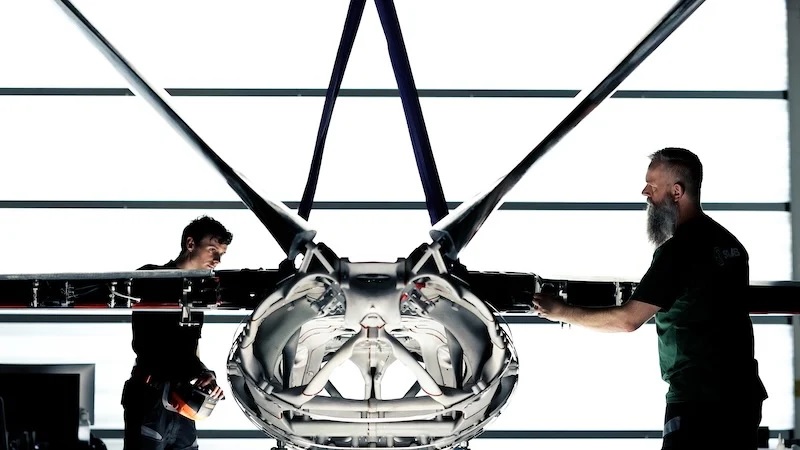
Saab has unveiled a landmark achievement in aerospace engineering: a five-metre aircraft fuselage produced entirely through 3D printing, using Divergent Technologies’ advanced additive manufacturing system. The structure, which has already passed initial proof-load testing, is scheduled for its first flight in 2026 and is being described as a decisive step toward a new era of software-defined hardware in aviation.
The demonstrator goes far beyond a novel manufacturing method. Saab says it represents the first attempt by any airframer to apply the rapid-iteration philosophy of software development to physical aircraft structures. If flight trials confirm its performance, the approach could transform how military aircraft are designed, produced and modernised—shifting from decades-long cycles to continuous, software-driven hardware evolution.
A New Phase in Swedish Aerospace Strategy
The project reflects a broader transformation inside Sweden’s aerospace sector. Saab has long argued that competitive advantage in future air combat will come from the ability to orient and adapt faster than opponents. That thinking shaped the original Gripen’s modular, low-cost architecture and later inspired the digital-engineering push behind the Gripen E.
The 3D-printed fuselage is positioned as the next expression of that strategy. Saab brought together additive production, AI-driven optimisation and its maturing model-based digital engineering environment to create a structure that can be redesigned as quickly as mission software.
Gripen E’s Digital Twin and AI Avionics Led to the Breakthrough
Much of the groundwork began during the Gripen E programme, where Saab abandoned traditional paper engineering in favour of a fully digital model-based approach. Every discipline worked from a shared digital twin of the aircraft, enabling early simulations, faster design trades and more accurate integration before any manufacturing began.
Gripen E’s avionics architecture advanced that concept further by separating flight-critical and mission-critical software, enabling rapid updates throughout the jet’s life cycle. Saab notes that Gripen E became the first production fighter to fly with an onboard AI agent integrated into standard avionics computers.
This prompted internal research into whether hardware could be made as flexible as software—a question that led directly to the 3D-printed fuselage project.
Inside Saab’s Push for Software-Defined Hardware
At the company’s Rainforest innovation centre, engineers began exploring how AI, 3D printing and model-based engineering could unlock a new class of adaptable airframes. Axel Baathe, who heads the unit, said the ambition was to give customers the same pace of iteration for structures that they currently enjoy for mission-system updates.
“Customers can develop mission-critical applications in the morning and fly them in the afternoon,” Baathe said. “Our challenge was to bring that same flexibility to physical hardware. We call this software-defined hardware manufacturing.”
Baathe noted that conventional factories rely heavily on fixed tooling, moulds and jigs—components that take months to produce and limit redesign. By contrast, software-defined manufacturing aims to eliminate those constraints entirely.
A 3D-Printed Fuselage Built From Just 26 Parts
To achieve this, Saab partnered with California-based Divergent Technologies, whose Divergent Adaptive Production System integrates AI-optimised design, high-precision metal additive manufacturing and fixtureless robotic assembly. The joint effort produced a five-metre fuselage section composed of only 26 printed metal parts, compared with the thousands typically found in a traditional aircraft section.
Instead of the familiar ribs and stringers of conventional designs, the internal structure follows flowing, organic load paths generated by optimisation algorithms. Saab says these shapes would be impossible to design by hand. The approach reduces part count by more than a factor of 100, eliminates thousands of fasteners and opens the door to embedding systems like wiring and cooling channels directly into the printed components.
The fuselage will be flight-tested on an autonomous airborne platform now in development. If successful, it would be one of the largest 3D-printed structures ever to complete powered flight.
Saab’s Reconfigurable Factory Vision
Beyond the hardware, Saab sees the project as the first step toward a fully reconfigurable “digital factory” capable of building any airframe defined in its digital twin. The company envisions production lines that shift instantly between designs without cost-prohibitive tooling changes.
“We believe the future factory will become one of our most important products,” Baathe said. “It will allow our customers to avoid being locked into fixed designs—either in hardware or software.”
The concept, internally summarised as “CAD in the morning, fly in the afternoon,” represents a dramatic departure from the aerospace industry’s traditional model, where tooling may remain in service for decades and restrict how often a design can evolve.
Implications for Future Fighters and Unmanned Systems
Although Saab has not linked the fuselage to any specific next-generation fighter programme, analysts say the implications are clear. The ability to rapidly redesign airframe sections could enable mission-specific variants, low-cost unmanned aircraft produced on demand, or frequent structural upgrades that are normally avoided due to cost and manufacturing complexity.
Saab says the new approach “reduces the cost of change, making redesign and implementing innovative ideas easier.” That philosophy aligns with the direction of modern airpower, where speed of adaptation is becoming as critical as outright performance.
A Potential Shift in Certification Standards
The 2026 test flight will also be closely watched by regulators. Aviation certification bodies have so far approved 3D printing primarily for small brackets and secondary structures due to concerns about fatigue behaviour and inspection challenges. A successful fuselage demonstration could push regulators to update certification pathways for large, printed primary structures.
Toward a Rapid-Iteration Future in Airpower
For Saab, the 3D-printed fuselage marks the beginning of a larger industrial shift—one that could enable smaller nations or constrained budgets to maintain cutting-edge fleets without the expense of decade-long development cycles.
“The joint team has done an excellent job preparing for first flight,” Saab said in its announcement.
If the 2026 demonstration succeeds, Saab and Divergent may help steer the aerospace sector toward an era where aircraft evolve continuously, driven by digital design, AI and software-defined manufacturing—reshaping not only how airframes are built, but how airpower itself is conceived.
✍️ This article is written by the team of The Defense News.