Saab Offers GlobalEye Early-Warning Aircraft to Saudi Arabia For AEW&C Modernisation
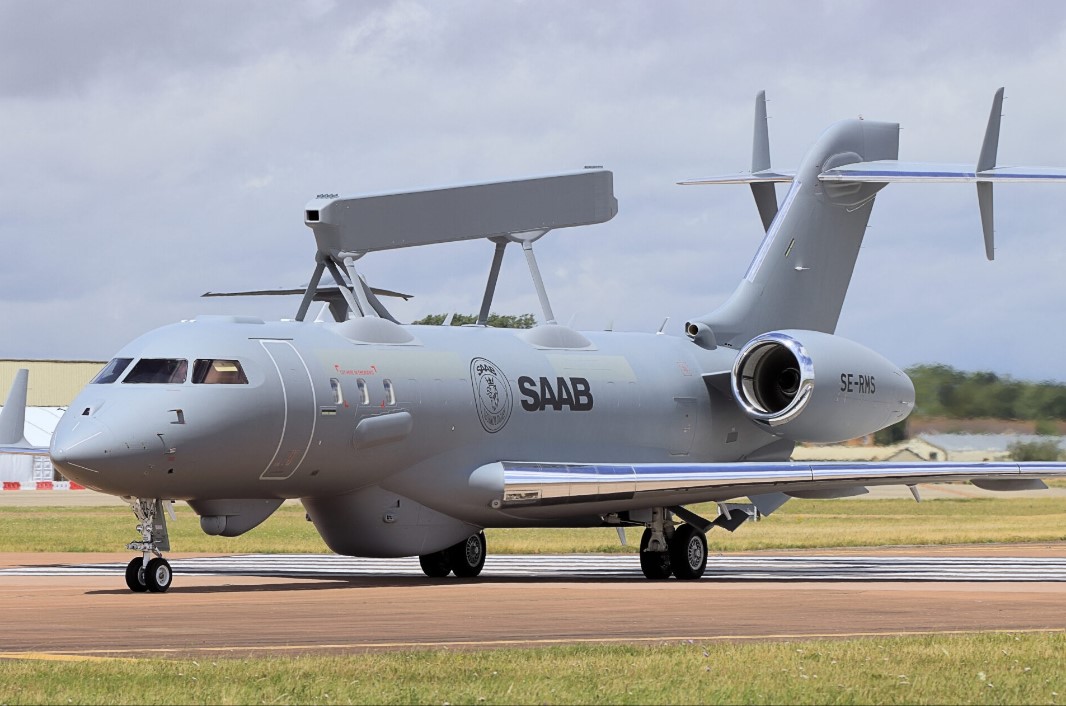
Swedish defence manufacturer Saab has formally offered its GlobalEye airborne early warning and control (AEW&C) aircraft to Saudi Arabia, according to a Reuters report released on 21 November 2025. The move comes as Riyadh accelerates efforts to modernise its long-range surveillance and command network under its broader defence transformation agenda.
Strong Saudi Interest, Confirms Saab
In an interview a day earlier in Montreal, Saab CEO Micael Johansson confirmed that Saudi Arabia has shown “strong interest” in the platform, which is already operated by the United Arab Emirates and several European customers. Johansson described the offer as part of ongoing discussions with the Kingdom, which has been evaluating options to strengthen its airborne and maritime situational awareness.
The proposal positions the GlobalEye as a potential future pillar of Saudi Arabia’s integrated air and missile defence, particularly as the region faces increasingly complex threats from drones, cruise missiles, and long-range precision weapons.
What GlobalEye Brings to the Table
Saab’s GlobalEye is widely regarded as one of the most advanced AEW&C platforms currently available. Built on the Bombardier Global 6000/6500 long-range business jet, the aircraft combines endurance, speed, and a sophisticated sensor suite designed for air, maritime and ground surveillance.
Its main features include:
-
Erieye ER AESA radar with a detection range exceeding 450–550 km, capable of tracking low-observable aircraft, cruise missiles, and drones across a wide area.
-
Leonardo Seaspray 7500E radar for maritime and ground surveillance, including synthetic-aperture and moving-target detection modes.
-
Electro-optical/infrared turret for day-night identification and tracking.
-
Mission suite with five operator consoles, satellite communications, and secure data-links enabling networked command and control.
-
Endurance of over 11 hours and a range exceeding 6,000 nautical miles, allowing extended operations over the Gulf, Red Sea, and Arabian Peninsula.
The GlobalEye’s ability to perform multi-domain surveillance simultaneously is a key selling point for militaries confronting both traditional air threats and emerging drone swarms.
Saudi Arabia’s Current AEW&C Fleet
If selected, GlobalEye would expand—and eventually supplement—Saudi Arabia’s existing airborne early-warning force. The Royal Saudi Air Force (RSAF) currently operates:
-
Five Boeing E-3 Sentry AWACS aircraft, acquired in the 1980s. These 707-based platforms remain central to Saudi airspace surveillance but face growing sustainment challenges due to their age and maintenance burden.
-
Two Saab 2000 Erieye AEW&C turboprops equipped with an earlier Erieye radar. These smaller aircraft have already familiarised Saudi crews with Saab’s AEW&C systems and operational concepts.
The E-3s have been heavily employed during the Yemen conflict, monitoring missile launches and guiding Saudi air defences. However, their older radar technology is less optimised for detecting small, low-flying drones and cruise missiles—threats that have become far more common in the region.
Why Saudi Arabia Is Interested
Saudi Arabia’s growing interest in the GlobalEye system is shaped by a combination of strategic, operational, and technological needs. Riyadh is seeking a more reliable and far-reaching early-warning capability to monitor Iranian missile launches, UAV activity, and regional airspace movements, especially as threats have become faster, stealthier, and more unpredictable. At the same time, the Kingdom wants to improve its visibility over key maritime zones—the Red Sea, Arabian Gulf, and Gulf of Aden—which are becoming increasingly contested due to drone attacks, smuggling networks, and great-power naval deployments.
Beyond surveillance, Saudi Arabia aims to strengthen multi-domain command and control, ensuring its fighter aircraft, naval forces, ground units, and missile-defence systems can share real-time data through a single airborne network. The GlobalEye fits naturally into this vision, particularly because it would also improve interoperability with the United Arab Emirates, which already operates the platform, and with European partners who are moving toward newer AEW&C solutions.
Finally, the interest is tied to Riyadh’s push for defence industrial localisation under Vision 2030. Saab’s willingness to support training, maintenance, and potential collaboration with Saudi Arabian Military Industries (SAMI) makes the GlobalEye not just an operational upgrade, but also an opportunity to expand domestic defence capabilities.
Growing Global Demand and Competitive Landscape
The offer to Saudi Arabia comes as international demand for advanced AEW&C systems rises sharply. NATO members, Gulf states and Indo-Pacific countries are reassessing their surveillance capabilities amid emerging long-range threats.
The GlobalEye has recently secured major export successes, including orders from Sweden and a planned acquisition by France, strengthening Saab’s position against competitors such as Boeing’s E-7 Wedgetail.
Potential Saudi Procurement Path
While Riyadh has not yet indicated the number of aircraft it may purchase, defence analysts expect a possible initial order of two to four GlobalEye aircraft, including mission systems, ground stations and long-term support packages. Such a deal could reach USD 1–1.4 billion, depending on configuration and industrial-offset requirements.
If negotiations progress, the GlobalEye could become the next major addition to Saudi Arabia’s expanding ISR architecture, marking one of the Middle East’s most significant airborne surveillance upgrades of the decade.
With Saab’s offer now formally on the table, Saudi Arabia joins a growing list of countries evaluating next-generation early-warning aircraft—at a time when information dominance is becoming as critical as firepower in modern warfare.
About the Author
Aditya Kumar:
Defense & Geopolitics Analyst
Aditya Kumar tracks military developments in South Asia, specializing in Indian missile technology and naval strategy.