Russia’s Su-75 Checkmate Seen Beside Su-57, Raising Fresh Questions on Program’s Direction
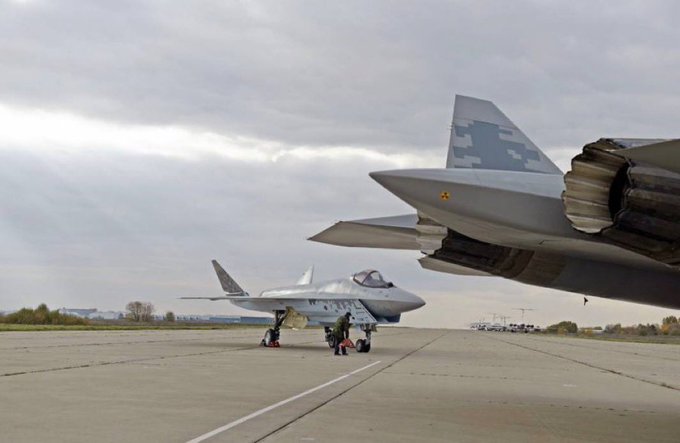
2 October 2025, a photograph circulated on social media showing Russia’s Su-75 “Checkmate” light stealth fighter parked near a Su-57 Felon. While both aircraft have been displayed together in staged presentations before, the latest image appears to be from an operational setting rather than a showroom floor. The presence of ground crew and wheel chocks suggests routine handling, sparking debate about whether the prototype is now transitioning into early testing.
The Su-75 program was first introduced in 2021 at the MAKS airshow, where a non-flying prototype was unveiled to the public. Russian officials at the time announced an ambitious schedule, promising a maiden flight within two years. That deadline has since shifted several times, with the current expectation pointing toward testing in 2025 or later. Despite the shifting timeline, the aircraft remains central to Russia’s plans for a lower-cost fifth-generation fighter intended for both domestic and export markets.
From a design perspective, the Su-75 is a single-engine, low-observable multirole fighter. Its configuration includes a diverterless supersonic inlet, V-tail surfaces, and internal weapons bays — features aligned with modern stealth design principles. The jet is projected to carry about 7.4 tons of weapons, reach speeds of nearly Mach 2, and cover a ferry range of 3,000 kilometers. These figures place it in competition with platforms such as the F-35 Lightning II from the United States and China’s FC-31 Gyrfalcon.
The question of engine choice is central to its credibility. The Checkmate is advertised to operate with the AL-51F-1, a next-generation powerplant derived from the AL-41 series. Developers claim it will be lighter, more fuel-efficient, and capable of producing higher thrust levels than its predecessor. However, it is unclear if the current prototype shown in the photograph is equipped with this engine or a temporary alternative for ground evaluation. Until the aircraft performs sustained flight trials, these claims remain untested.
The program has been actively marketed abroad, with Russia presenting it as an affordable alternative to Western fighters. A suggested unit price in the range of 25–30 million USD has been mentioned by officials, though such projections face skepticism given the complexities of stealth manufacturing under sanctions. In May 2025, discussions between United Aircraft Corporation and Belarus raised the possibility of co-production, which would not only provide financing but also position the jet close to NATO’s borders. Beyond Belarus, countries like the UAE, India, and Vietnam have been linked to the aircraft in past reports, though no confirmed deals exist.
For Russia, advancing the Su-75 serves two objectives: filling a domestic niche below the Su-57, and offering an export platform that could secure funding and political partnerships. For other nations, the attraction lies in acquiring stealth capability at a lower operational cost than twin-engine designs. However, this value depends entirely on whether the aircraft achieves reliable performance, particularly in areas such as engine durability, avionics integration, and stealth maintenance standards.
The appearance of the prototype alongside a Su-57 indicates more than simple display. The Su-57 is already in limited service and undergoing further development. Positioning the Su-75 in the same environment may allow data comparisons, test coordination, or ground handling rehearsals. While the photograph alone does not confirm flight readiness, it points toward progress beyond static exhibition — a necessary step if the aircraft is to move closer to operational testing.
The timeline for the Su-75 remains uncertain. If Russia can bring the AL-51 engine into full production and resolve supply chain constraints, the aircraft could enter flight trials within the next two years. For now, it remains a prototype with potential, but also with many unanswered questions. Whether it becomes a serious addition to Russia’s arsenal or primarily a marketing tool for foreign buyers will depend on the outcomes of its first real-world tests.
About the Author
Aditya Kumar:
Defense & Geopolitics Analyst
Aditya Kumar tracks military developments in South Asia, specializing in Indian missile technology and naval strategy.