Russia’s Su-57 Displays Stealth SEAD Capability With Internal Kh-58 Anti-Radiation Missiles
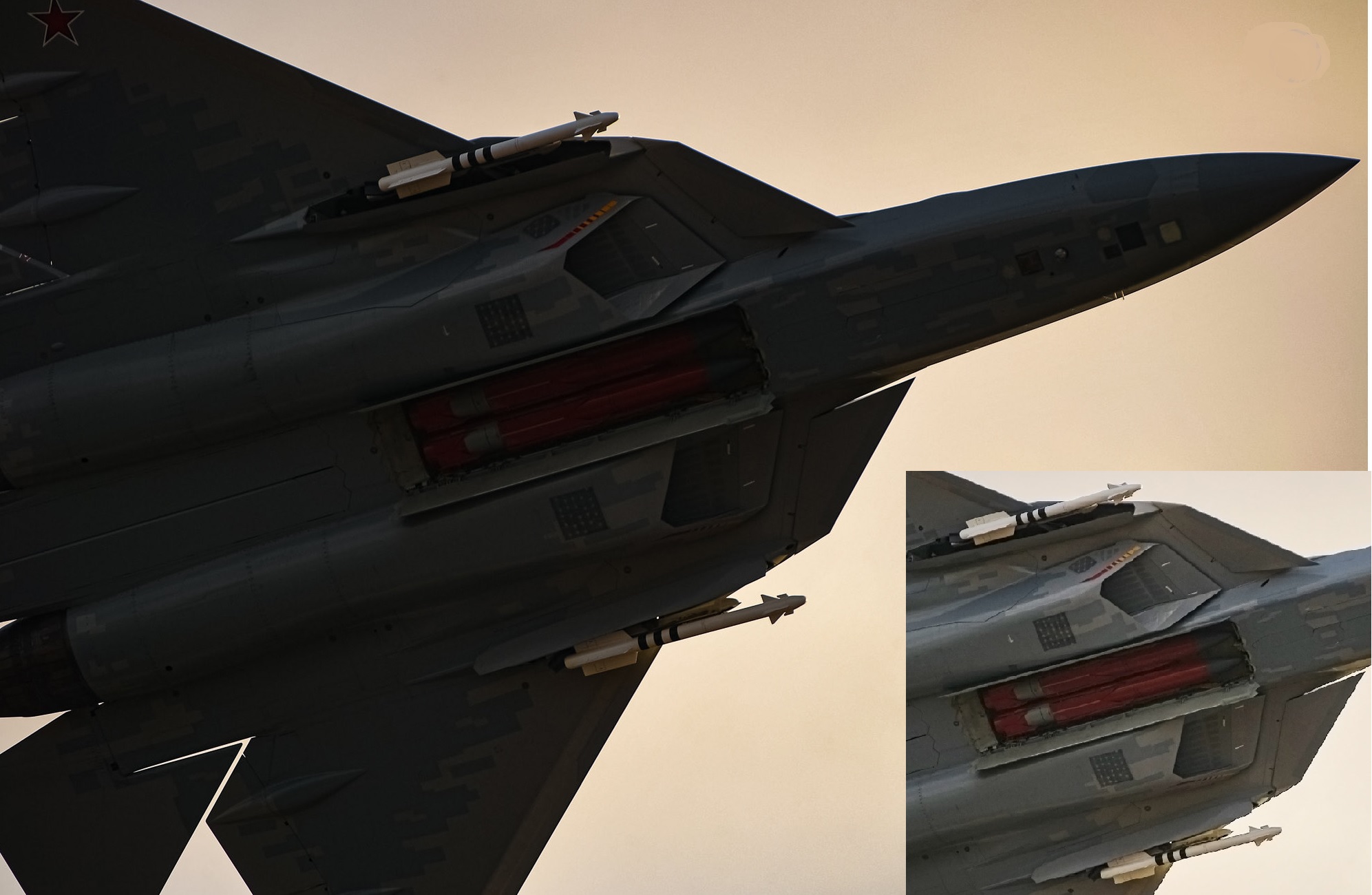
On November 9, 2025, the United Aircraft Corporation (UAC) released new promotional footage that immediately caught the world’s attention. For the first time, the video clearly showed Russia’s fifth-generation Su-57 Felon with its forward internal weapons bay open, revealing two large anti-radiation missiles nestled inside. The timing of this reveal—just days before the Dubai Airshow 2025—was no coincidence. It was a calculated display aimed at showcasing a maturing Suppression of Enemy Air Defenses (SEAD) capability, signaling to global buyers that the Su-57 has evolved into more than just a stealthy air-superiority fighter.
The Reveal: Inside the Felon’s Forward Bay
In the footage, the Su-57—specifically test airframe T-50-9 (“509”)—was seen performing dynamic fly-pasts with its bay doors partially open. What viewers saw inside those bays confirmed years of speculation: two long-bodied Kh-58UShK anti-radiation missiles adapted for internal carriage. This marks the first public proof that the Su-57 can carry such heavy ordnance internally, validating its UVKU-50 ejector system and confirming Russia’s progress in internal weapons integration.
The Kh-58UShK, part of the long-standing Kh-58 family, has been redesigned with folding control surfaces to fit within the Felon’s deep internal bays. This engineering feat allows the aircraft to carry and deploy heavy missiles without compromising stealth—something few non-Western fighters can claim.
Interestingly, the footage also showed two R-74 short-range air-to-air missiles mounted externally. While this compromises the Su-57’s radar signature, it served a marketing purpose: to visually demonstrate the fighter’s dual role—capable of striking enemy radars while defending itself in close-range engagements. In real operations, analysts believe these missiles would be moved into the Su-57’s side bays to preserve its low observable profile.
The Kh-58UShK: Russia’s Long-Range Anti-Radiation Spear
The Kh-58 family remains the backbone of Russia’s anti-radiation missile arsenal. Originally developed in the Soviet era, the missile has evolved into modern variants optimized for digital warfare environments and stealth integration. The Kh-58UShK, the variant adapted for the Su-57, features modular architecture and improved guidance capable of detecting and homing in on radar emissions from enemy surface-to-air missile (SAM) systems.
Key Specifications (Kh-58UShK):
-
Length: ~4.8 meters
-
Weight: ~650 kilograms
-
Speed: Up to Mach 3.6
-
Range: 200–250 kilometers (depending on altitude and launch profile)
-
Warhead: ~150 kg high-explosive fragmentation
-
Guidance: Passive radar seeker with programmable frequency bands
This long-range reach allows the Su-57 to target advanced air defense radars, such as the Patriot, SAMP/T, or NASAMS, without leaving the stealth protection envelope. The internal carriage ensures reduced radar cross-section (RCS) while maintaining the fighter’s aerodynamic efficiency and speed during ingress missions.
Engineering Feat: The UVKU-50 Ejector System
One of the less visible but most critical elements of this capability is the UVKU-50 family of internal ejectors developed by Vympel. These launchers were purpose-built to release large weapons like the Kh-58UShK cleanly into the airstream, even during high-speed or high-G maneuvers.
Until now, there had been doubts about whether the Su-57’s internal structure could accommodate and eject such long weapons without compromising the stealth bay’s integrity. The new footage ends that debate: the Su-57’s forward bay has sufficient volume, sequencing, and door clearance to deploy large anti-radiation missiles safely.
Comparisons: How Other Stealth Fighters Handle SEAD
In the global context, only a handful of stealth fighters are capable of internally carrying anti-radiation missiles.
-
F-35 Lightning II (USA): The F-35 has been progressively integrated with the AGM-88G AARGM-ER and SiAW (Stand-in Attack Weapon)—smaller, faster, and more compact missiles designed to fit into its internal bays. These weapons can hit targets over 200 km away and are optimized for stealth operations.
-
F-22 Raptor (USA): The F-22 remains primarily an air-superiority fighter. It does not routinely carry large ARMs internally and relies on other platforms for SEAD roles.
-
J-20 Mighty Dragon (China): While the Chinese J-20 possesses internal bays large enough for long-range weapons, no evidence has surfaced of internal ARM carriage.
This puts the Su-57 in a unique position among non-Western stealth aircraft: capable of housing heavy, full-sized anti-radiation missiles internally, rather than relying on externally mounted or miniaturized versions.
Strategic Timing: A Message Before Dubai
The release of this footage just before the Dubai Airshow 2025 was a masterstroke in defense marketing. Moscow is seeking to attract foreign buyers for the Su-57 amid Western sanctions and production challenges. The clip also follows a string of leaks—allegedly by the “Black Mirror” group—hinting at export talks with Iran, Algeria, and Ethiopia.
For each of these nations, the Su-57’s new SEAD capability carries specific strategic value:
-
Iran could use such capability to counter advanced radar systems in the Persian Gulf region.
-
Algeria seeks to maintain a technological edge in North Africa’s increasingly layered air defense environment.
-
Ethiopia may view the Su-57 as a prestige purchase to anchor its air force modernization program.
By showing the Su-57 carrying heavy ARMs internally, Russia signals not just technological progress—but a readiness to export a complete fifth-generation strike and suppression package.
Operational Significance: From Speculation to Reality
For years, the Su-57’s combat potential in SEAD/DEAD missions was speculative. With this footage, it becomes tangible. The dual Kh-58UShK loadout demonstrates that the aircraft can engage radar emitters deep inside defended zones while maintaining stealth.
Combined with its sensor fusion, L-band radar arrays, and infrared search and track (IRST) systems, the Su-57 can independently locate, classify, and strike enemy radars. The presence of external R-74 missiles—even if theatrical—reinforces the notion of a self-protecting strike fighter rather than a single-role stealth jet.
The Bigger Picture
The Su-57’s latest reveal is more than a marketing stunt. It’s a statement of intent and capability. By showing heavy anti-radiation missiles carried internally, Russia is positioning the Felon as a fifth-generation SEAD/strike platform capable of penetrating complex Integrated Air Defense Systems (IADS).
For Western observers, the video suggests that Russian engineers have solved one of the major challenges of stealth aircraft design—integrating long, heavy missiles into internal bays without sacrificing aerodynamic or radar performance.
At the same time, it reflects Moscow’s strategic effort to reassure potential buyers that the Su-57 is not just a developmental showpiece but an evolving, export-ready fighter that combines stealth, speed, and firepower.
The November 9 footage of the Su-57 carrying two Kh-58UShK anti-radiation missiles internally marks a turning point in the Felon’s narrative. For years, the Su-57 has been seen as Russia’s answer to the F-35—ambitious but uncertain. Now, with tangible proof of a credible internal SEAD loadout, it’s clear that the aircraft has reached a new stage of operational maturity.
As the Dubai Airshow 2025 approaches, Russia’s message to the global defense community is unmistakable: the Su-57 is not merely a stealth fighter—it’s a stealth strike platform built to suppress modern air defenses and open corridors for the rest of Russia’s airpower.
In the crowded arena of fifth-generation jets, this may be Moscow’s most compelling argument yet.
About the Author
Aditya Kumar:
Defense & Geopolitics Analyst
Aditya Kumar tracks military developments in South Asia, specializing in Indian missile technology and naval strategy.