Russia’s Secret Poseidon-Carrier Khabarovsk Nuclear Submarine to Begin Sea Trials in 2026

MOSCOW / SEVERODVINSK : Russia’s most secretive new nuclear submarine, Project 09851 Khabarovsk, is expected to begin sea trials in 2026 as construction and fitting-out activities near completion at the Sevmash shipyard in Severodvinsk, according to reports in Russian media. Designed as a dedicated carrier for the Poseidon nuclear-powered unmanned underwater vehicle, the submarine represents a critical element of Moscow’s evolving strategic deterrence posture beneath the world’s oceans.
According to the newspaper Izvestia, Khabarovsk has completed its main construction phase and has entered preparations for mooring and harbor tests following its launch in November 2025. Built at Sevmash, Russia’s premier facility for nuclear submarine production, the vessel is now moving toward the final stages before full sea trials, a process that typically lasts many months and includes extensive testing of propulsion, navigation, weapons integration, and acoustic characteristics.
A Purpose-Built Platform for Poseidon
Unlike conventional attack submarines or ballistic-missile submarines, Project 09851 was conceived from the outset as a specialized carrier for Status-6, better known as Poseidon, a nuclear-powered unmanned underwater vehicle. The system is designed to operate independently after launch, traveling extreme distances at high speed and great depth, before detonating a nuclear warhead near coastal or maritime targets.
Khabarovsk is widely believed to be the first standard, purpose-built carrier of Poseidon, distinguishing it from the modified Project 09852 submarine Belgorod, which has been used as a test and experimental platform. Defense analysts in Russia describe Khabarovsk as the future backbone of Poseidon deployment, once the system is declared operational.
Six large-diameter launchers for Poseidon are expected to be installed in the forward section of the submarine. Given the exceptional size of the vehicle—far larger than any conventional torpedo—this required a unique internal arrangement, including a specially designed torpedo compartment and handling systems capable of supporting weapons estimated to weigh up to 100 tonnes each.
Borei-Derived Design With Strategic Roots
Technically, Khabarovsk draws heavily on solutions developed for Russia’s Borei-A class ballistic-missile submarines. This design lineage is intended to reduce development risk while ensuring high survivability and stealth. The hull form, internal layout, and several systems are understood to be adapted from proven Borei technologies, while being reconfigured to support unmanned underwater vehicles rather than intercontinental ballistic missiles.
Propulsion is provided by a nuclear power plant believed to be a pressurized-water reactor designated KTP-6-185SP, with an estimated thermal output of around 200 megawatts. Power is transmitted through a steam turbine rated at approximately 50,000 horsepower, driving a single shaft connected to a waterjet propulsor. Two auxiliary thrusters are reportedly installed to enhance maneuverability during low-speed operations and precise positioning.
This configuration allows the submarine to operate without range limitations and contributes to reduced acoustic signatures compared with traditional propeller-driven designs. Underwater speed is estimated at 30 to 32 knots, while maximum diving depth is reported to reach up to 500 meters, placing Khabarovsk among the higher-performance nuclear submarines in the Russian Navy.
Advanced Stern and Stealth Features
The submarine’s stern is believed to feature a Borei-derived configuration with large vertical stabilizers and an X-shaped or modified cruciform control surface arrangement, rather than the classic cross-tail seen on older Soviet designs. This layout improves hydrodynamic stability at high submerged speeds and provides greater control authority at depth, particularly important for a large hull operating with a pump-jet propulsion system.
Naval engineers note that such a stern design also helps reduce cavitation and alters noise characteristics, enhancing stealth during patrols. These features are critical for a submarine expected to conduct long-duration strategic missions while remaining concealed from advanced anti-submarine warfare forces.
Life Aboard and Endurance
Khabarovsk is designed for extended deployments, with mission endurance estimated between 90 and 120 days. Crew size is reported at approximately 100 personnel, reflecting the need to balance operational capability with habitability on long patrols. A draft of around 10 meters is cited, consistent with the submarine’s displacement and internal volume.
Habitability systems are designed to support sustained operations, including the management of unmanned vehicle support tasks alongside traditional navigation, engineering, and combat duties. This dual mission profile marks a significant evolution in undersea warfare concepts.
Poseidon: The Strategic Payload
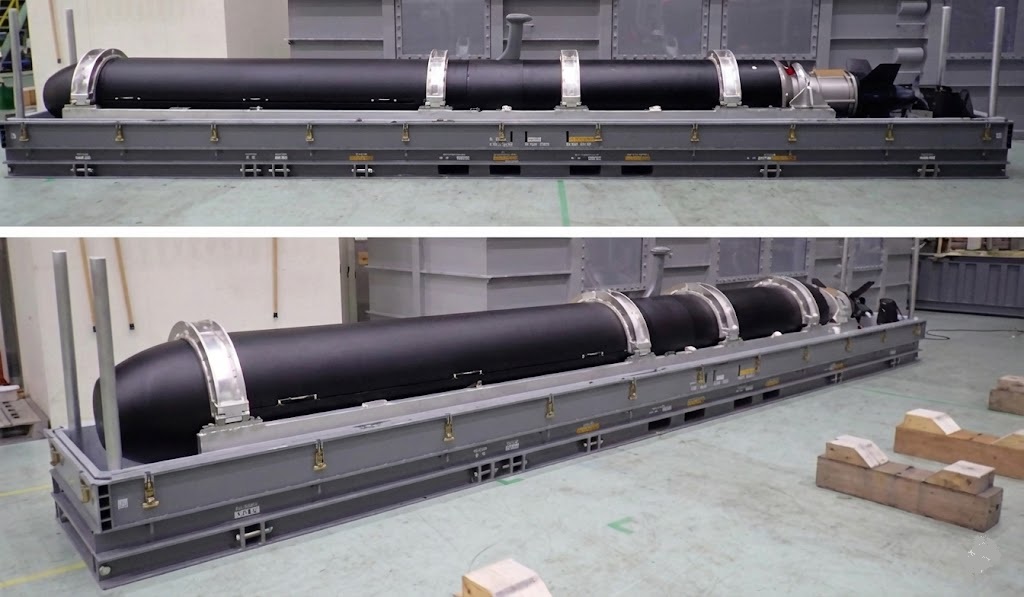
The Poseidon unmanned underwater vehicle remains one of Russia’s most controversial and least transparent strategic weapons. Nuclear-powered and capable of operating at depths reportedly up to 1,000 meters, Poseidon is believed to reach speeds of 60 to 70 knots. Estimates of its size commonly range from 16 to 24 meters in length, with a diameter of up to 2 meters, making it vastly larger than standard 533 mm torpedoes.
Russian sources claim Poseidon can carry a nuclear warhead with a yield of up to 2 megatons, designed to produce powerful underwater shockwaves and radioactive contamination near coastal targets. Moscow has presented the system as a response to missile defense networks, arguing that it provides a survivable second-strike capability immune to interception.
As of now, Poseidon has not been officially declared fully operational. Until that milestone is reached, Khabarovsk is expected to rely on conventional self-defense armaments, including multiple 533 mm torpedo tubes compatible with USET-80, Fizik-2, and Futlyar torpedoes, as well as the potential use of Kalibr cruise missiles and naval mines. Some reports also mention man-portable air-defense systems for limited surface defense scenarios.
Future Role in the Fleet
Once trials are completed and the submarine is accepted into service, Khabarovsk is expected to join the Pacific Fleet, potentially operating from bases on the Kamchatka Peninsula. Analysts suggest it could form the core of a new specialized submarine division dedicated to Poseidon missions, signaling a long-term commitment by Russia to integrating nuclear-powered unmanned systems into its strategic forces.
If sea trials begin as planned in 2026, Khabarovsk will mark the transition of the Poseidon concept from experimental development toward an operational capability, underscoring a significant shift in undersea nuclear strategy that blends traditional nuclear submarines with autonomous weapons designed for extreme endurance, depth, and destructive power.
About the Author
Aditya Kumar:
Defense & Geopolitics Analyst
Aditya Kumar tracks military developments in South Asia, specializing in Indian missile technology and naval strategy.