Russia’s PAK DA Stealth Bomber Reuses Su-57 Components Due to Sanctions and Delays: Leaked Files Reveal
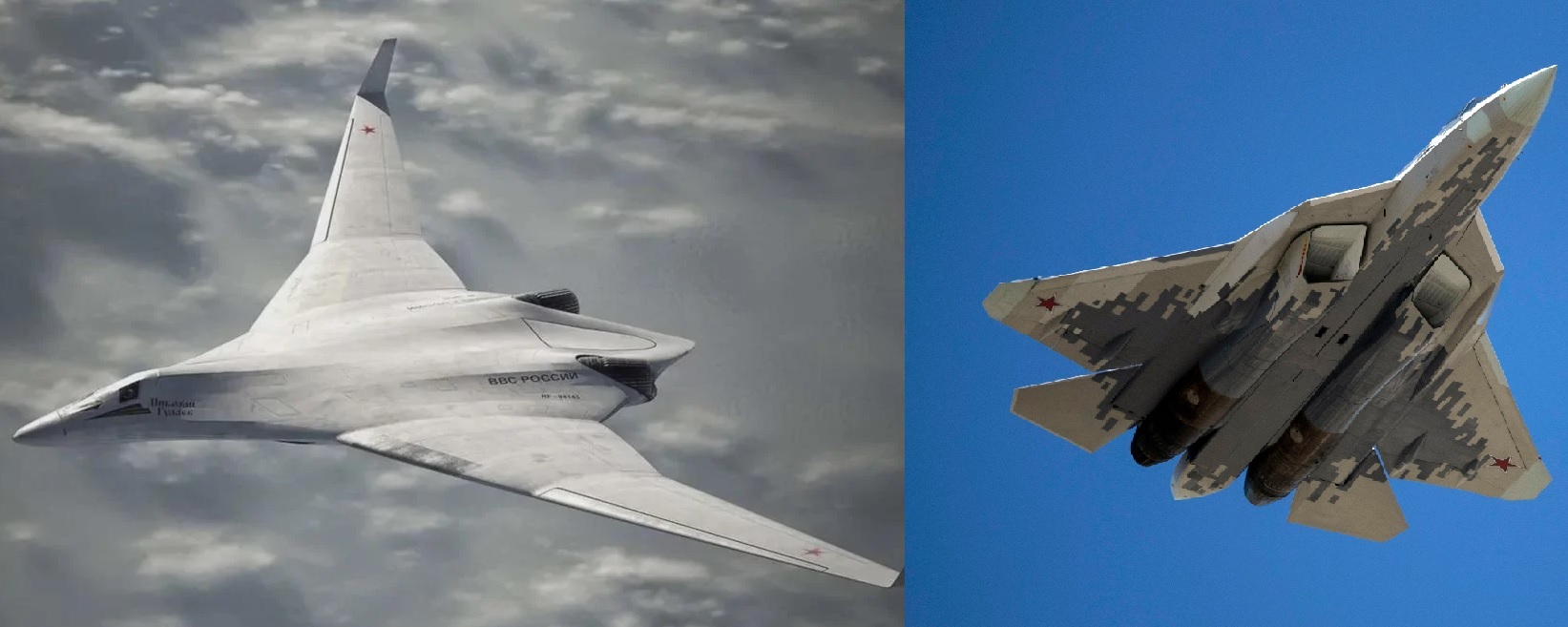
Russia’s top-secret PAK DA stealth bomber program — meant to replace its old Tu-95 and Tu-160 bombers — is facing serious delays. New leaked documents, reviewed by the group InformNapalm, show that Russian engineers are reusing parts from the Su-57 stealth fighter jet to keep the project alive.
The leaks also reveal that Western sanctions and a shortage of modern manufacturing tools are slowing the aircraft’s progress. Production targets have now been pushed back to 2027, several years later than originally planned.
Leaked Evidence of Shared Components
The files, originating from OKBM, a key Russian manufacturer of aircraft hydraulic and mechanical subsystems, describe the integration of hydraulic actuators and geared hinges labeled 80RSh115 and 80RSh. These mechanisms — used to open and close internal weapon bays — are nearly identical to those developed for the Su-57 stealth fighter.
In the PAK DA, these systems serve a similar purpose: operating the bomber’s large internal weapon bays while minimizing noise and radar signature. The documentation confirms a direct design lineage between fighter and bomber hardware, reflecting Moscow’s effort to standardize subsystems across platforms amid mounting resource limitations.
The leak, published on November 4, 2025, also reveals that the program’s development has been slowed by European Union sanctions imposed on October 23 against OKBM, which further restricted access to precision machine tools and specialized materials.
Sanctions and Tooling Bottlenecks
Russia’s aviation industry has been under increasing strain since the 2022 sanctions wave that cut off access to Western industrial machinery. According to InformNapalm’s analysis, OKBM remains dependent on foreign-made CNC machines and grinding tools for precision actuator assembly.
The EU’s 19th sanctions package, which blacklisted OKBM and related subsidiaries, has now severed imports of even basic metalworking accessories. This has caused production schedules for hydraulic and hinge assemblies to slide further, with the earliest subsystem readiness pushed to 2027.
Insiders within Russia’s aerospace sector privately acknowledge that the lack of modern five-axis machining tools has forced manufacturers to rely on older Soviet-era equipment, resulting in slower throughput and higher defect rates.
A Moscow-based aerospace analyst, speaking on condition of anonymity, said:
“The sanctions are biting at the deepest level — production tooling. Without precision machining, you can’t build stealth-quality airframes. The PAK DA is suffering the same bottlenecks as the Su-57: an elegant design stuck inside an outdated industrial ecosystem.”
A Project Decades in the Making
The PAK DA (short for Perspektivny Aviatsionny Kompleks Dalney Aviatsii, or “Prospective Long-Range Aviation Complex”) has been under development since the late 1990s as Russia’s answer to the American B-2 Spirit and B-21 Raider stealth bombers.
Initially conceived as a supersonic replacement for the Tu-160 and Tu-95MS, the project evolved in the 2010s into a subsonic flying-wing design, prioritizing range, payload, and radar invisibility over speed. The aircraft is being developed by Tupolev, with prototype assembly ongoing at the Kazan Aviation Plant.
The bomber’s configuration features:
-
A flying-wing airframe built with composite materials and radar-absorbent coatings.
-
Two NK32-02 engines derived from the Tu-160M2, producing around 14,000 kg of thrust each in non-afterburning mode.
-
An internal payload capacity of up to 35 tonnes, including nuclear and conventional standoff missiles such as the Kh-101, Kh-102, Kh-BD, and potentially future Kh-95 hypersonic weapons.
-
An estimated range of 12,000–15,000 kilometers and endurance approaching 30 hours, allowing for intercontinental operations without refueling.
Shared DNA with the Su-57
The reuse of Su-57 components is more than a cost-saving measure — it reflects the growing integration of Russia’s aerospace programs under industrial duress. Both aircraft rely on similar design philosophies: low observability, internal weapons storage, and modular subsystems that can be adapted across platforms.
The Su-57’s internal weapon bay mechanisms, originally designed to reduce radar cross-section during missile deployment, were deemed compatible with the PAK DA’s stealth requirements. Engineers adapted the smaller fighter components into scaled-up actuator assemblies capable of handling the bomber’s significantly heavier bay doors.
This convergence of design and production may simplify logistics and testing but also suggests limited innovation capacity, as existing technology is being repurposed instead of newly developed.
Delays Stretch Toward 2027
The leaked files confirm that the testing phase for critical flight subsystems — including bay actuators, structural hinges, and thermal control systems — has been rescheduled through late 2026, with prototype integration planned for 2027.
Originally, Russian officials hinted that the first PAK DA prototype would be ready for ground testing by 2023 and achieve a maiden flight by 2025. Those goals are now unrealistic. Insiders say that pre-production tooling, materials procurement, and component certification are lagging well behind schedule.
The situation has been compounded by labor shortages across Russia’s defense industry, as skilled technicians are drawn to ongoing programs such as the Su-57 fighter and the Tu-160M2 modernization line.
A Comparison with Western and Chinese Projects
When compared to its Western counterpart, the U.S. B-21 Raider, the PAK DA faces a clear disadvantage. The B-21 benefits from an automated and diversified industrial base, while Russia’s program relies on a handful of specialized suppliers, all vulnerable to sanctions.
China’s H-20 stealth bomber also presents competition in the same class — a flying-wing, subsonic platform optimized for endurance and low observability. While both the H-20 and PAK DA share design philosophy, China enjoys greater access to modern electronics and composite manufacturing, giving it a potential edge in development speed.
Nonetheless, the PAK DA is expected to carry a larger payload and offer longer range, if Russia can overcome its production hurdles.
Industrial Dependency: The Achilles’ Heel
At the heart of the delays lies Russia’s dependence on precision manufacturing — an area still reliant on Western equipment. InformNapalm’s review of OKBM documents revealed contracts listing foreign machine tools from Hartford, Johnford, and Grindex brands as essential to the actuator production line.
These machines were used to fabricate tight-tolerance hinge assemblies and hydraulic systems necessary for stealth operation. The sanctions regime now effectively blocks access to spare parts, software updates, and maintenance services for these tools, creating cascading disruptions across the production chain.
Even with domestic support programs, Russia’s ability to scale production remains limited. The files conclude that industrial capacity — not design readiness — is the decisive factor affecting PAK DA’s timeline through the mid-2020s.
A Stealth Bomber in Limbo
The leaked files paint a sobering picture of Russia’s stealth bomber ambitions. While the PAK DA program continues to make incremental progress, it is constrained by technological isolation, manufacturing bottlenecks, and an overstretched defense industrial base.
By reusing Su-57 fighter jet components, Moscow may have found a temporary workaround to sustain development. But the deeper reality remains: without access to advanced precision tooling and materials, Russia’s dream of fielding a next-generation stealth bomber before the end of the decade faces a turbulent flight path.
In the words of one Russian defense insider:
“The PAK DA is an impressive concept trapped in an outdated workshop. The design belongs to the 21st century — but the tools belong to the last one.”
About the Author
Aditya Kumar:
Defense & Geopolitics Analyst
Aditya Kumar tracks military developments in South Asia, specializing in Indian missile technology and naval strategy.