Russia’s Orion Drone Spotted With New Kh-BPLA Missiles Near Ukraine
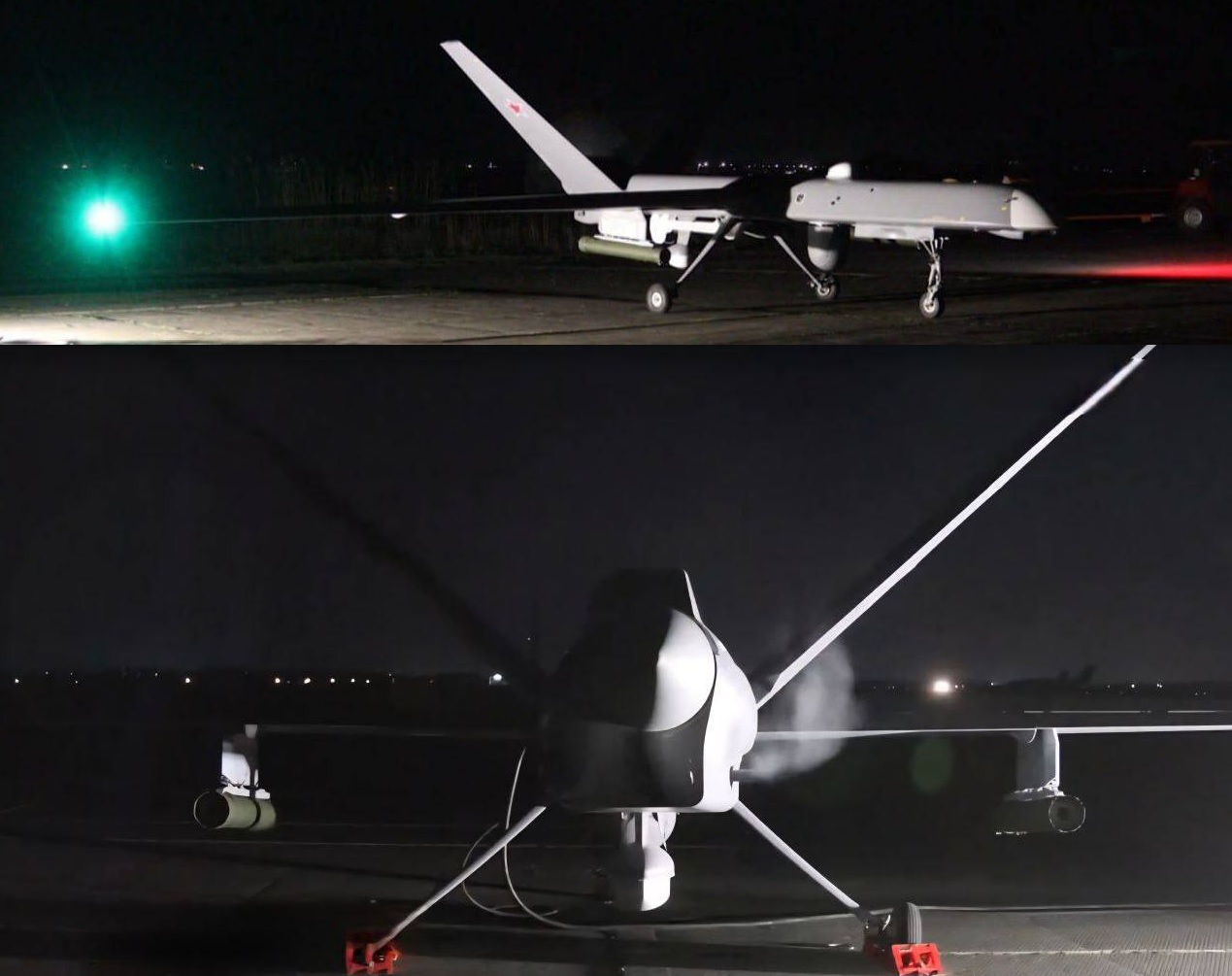
Newly surfaced images on Russian social media appear to show the Orion MALE drone fitted with two Kh-BPLA laser-guided missiles, indicating Moscow’s push to enhance its low-signature precision-strike capabilities along the front line in Ukraine. The photos, reposted by OSINT monitors on X, were captured on 18 November and quickly drew attention across defense circles.
The release coincides with Russia’s escalating drone-missile campaign and with the Kh-BPLA missile series being publicly showcased at the Dubai Airshow 2025, further suggesting a coordinated effort to highlight the maturation of Russian unmanned combat systems.
A Rare Glimpse of a Fully Weaponised Orion
The images show an Orion UAV parked on a dim airstrip, carrying a Kh-BPLA missile under each wing. The munitions, identifiable by their cylindrical launch tubes and folding fins, represent the first clear view of a fully armed Orion prepared for operational deployment. Until now, the drone had most often been linked to lighter glide bombs or test-fit weapons.
The Kh-BPLA, developed by the KBP Instrument Design Bureau, shares design lineage with the Kornet anti-tank family and Krasnopol laser-guided artillery rounds. The missile weighs 32 kg (42 kg with container), boasts a 6 kg fragmentation warhead, and engages targets between 2–8 km. It is intended to strike vehicles, artillery, radars, and small surface targets, rather than heavily armored tanks.
Russian military commentators have also highlighted the missile’s salvo-fire capability, designed to challenge active protection systems, a tactic reflected in the twin-missile load seen on the Orion.
A Drone Designed for Endurance, Now Stepping Into a Strike Role
Built by the Kronstadt Group, the Orion represents Russia’s first attempt at a homegrown, serially produced MALE reconnaissance-strike UAV. Comparable to the MQ-1 Predator or Bayraktar TB2, the drone carries:
-
A 16-meter wingspan
-
Up to 250 kg payload
-
24–30 hours endurance
-
A 250 km operational radius, extendable through satellite links
It has appeared before—in Syria, and sporadically over Ukraine—but always in small numbers, overshadowed by cheaper loitering munitions like Lancet drones. Downed Orion airframes previously recovered in Ukraine suggested Russia was testing missile integrations, but the new imagery is the clearest indication yet of an operational pairing.
The Tactical Value Russia Hopes to Gain
Mounting guided missiles rather than glide bombs marks a turning point for Orion’s battlefield utility. With Kh-BPLA, the drone can:
-
Strike moving targets
-
Deliver hits faster, with reduced time-to-target
-
Attack with slightly greater standoff distance
-
Maintain long endurance even while armed
It doesn’t put Orion in the same league as heavily armed Western drones, but it does give Russian forces a reusable precision-strike option—one that could threaten artillery, mobile radars, and light vehicles near the frontline.
Still, the drone’s 8 km missile range keeps it highly vulnerable to Ukrainian radar-guided systems and fighter patrols, meaning it can only operate safely along the edge of Russian-held airspace.
Beyond the Battlefield: A Message for the World
The release of these images appears crafted not only for soldiers but for spectators. Russia has been showcasing the Kh-BPLA and its unmanned fleet at trade shows like Army-2024 and Dubai Airshow 2025, promoting itself as a contender in the global drone marketplace alongside Western and Turkish suppliers.
Ukrainian intelligence meanwhile warns that Russia’s Orion production line—supported by more than 40 domestic companies—may survive sanctions by maintaining access to critical foreign electronics, often through intermediaries.
In this broader context, the imagery becomes part of a narrative Russia wants to project: that despite sanctions and setbacks, it is still advancing its unmanned-strike ecosystem.
A Signal of What’s Coming
Experts caution that this sighting does not confirm mass fielding of armed Orions. Instead, it reinforces a pattern—Russia slowly transforming its first-generation MALE drone from a reconnaissance platform into a precision-guided strike asset.
How far this transformation goes will depend on:
-
Russia’s ability to produce more Orion airframes and Kh-BPLA missiles, and
-
Ukraine’s continued success in denying frontline airspace to Russian drones.
For now, the dimly lit photos circulating online are more than just visuals. They serve as a reminder of how, in today’s conflict, images have become weapons of narrative, offering early hints of technologies shifting from prototype halls to active combat missions.
About the Author
Aditya Kumar:
Defense & Geopolitics Analyst
Aditya Kumar tracks military developments in South Asia, specializing in Indian missile technology and naval strategy.