Russia to Transfer 100% RD-191M Engine Semi-Cryogenic Engine Technology to ISRO After Putin’s India Visit
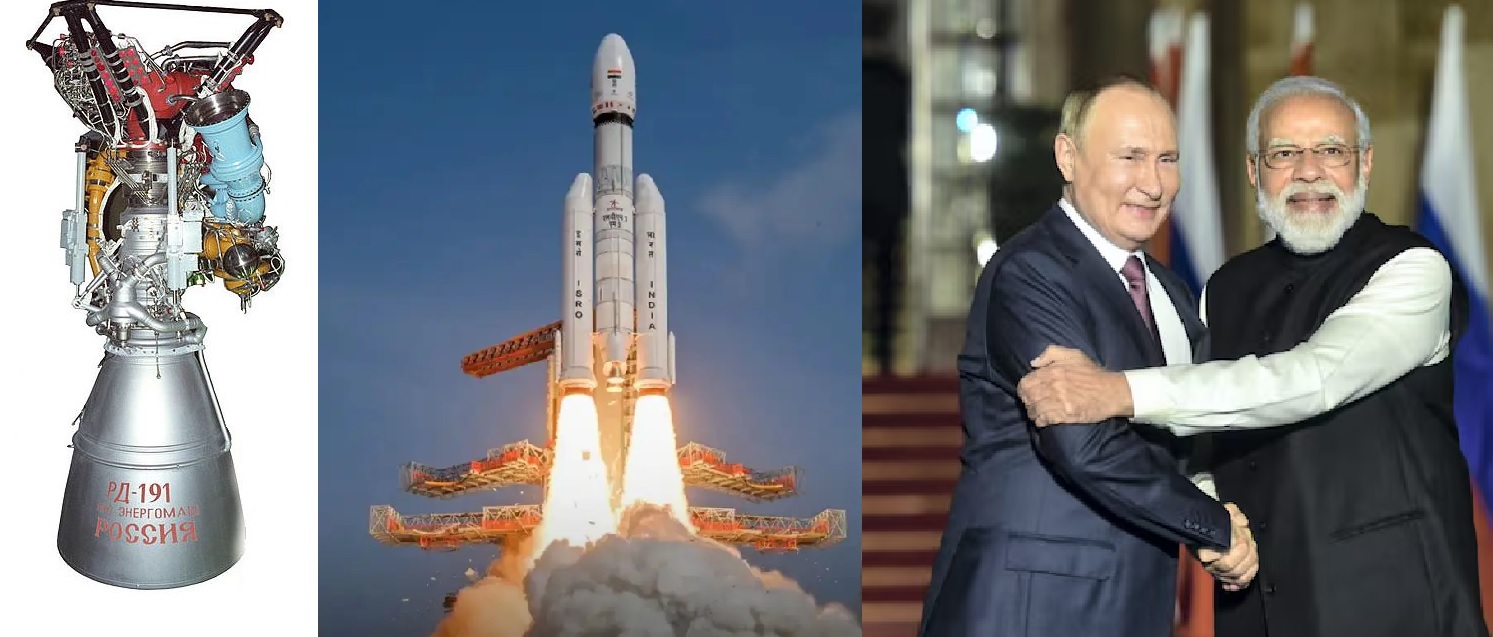
In a move that could redefine India’s heavy-lift space capabilities, President Vladimir Putin’s visit to New Delhi has been marked by a landmark agreement under which Russia will provide 100% technology transfer of its RD-191M semi-cryogenic rocket engine to the Indian Space Research Organisation (ISRO). The engine, to be integrated into future variants of the GSLV Mk3 / LVM3, is expected to boost India’s geostationary transfer orbit (GTO) payload capacity from the current 4.2 tonnes to nearly 6.5–7 tonnes, dramatically expanding the range of missions LVM3 can perform.
The announcement comes as Putin begins a two-day visit to India aimed at revitalising defence, energy and high-technology cooperation, including space, amid continuing Western pressure on both Moscow and New Delhi.
What Is The RD-191M Engine — And Why It Matters For India
The RD-191 family is Russia’s latest generation of high-performance liquid oxygen (LOX) + kerosene semi-cryogenic engines, developed by NPO Energomash. It powers the modular Angara launch vehicle, and is derived from the famous RD-170/180 line that has long been considered among the world’s most advanced kerolox engines.
The baseline RD-191 delivers around 196 tonnes of thrust at sea level and over 212 tonnes in vacuum, using an oxygen-rich staged-combustion cycle — a highly efficient but technologically demanding architecture.
The upgraded RD-191M variant, developed for Russia’s Angara-A5M/A5V heavy rockets, pushes thrust even higher and has recently completed tune-up tests, paving the way for operational use. For India, the attraction lies in three key aspects:
-
High thrust and efficiency suitable for LVM3 and future heavy-lift rockets.
-
Proven flight heritage on Angara, reducing technical risk.
-
A complete technology transfer package, covering design, materials, turbomachinery, control systems and manufacturing know-how.
With full ToT, Indian industry would not merely import engines but build them in India, adapt them to ISRO’s stages, and eventually maintain and upgrade the design independently.
India’s Own Semi-Cryogenic Journey: SCE-200 / SE-2000
India is not starting from zero in semi-cryogenic technology. ISRO has been developing its own 2-MN-class semi-cryogenic engine, known as SCE-200 or SE-2000, intended to power upgraded LVM3 and future heavy/super-heavy launch vehicles.
Key features of SE-2000 include:
-
LOX + RP-1 kerosene propellant
-
Staged-combustion cycle
-
Around 2,000 kN (≈ 200 tonnes) thrust
-
Throttle range from 60% to 105%
-
Vacuum specific impulse comparable to top global engines
ISRO reached a major milestone on 28 March 2025, when it successfully conducted the first hot test of the semi-cryogenic Power Head Test Article (PHTA) at Mahendragiri, validating the core turbopump, pre-burner and feed system design. Follow-up hot tests in April and May 2025 pushed the system to 60% power level, demonstrating stable and controlled operation.
Once fully qualified, SE-2000 is expected to replace the current L110 hypergolic core stage on LVM3 and form the backbone of India’s next-generation HLVM3 (human-rated LVM3) and future reusable or cargo launch vehicles.
In parallel, ISRO has also been steadily maturing cryogenic technology. Recent tests on the CE20 cryogenic engine — including bootstrap start and in-space restart capability — have expanded the performance and flexibility of LVM3’s upper stage, underlining India’s growing confidence in complex cryogenic systems.
If India Has SE-2000, Why Does It Still Need Russia’s RD-191M?
At first glance, India’s indigenous SE-2000 and Russia’s RD-191M occupy a similar space: both are high-thrust kerolox staged-combustion engines aimed at heavy-lift rockets. So why pursue full technology transfer of RD-191M when ISRO is already investing heavily in its own design?
There are several layered reasons — strategic, technical and programmatic:
1. Time To Orbit: Accelerating Payload Upgrades
Even with encouraging test results, SE-2000 is still under development. It must pass a long series of ground tests, integrated stage trials and qualification campaigns before flying on an operational LVM3. That process can easily stretch over several years.
By contrast, RD-191-series engines have already flown multiple times on Angara rockets, and the RD-191M is an incremental upgrade of a proven design. Adapting this engine to a modified LVM3 core could allow ISRO to field a higher-performance LVM3 variant much sooner, pushing GTO capacity from 4.2 t to the 6.5–7 t range while SE-2000 continues its own qualification path.
This dual-track approach reduces the risk of bottlenecks in India’s commercial and strategic launch schedule, especially as demand grows for heavier communication satellites, space-station modules and deep-space missions.
2. Risk Reduction And Benchmarks For Indigenous Design
Semi-cryogenic, oxygen-rich staged-combustion engines are among the most difficult rocket engines to design, demanding cutting-edge metallurgy, turbomachinery and combustion stability control.
A full, unredacted transfer of RD-191M design and manufacturing data gives Indian engineers a benchmark:
-
They can compare turbopump layouts, cooling channels, injector design and control algorithms against their own SE-2000 solutions.
-
It provides proven answers to tricky problems like high-pressure oxygen handling, ignition transients and long-duration stability.
-
Lessons from licensed production of RD-191M can feed back into making SE-2000 more reliable and easier to certify.
In effect, India gets both a near-term operational engine and a technology school for its own programme.
3. Industrial Upskilling And Export Potential
The agreement also fits into New Delhi’s broader “Make in India” strategy. With 100% ToT, Indian public and private firms can master:
-
Precision manufacturing of cryogenic turbopumps
-
High-pressure combustion chambers and nozzles
-
Complex engine health-monitoring and control systems
Such capabilities will be invaluable not only for SE-2000 but also for future reusable stages and super-heavy launch concepts.
If export restrictions and intellectual-property clauses are handled carefully, India could eventually offer launch services based on RD-191M-powered LVM3 variants to global customers, adding to the commercial appeal of its already competitive PSLV and LVM3 fleets.
4. Strategic Depth In India–Russia Space Ties
Space has been a pillar of India–Russia cooperation since the Aryabhata satellite days, and more recently in the Gaganyaan human spaceflight programme, where Russia has trained Indian astronauts and discussed potential joint missions.
A full-blown RD-191M technology-transfer deal deepens that partnership at a high-trust, high-technology level, signalling that despite geopolitical turbulence, Moscow and New Delhi are willing to share some of their most sensitive aerospace know-how.
Why ISRO Hasn’t “Just Done It” Alone — Yet
Critics often ask: India developed its own cryogenic CE-20 after facing Western technology denial. Why not simply do the same for semi-cryogenic engines, without importing any foreign design?
The reality is that ISRO is indeed doing it — SE-2000 is exactly that effort — but there are hard constraints:
-
Complexity & learning curve: Oxygen-rich staged-combustion kerolox engines are more demanding than open-cycle or gas-generator designs. They push materials to their limits and require extensive iterative testing.
-
Test infrastructure: India is still expanding high-capacity test stands and long-duration semi-cryogenic facilities. Until these reach full maturity, development pace will be cautious.
-
Mission timelines: Upcoming goals — from heavier GTO satellites to cargo for space stations and potential lunar logistics — demand higher LVM3 performance sooner than SE-2000 alone might deliver.
In that context, leveraging a proven foreign engine with full technology transfer is less a sign of dependence and more a strategic shortcut: India buys time and reduces risk while still building its own independent capability in parallel.
What Changes On The Rocket: From Today’s LVM3 To A Semi-Cryo Future
Today’s LVM3 uses:
-
Two massive S200 solid boosters
-
A hypergolic L110 core stage (two Vikas engines burning UDMH + N₂O₄)
-
A cryogenic C25 upper stage powered by CE-20
This configuration gives about 4.0–4.2 tonnes to GTO, enough for many missions but increasingly tight for heavier satellites.
Replacing the L110 core with an RD-191M-based semi-cryogenic stage would bring multiple benefits:
-
Higher specific impulse and thrust, directly translating into more payload
-
Cleaner, non-toxic propellants (kerosene instead of hydrazine)
-
Better throttling and restart options for advanced mission profiles
Once India’s SE-2000 is ready, the same semi-cryogenic stage design could simply swap in the indigenous engine, giving ISRO a smooth transition from Russian to Indian powerplants without redesigning the entire vehicle.
From Agreement To Flight
The real work will begin after the summit handshakes:
-
Finalising the inter-governmental agreement, IP provisions and export-control compliance
-
Establishing joint design review teams between NPO Energomash and ISRO’s LPSC
-
Setting up production lines in India for RD-191M components
-
Designing and testing a new LVM3 semi-cryogenic core stage, followed by structural tests, static fires and eventually flight tests
If executed as planned, the RD-191M technology-transfer deal — combined with the steady progress of India’s own SE-2000 — could catapult ISRO into the top tier of heavy-lift launch providers, while ensuring that the underlying know-how ultimately resides in India.
For New Delhi, it is a way to buy speed without surrendering sovereignty. For Moscow, it secures a long-term, sanctions-resilient partner for high-end space technology. And for ISRO, it opens the door to a future where 6.5–7-tonne GTO launches from Indian soil become routine rather than exceptional.
About the Author
Aditya Kumar:
Defense & Geopolitics Analyst
Aditya Kumar tracks military developments in South Asia, specializing in Indian missile technology and naval strategy.