Russia Unveils Plasma Engine That Could Cut Mars Travel From Nine Months to 30 Days
TROITSK, Russia : Russian scientists have revealed a laboratory-built plasma propulsion system that, if successfully matured, could compress the journey to Mars from nearly a year to little more than a month, potentially redrawing the roadmap for human interplanetary travel.
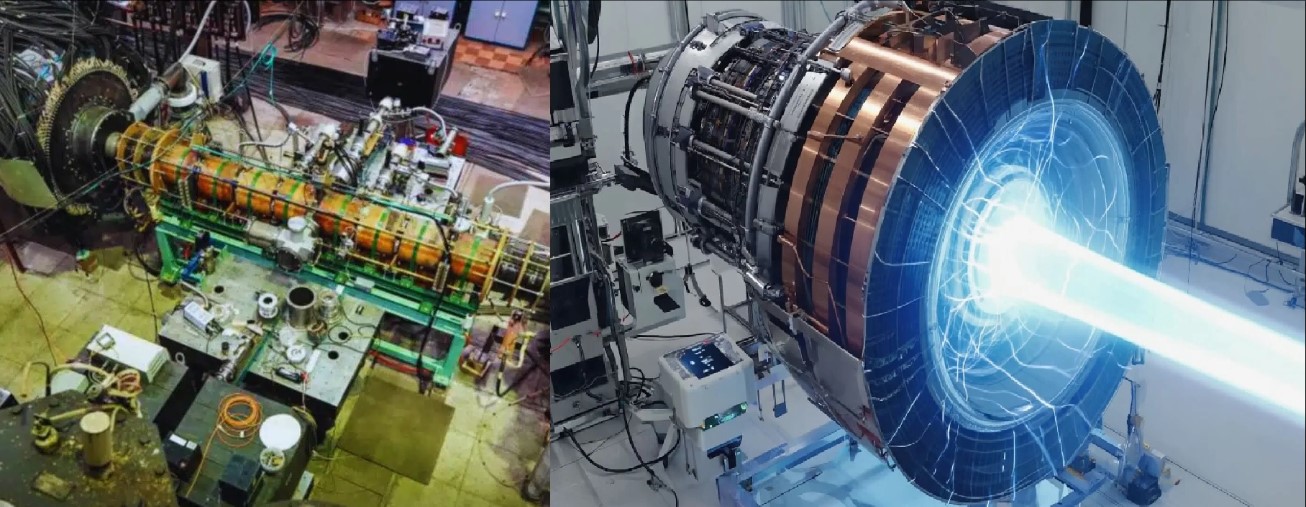
The prototype engine was unveiled this week by researchers at the Troitsk Institute for Innovation and Fusion Research, a key scientific center operating under Rosatom. Unlike speculative propulsion concepts that exist largely on paper, the new system is already undergoing physical testing inside one of Russia’s largest space-simulation vacuum chambers, marking a decisive shift from theory to hardware.
A Radical Departure From Chemical Rockets
At the heart of the announcement is a high-power magnetic plasma accelerator, a form of electric propulsion that replaces explosive combustion with sustained electromagnetic acceleration. Instead of burning fuel for short, violent bursts of thrust, the engine ionizes hydrogen into plasma and uses powerful magnetic fields to hurl charged particles out of the exhaust at extreme velocities.
According to Alexey Voronov, First Deputy Director for Science at the Troitsk institute, the limitations of chemical propulsion make it increasingly unsuitable for crewed deep-space missions.
“A conventional flight to Mars can take eight months or more,” Voronov said. “That duration exposes astronauts to radiation levels that approach or exceed acceptable limits. Plasma propulsion changes the equation. A 30- to 60-day transit would allow a round-trip mission before radiation doses become critical.”
Performance That Redefines Electric Propulsion
Electric thrusters are not new; low-power ion engines already keep satellites in position and propel deep-space probes. What sets the Russian prototype apart is the combination of thrust and exhaust velocity.
The engine produces a sustained thrust of roughly six newtons—modest by terrestrial standards, but exceptionally high for an electric system. In the frictionless vacuum of space, that continuous push allows a spacecraft to accelerate for weeks. The exhaust velocity, measured at approximately 100 kilometers per second, dwarfs the roughly 4.5 kilometers per second achieved by even the most advanced chemical rockets.
Engineers describe the device as operating in a pulse-periodic mode, drawing about 300 kilowatts of power while maintaining magnetic field stability. The result is a propulsion system designed not for dramatic launch sequences, but for relentless, efficient acceleration once in orbit.
The Nuclear Power Requirement
That performance comes with a critical caveat: power. A 300-kilowatt plasma engine cannot realistically be supported by conventional solar arrays, particularly beyond Earth orbit. The solution, Rosatom officials say, lies in nuclear energy.
The plasma accelerator is intended to pair with Russia’s “Zeus” nuclear space tug, a spacecraft concept built around a megawatt-class nuclear reactor capable of supplying continuous electrical power for months. In this configuration, the reactor feeds electricity to the engine, sustaining the magnetic fields that drive the plasma and enabling prolonged acceleration toward Mars or beyond.
Rosatom has framed the project as a logical extension of Russia’s decades-long experience with compact nuclear reactors, including those used in icebreakers and remote terrestrial installations.
From Vacuum Chamber to Deep Space
For now, the engine remains firmly on the ground. It is mounted inside a cylindrical vacuum chamber at the Troitsk facility measuring roughly 14 meters in length and four meters in diameter, designed to replicate the near-perfect vacuum of interplanetary space.
Testing through 2025 and 2026 will focus on refining magnetic confinement, improving electrode durability, and verifying long-duration operational stability. Engineers caution that plasma erosion, heat management, and reactor integration remain formidable challenges.
Rosatom has set an ambitious target of 2030 for a flight-ready system, though officials acknowledge that timelines could shift as testing progresses.
Strategic and Global Implications
If the technology performs as advertised, it addresses two of the most persistent obstacles to human Mars missions. Shorter transit times dramatically reduce the mass of food, water, and life-support systems, lowering launch costs. More importantly, they cut astronauts’ exposure to cosmic radiation and microgravity, both of which pose serious long-term health risks.
Internationally, the announcement positions Russia as a serious contender in advanced propulsion. While NASA and private firms such as Ad Astra Rocket Company are pursuing similar plasma-based concepts, Rosatom’s ability to integrate high-thrust electric engines with nuclear reactors gives it a distinctive edge.
Whether the Troitsk prototype ultimately fulfills its promise remains uncertain. But by demonstrating hardware capable of sustained, high-power plasma propulsion, Russian scientists have moved the idea of a one-month trip to Mars from science fiction toward experimental reality.
About the Author
Aditya Kumar:
Defense & Geopolitics Analyst
Aditya Kumar tracks military developments in South Asia, specializing in Indian missile technology and naval strategy.