Russia Unveils First-Ever Drone Capable of Firing Air-to-Air Missiles, Signaling Major Shift in Ukraine War
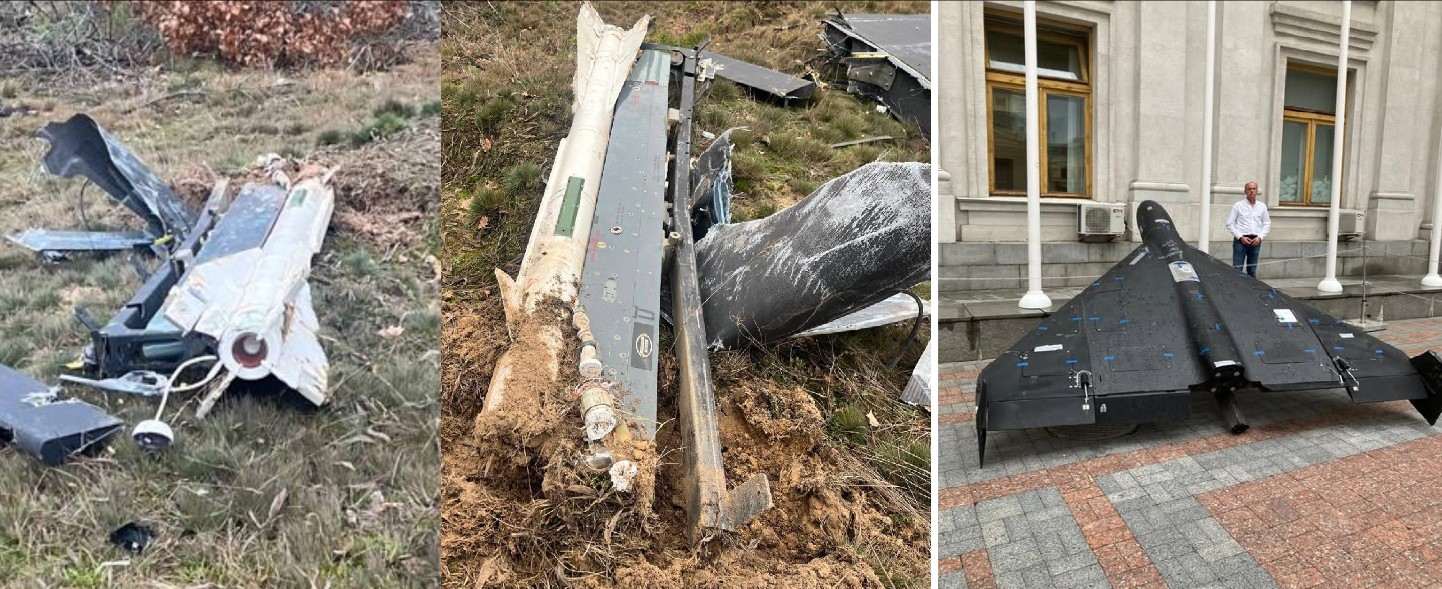
Ukraine is confronting a dangerous new escalation in aerial warfare after Russian forces modified Shahed/Geran-2 drones to carry and potentially fire R-60 (AA-8 “Aphid”) air-to-air missiles, a capability never before seen in any modern conflict. The discovery marks the world’s first documented instance of a disposable kamikaze drone being adapted to threaten fighter jets and helicopters.
The development underscores how rapidly Russia has advanced its drone program—once considered far behind Ukraine’s—into one of the most aggressive and experimental unmanned warfare systems on the battlefield.
Evidence From Wreckage Confirms R-60 Missile Integration
The breakthrough emerged when Ukrainian forces examined wreckage from several downed Geran-2 drones.
A detailed video released by the Darknode Battalion of the 412th Nemesis Brigade, part of Ukraine’s Unmanned Systems Forces, revealed:
-
A custom launch rail mounted atop the drone
-
A fully integrated R-60 missile
-
Modified wiring and stabilizers to support guided weapon release
The R-60 missile—introduced in the 1970s—is a compact, highly maneuverable infrared-guided weapon capable of:
-
Mach 2+ speeds
-
200–300 m engagement range
-
3-kg fragmentation warhead
Although designed for dogfights between jets, even a single R-60 is deadly enough to destroy helicopters, low-flying aircraft, and slow-moving interceptors.
Ukraine Intercepted the Drones — But Calls the Threat Serious
Ukraine confirmed that the modified Shahed drones carrying R-60 air-to-air missiles were brought down by Sting interceptor UAVs, a counter-drone system developed by the Ukrainian company Wild Hornets.
Despite these successful interceptions, officials warn the development represents a serious and escalating threat. If the Russian modifications prove fully functional, the drones could endanger incoming F-16s, Mirage 2000 fighters, and frontline helicopter units such as the Mi-8 and Mi-24, along with Ukraine’s specialized drone-hunter helicopters.
Even if the R-60 cannot reliably lock onto fast jets, the mere presence of a missile-armed drone forces Ukrainian aircraft to fly higher, avoid frontline zones, and operate at larger standoff distances, reducing their tactical flexibility—an outcome that clearly serves Russian interests.
Is the System Fully Operational? Experts Divided
Although the presence of the R-60 missile on the modified Geran-2 has been confirmed, analysts remain divided about its true operational readiness. The R-60 typically requires precise heat-lock capability, something extremely difficult for a Shahed drone to achieve due to its lack of targeting sensors, radar, or infrared tracking systems.
Launching a supersonic weapon from a slow, propeller-driven drone also poses major technical risks, with experts warning that the force of separation could destabilize or destroy the drone.
Some analysts believe the modification is intended primarily as a psychological weapon, compelling Ukraine to change its flight patterns. Others argue that Russia may be testing early prototypes aimed at creating drone-based air-defense interceptors or anti-helicopter loitering traps. Regardless of functionality, the adaptation demonstrates Russia’s clear intent to expand drone warfare into air-to-air roles.
Ukraine Did It First — And Russia Followed
Ukraine itself pioneered missile-armed drones earlier in the war, when its Magura V5 naval drones were equipped with R-73 heat-seeking missiles and later AIM-9 Sidewinders.
These armed drones achieved several confirmed kills, bringing down Russian Mi-8 helicopters and Su-30 fighters over the Black Sea during 2023 and 2024.
Russia’s decision to adapt its Geran drones with R-60 missiles may be a direct response to Ukraine’s earlier successes, as both sides continue to escalate their technological race.
Rapid Russian Drone Evolution: From Weakness to Dominance
At the beginning of the invasion, Russia suffered heavy battlefield losses due to Ukraine’s superior drone tactics. Kyiv’s quadcopters, strike drones, and naval drones destroyed armored columns, artillery sites, and supply convoys, giving Ukraine a clear technological lead.
But by 2023–2025, Russia launched one of the fastest drone expansion programs in the world, rapidly shifting from vulnerability to dominance. The Kremlin invested massively in the mass production of Geran-2 drones, deployed Lancet loitering munitions, rolled out long-range Italmas and Privet-82 UAVs, built FPV strike swarms with thermal imaging, fielded anti-drone drones, and created a growing fleet of electronic-warfare-resistant UAVs. The introduction of an R-60-equipped Shahed now adds a new anti-air capability to Russia’s expanding unmanned arsenal.
A Turning Point in Drone Warfare
The appearance of a kamikaze drone carrying an air-to-air missile marks a historic turning point in modern aerial warfare. For the first time, a cheap, expendable UAV could potentially threaten multi-million-dollar fighter jets. Suicide drones, once used mainly for ground strikes, are evolving into multi-role aerial combat platforms. Drone-versus-aircraft engagements, once considered theoretical, are now becoming a real possibility on the Ukrainian battlefield.
Both nations already rely heavily on UAVs for reconnaissance, deep strikes, artillery guidance, and maritime operations, but the ability to fire an air-to-air missile pushes drone warfare into a new, more complex and dangerous phase. Analysts warn that future drones may carry miniaturized air-defense systems, anti-helicopter weapons, small radar seekers, electronic-warfare emitters, and even coordinated swarm interceptors. With every new innovation, Ukraine becomes the world’s most active testing ground for next-generation aerial robotics, and the consequences are likely to reshape global air warfare for years to come.
About the Author
Aditya Kumar:
Defense & Geopolitics Analyst
Aditya Kumar tracks military developments in South Asia, specializing in Indian missile technology and naval strategy.