Russia Start Mass Production of Typhoon-PVO Air Defense Vehicle to Counter Drone Threats
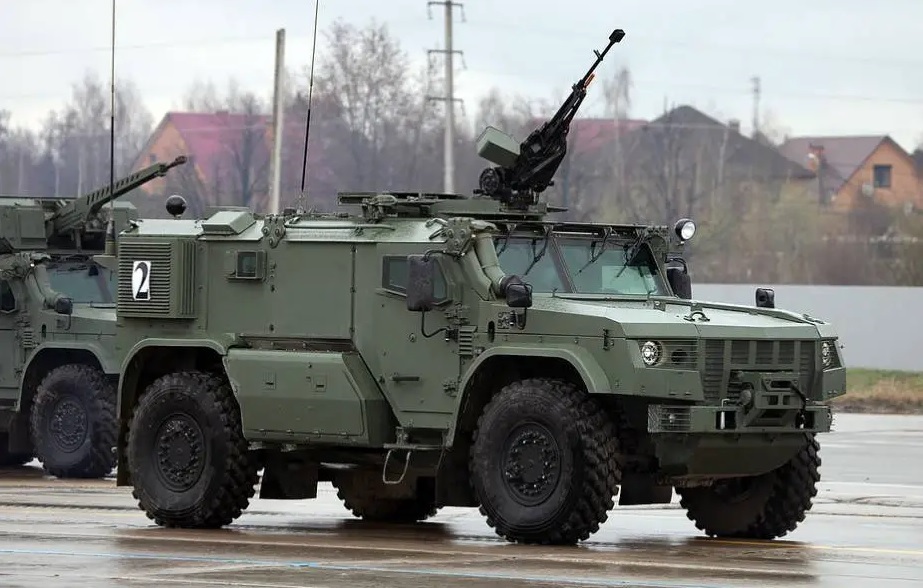
In a significant move to strengthen its short-range air defense capabilities, Russia has officially started serial production of the Typhoon-PVO—a modern, mobile air defense vehicle designed to counter threats from drones, cruise missiles, and low-flying aircraft. This announcement came on July 15, 2025, from Fanil Ziyatdinov, head of the Izhevsk Electromechanical Plant "Kupol", under the Almaz-Antey Air and Space Defense Concern, following successful state qualification trials.
The Typhoon-PVO is a new generation MANPADS (man-portable air defense system) carrier, optimized for mobility, survivability, and responsiveness on the modern battlefield. Unlike older systems mounted on standard trucks or infantry vehicles, the Typhoon-PVO is purpose-built and based on the rugged KamAZ-4386 4x4 chassis from the Typhoon-VDV family, known for its armored protection and mobility.
At its core, the Typhoon-PVO carries nine shoulder-fired missiles, including the Igla, Igla-S, and the newer Verba systems. These allow it to effectively engage small aerial targets such as helicopters, cruise missiles, and UAVs. In particular, the Verba (9M336) missile system has become a standout feature, thanks to its three-spectral seeker (ultraviolet, shortwave IR, and medium-wave IR), providing superior lock-on capabilities against low-signature aerial threats. The Verba is also compatible with the Barnaul-T command system, enabling friend-or-foe identification and external targeting data integration.
The vehicle comes with a five-member crew: commander, driver, machine gunner, and two MANPADS operators. Inside, it has space for:
-
9 missiles
-
3 radar interrogator sets
-
9 power units
-
Ammunition for the 12.7 mm Kord heavy machine gun
The 12.7 mm Kord machine gun, mounted on a rotating turret, can engage aerial targets even while the vehicle is moving at speeds of up to 20 km/h. Two roof hatches allow operators to fire without exiting the vehicle—an important feature for combat safety.
Armor protection meets STANAG 4569 Level 4, defending against 14.5 mm armor-piercing rounds and 8 kg mine blasts (Level 3b). The vehicle is equipped with:
-
360-degree camera coverage
-
Overpressure-sealed NBC protection
-
FVU-100 filtration system
-
Emergency roof evacuation hatches
Performance-wise, it’s powered by a KamAZ-650 diesel engine (350 hp), achieving speeds up to 100 km/h and a range of over 1,200 km. The independent hydropneumatic suspension helps it cross 1.75-meter water obstacles and ascend 30-degree slopes. It measures about 6.9 meters long, 2.5 meters wide, and 2.7 meters high, with a combat weight around 14 tons.
While the Typhoon-VDV chassis was originally designed for airborne forces and airdropping, the Typhoon-PVO sacrifices air-drop capability in favor of stronger protection and air defense specialization. A cheaper spring-suspension version is also being offered for non-airborne units like Russia’s Interior Ministry.
The system is fully integrated into Russia’s layered air defense network, and can operate alongside systems like Tor-M2. It can receive and act on external radar data, offering protection not only on the frontlines but also for critical infrastructure like oil refineries, railways, and bridges. It has also been seen in Victory Day parades since 2021, marking its official adoption.
Field tests include a notable demonstration at the 2019 Clear Sky competition in China, where it completed a 9.5 km obstacle course with 12 obstacles in under 44 minutes. Its performance during the Army-2020 event at Ashuluk range also met expectations.
Beyond domestic use, there is growing interest from foreign militaries, especially in Africa, where older Soviet systems are becoming obsolete. The low-cost, modular design, effective counter-UAV capabilities, and networked architecture make Typhoon-PVO attractive for asymmetric and urban warfare. Almaz-Antey officials have confirmed discussions with countries in Africa, the CIS, and Asia-Pacific regions.
Russian defense experts, including Major General Vladimir Popov, describe the vehicle as filling the gap between basic MANPADS teams and more expensive systems like Pantsir-S1, offering flexible and affordable protection in dispersed battle zones.
With drone warfare rapidly evolving, the Typhoon-PVO enters service at a critical time—aimed squarely at ensuring Russia’s frontline forces and key assets remain shielded from the growing threat of low-flying and low-cost aerial attacks.
✍️ This article is written by the team of The Defense News.