Russia Proposes M-90FR Gas Turbine Tech Transfer to Indian Navy
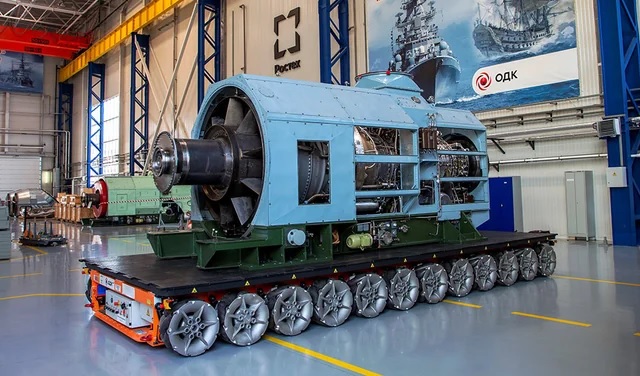
In a major step towards strengthening India’s naval self-reliance, Russia has formally offered its advanced M-90FR marine gas turbine engine to the Indian Navy, along with a full transfer of technology (ToT) for local manufacturing. The proposal comes at a critical time as India looks for a long-term solution to the propulsion challenges created by the Russia–Ukraine conflict.
Reliance on Ukraine and Emerging Challenges
For decades, India’s Talwar-class frigates and Delhi-class destroyers have been powered by Ukrainian engines supplied by Zorya-Mashproekt. But since the escalation of the Russia–Ukraine war in 2022, the supply of engines and spare parts has been disrupted, delaying projects and complicating maintenance. The problem was evident in the commissioning of INS Tushil, where India had to source Ukrainian engines independently and send them to Russia for installation.
With two more Talwar-class frigates under construction at Goa Shipyard Limited, India urgently needs a dependable and future-ready propulsion system.
Russia’s M-90FR: A Proven Solution
The M-90FR, developed by Russia’s United Engine Corporation (UEC-Saturn), is a modern marine power plant already in service with Russia’s Admiral Gorshkov-class (Project 22350) frigates. It delivers 27,500 shaft horsepower and achieves 36% thermal efficiency, compared to the 32% of Ukrainian engines. This means better fuel efficiency, greater operational range, and lower running costs.
Full Technology Transfer: A Game Changer
Unlike a simple supply deal, Russia’s offer includes a comprehensive technology transfer, allowing India to manufacture the M-90FR engines domestically. This aligns perfectly with the government’s “Make in India” and “Atmanirbhar Bharat” (Self-Reliant India) programs. Local manufacturing would:
-
Reduce long-term costs and dependence on imports
-
Ensure a steady supply of engines and spares
-
Build a skilled industrial ecosystem for marine propulsion
-
Enable future upgrades and mid-life refits of existing ships
Public sector enterprises such as Hindustan Aeronautics Limited (HAL), which already produces Russian-origin aircraft engines under license, could play a key role in setting up the production line.
Strategic Implications for the Navy
-
Operational Continuity: A seamless replacement for Ukraine-supplied turbines on Russian-origin ships.
-
Fleet Expansion Support: Critical for India’s plan to grow to 175 warships by 2035.
-
Industrial Growth: Boost to domestic defense manufacturing and MRO (maintenance, repair, overhaul) capacity.
-
Strategic Autonomy: Insulation from geopolitical supply shocks.
India’s Diversification Efforts
India has already diversified by integrating GE LM2500 engines from the United States into its Shivalik-class and Nilgiri-class frigates. However, the M-90FR remains the most compatible option for India’s large fleet of Russian-origin warships, making it vital for continuity and standardization.
If finalized, the M-90FR deal would not only secure propulsion for new ships under construction but also ensure that existing vessels receive reliable upgrades throughout their service life. More importantly, it would mark a historic shift from dependence on external suppliers to true indigenous capability in naval propulsion.
India now faces a strategic opportunity: to turn a supply crisis into a long-term advantage, using Russian technology to fuel self-reliance and maritime dominance in the Indian Ocean Region.
✍️ This article is written by the team of The Defense News.