Russia Offers India Massive FAB-1500, FAB-3000 & FAB-5000 ‘Super Bombs’ Ahead of Putin’s Visit
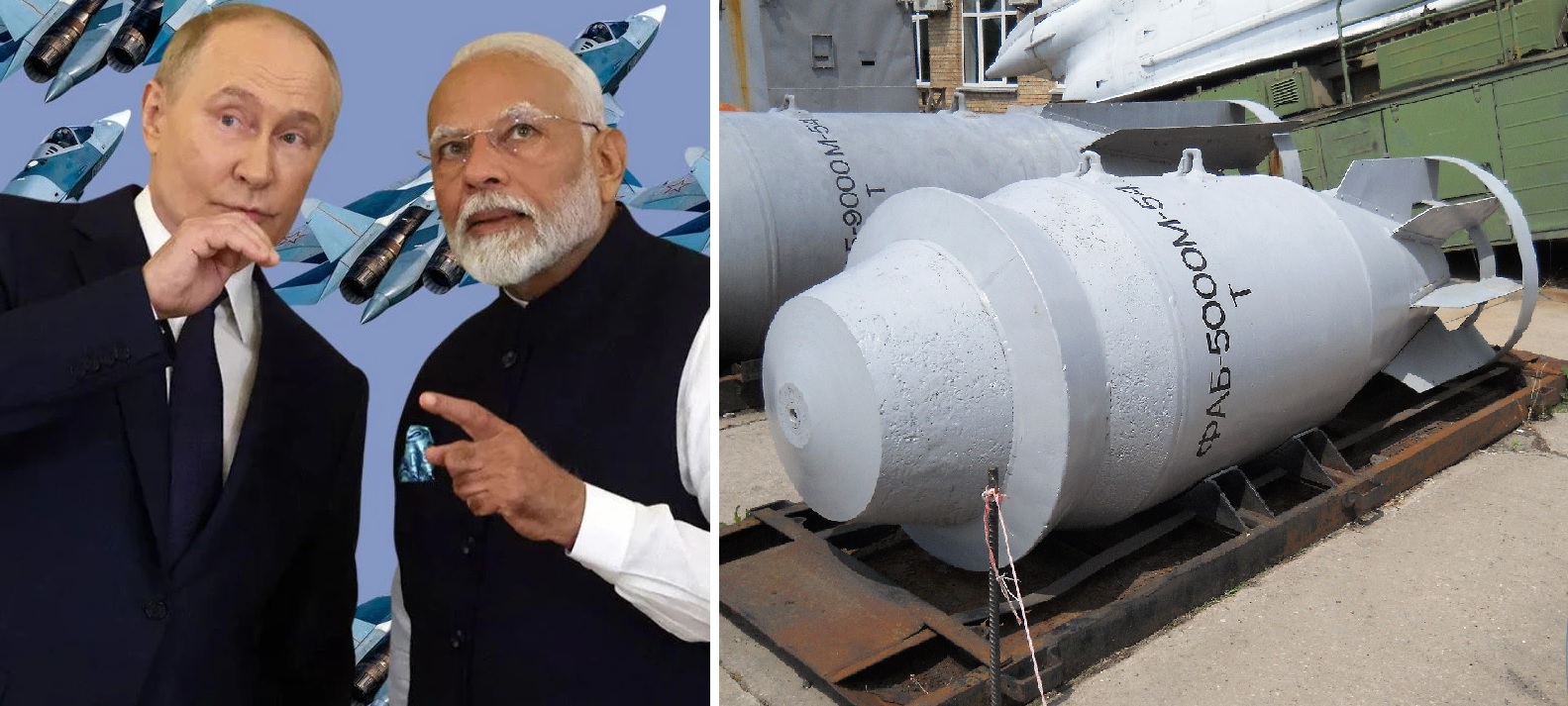
As New Delhi prepares to host Russian President Vladimir Putin for the 23rd India–Russia Annual Summit on 4–5 December 2025, reports on social media claim that Moscow has offered India a package of ultra-heavy aerial bombs – the FAB-1500, FAB-3000 and FAB-5000 – as part of a wider defence pitch.
There is no official confirmation yet from either government. But the very idea of these weapons entering the Indian toolbox has drawn attention, because these are not ordinary bombs – they are among the heaviest conventional air-dropped munitions in Russia’s inventory, now being adapted into precision glide bombs and used extensively in Ukraine.
This article explains what these FAB bombs are, how they differ from “normal” bombs, and what such an offer could mean for India.
What Does “FAB” Mean?
In Russian nomenclature, FAB stands for “fugasnaya aviatsionnaya bomba” – literally a high-explosive aerial bomb. These are general-purpose blast bombs designed to destroy infrastructure, military facilities, and troop concentrations through a combination of massive explosion, shockwave and fragmentation.
Traditionally, FAB bombs were unguided “iron bombs” in calibres like 250 kg and 500 kg, dropped from relatively short distances. Since 2023–24, however, Russia has been fitting them with UMPK (Unified Planning and Correction Module) glide-and-guidance kits – adding pop-out wings and satellite/inertial guidance to turn them into low-cost precision glide bombs with stand-off ranges of tens of kilometres.
The FAB-1500, FAB-3000 and FAB-5000 are simply much bigger members of this same family.
FAB-1500: The ‘Workhorse’ Heavy Glide Bomb
The FAB-1500 M-54 is a 1,500 kg-class high-explosive bomb originally designed in the 1950s to shatter industrial plants, port facilities and hardened military targets.
Key characteristics (M-54 variants):
-
Total weight: about 1,550–1,600 kg
-
Explosive filler: roughly 675–725 kg of high explosive
-
Dimensions: length ~2.76 m, diameter ~630 mm
-
Employment envelope: release from up to 16,000 m altitude and speeds up to 1,200 km/h
-
With UMPK glide kit: estimated stand-off range 50–70 km, possibly more with improved kits
In Ukraine, FAB-1500 glide bombs have been used to pulverise fortified positions and urban strongpoints, creating craters up to 10–15 m across and an effective lethal radius of several hundred metres.
If offered to India with UMPK-style kits, FAB-1500 would give the Indian Air Force (IAF) a heavy precision strike option against bunkers, airbases, bridges and logistics hubs – roughly analogous in effect to very large guided bombs or small tactical cruise-missile strikes, but at a lower cost per shot.
FAB-3000: A Three-Ton ‘Fat Bomb’
The FAB-3000 is a 3-tonne high-explosive demolition bomb, sometimes called a “fat bomb” due to its squat, wide body. It originated in Soviet designs of the 1940s–50s and has been brought back into large-scale production by Russia in recent years.
Typical characteristics for modern FAB-3000 variants:
-
Total weight: around 3,000–3,300 kg
-
Explosive filler: roughly 1,400 kg of TNT-class explosive
-
Role: demolition of fortified structures, bridges, ports and large industrial targets
-
With UMPK glide kit: stand-off release from strike aircraft such as the Su-34, captured on Russian MoD footage in Ukraine
The destructive effect is enormous: a single FAB-3000 can flatten multi-storey buildings or heavily damage large facilities, with a blast radius far beyond standard 500 kg bombs. Analysts describe it as a “strategic-level” conventional weapon, sitting just below tactical nuclear weapons and the very largest conventional bombs in terms of sheer blast power.
For India, access to FAB-3000 (especially with glide kits) would imply that only a few weapons would be needed to cripple a major high-value target – but would also demand specialised integration, flight-safety analysis and doctrine, since only the heaviest aircraft could safely carry such loads.
FAB-5000: A Five-Ton Demolition Giant
The FAB-5000 is one of the largest conventional aerial bombs ever fielded by the Soviet Union/Russia. In its World War II configuration (FAB-5000NG) it weighed about 5,400 kg with a 3,200 kg explosive charge in a relatively thin steel casing, optimised for colossal blast effect.
Test and combat reports from the 1940s describe FAB-5000 bombs creating craters up to 20 m in diameter and 9 m deep, tearing up hundreds of trees or wrecking large sections of railway yards and industrial zones.
More recently, a modernised FAB-5000M-54 version has been described as a high-explosive bomb intended to destroy large military-industrial facilities and factory buildings when dropped from altitudes up to 16,000 m at speeds up to 1,200 km/h.
Mounting such a bomb requires very heavy bombers or specially adapted aircraft; historically it was carried by aircraft like the Pe-8, and any modern use would likely be limited and highly specialised.
If Russia has indeed floated FAB-5000s to India, it would represent an offer of niche, extreme-destruction capability – something more symbolic and strategic than routine battlefield munition.
How Are These Different From ‘Normal’ Bombs?
Compared to the 250–1,000 kg-class general-purpose bombs commonly used by most air forces — including India’s own HSLD series and Gaurav glide bombs — Russia’s FAB-1500, FAB-3000 and FAB-5000 stand in an entirely different category. Their differences are defined by size, destructive capability, delivery method, and operational demands, making them far more powerful than conventional munitions.
1. Sheer Size and Explosive Power
A standard 500 kg bomb usually carries around 200 kg of explosive.
In contrast:
-
The FAB-1500 packs three to four times that explosive mass.
-
The FAB-3000 contains nearly 1.4 tonnes of explosive — about seven times a typical 500 kg bomb.
-
The FAB-5000 carries over 3 tonnes of explosive, more than fifteen times the yield of a standard weapon.
This enormous payload produces far bigger craters, shockwaves and damage radii, meaning a single bomb can achieve what would normally require an entire strike package of smaller munitions.
2. Intended Target Set
While normal bombs are used against runways, parked aircraft, depots, and isolated military structures, the FAB family is designed for strategic demolition. These heavy bombs can:
-
Collapse deep bunkers and underground positions
-
Destroy large bridges, ports, refineries, rail yards and factories
-
Level entire strongpoints or urban blocks in a single attack
In effect, they operate as the sledgehammers of conventional air warfare.
3. Glide Kits and Stand-Off Strike Ability
When equipped with Russia’s UMPK glide kit, these large bombs start to behave like low-cost cruise missiles. The kit provides:
-
Pop-out wings enabling 40–80 km glide ranges
-
Satellite + inertial guidance improving accuracy dramatically
-
The ability for aircraft to release the bombs well outside enemy air-defence zones
This contrasts sharply with standard unguided bombs, which must be dropped close to the target, exposing aircraft to far greater risk.
4. Aircraft and Infrastructure Requirements
These bombs are simply too heavy for most fighter aircraft:
-
FAB-1500 can be carried by heavy strike aircraft like the Su-34 or a structurally reinforced platform.
-
FAB-3000 and FAB-5000 usually require large bombers or specialised hardpoints, along with dedicated ground-handling equipment.
For the Indian Air Force, such weapons would likely be limited to specific aircraft (e.g., modified Su-30MKI) and require upgraded base infrastructure for safe storage, transport and loading.
5. Political and Humanitarian Considerations
Because of their massive blast radius, the FAB-3000 and FAB-5000 involve serious collateral-damage risks, especially near populated areas. Their employment carries significant political and diplomatic implications, and militaries typically reserve them for high-value, isolated, clearly defined strategic targets.
Why Might Russia Offer These To India?
Russia’s reported offer of FAB-series heavy bombs to India appears to align with a broader strategic trend in Moscow’s defence outreach. After gaining extensive operational experience with glide-bomb warfare in Ukraine, Russia is now looking to monetise its UMPK-equipped munitions by showcasing them to foreign partners. Ahead of President Vladimir Putin’s visit to New Delhi, Moscow has also been pitching Su-57 “fifth-generation” fighter technologies and other advanced systems, signalling a renewed willingness to share high-end capabilities to keep India anchored as a long-term strategic defence partner.
For India, such an offer brings a mix of potential advantages and serious dilemmas. A limited stock of extremely heavy, high-precision bombs could strengthen deterrence by giving the Indian Air Force the ability to threaten hardened or high-value targets belonging to Pakistan or China. The FAB-1500, if equipped with glide kits, could also serve as a cost-effective standoff weapon, offering a cheaper alternative to cruise missiles while using existing aircraft platforms.
At the same time, India must weigh doctrinal and operational considerations. The country is already developing its own family of precision-guided weapons, including the 1,000-kg-class Gaurav glide bomb, and importing massive FAB-3000 or FAB-5000 munitions would require careful evaluation against operational needs and indigenisation priorities. There is also a significant reputational and diplomatic risk: the larger FAB bombs have become associated with urban devastation in Ukraine, and acquiring such “city-buster” weapons could attract unwanted international scrutiny or raise concerns about India’s strategic messaging.
Where Things Stand
At this stage, the claim that Russia has offered FAB-1500, FAB-3000 and FAB-5000 bombs to India appears to be based on social-media reports citing unnamed “sources”, not on formal government announcements.
What is clear, however, is:
-
FAB-series heavy bombs have become a key element of Russian strike tactics in Ukraine, especially in their glide-bomb form.
-
Russia is actively advertising these capabilities abroad.
-
India, already operating Russian platforms like the Su-30MKI, is an obvious potential customer for any such munitions package.
Whether New Delhi chooses to actually acquire these “monster bombs” will depend on a mix of technical feasibility, cost, doctrine, and diplomacy – questions that are likely to surface, publicly or behind closed doors, when President Putin lands in India in early December.
About the Author
Aditya Kumar:
Defense & Geopolitics Analyst
Aditya Kumar tracks military developments in South Asia, specializing in Indian missile technology and naval strategy.